Young Talent Asking About Work-Life Balance: 4-Day Hiring Advantage
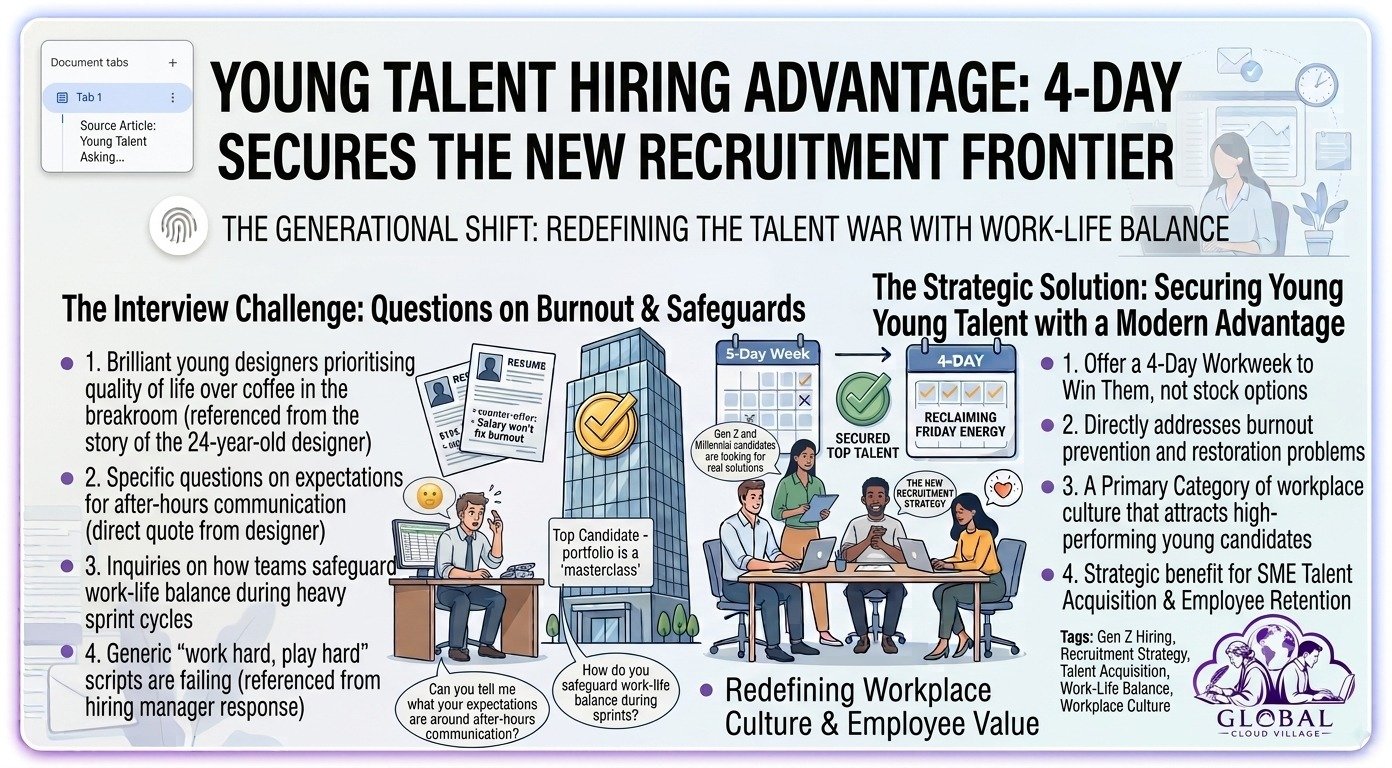
The interview was going exceptionally well. Across the conference table—or rather, inside the crisp video grid of a Zoom call—sat a brilliant 24-year-old product designer. Her portfolio was a masterclass in clean minimalism, her technical answers were razor-sharp, and her enthusiasm for the company’s core mission was palpable.
Then came the inevitable moment in the interview when the floor opened for candidate questions.
The young designer didn’t ask about stock options or the brand of coffee in the breakroom. She leaned forward slightly, looked the hiring manager in the eye, and asked a question that has become the opening salvo in the modern talent war: “Can you tell me what your expectations are around after-hours communication, and how your team actually safeguards work-life balance during heavy sprint cycles?”
The hiring manager blinked, momentarily caught off guard. He fumbled through a well-worn corporate script about how they “work hard and play hard,” mentioning that while they value personal time, weekend Slack pings do happen when things get “fast-paced.”
Two days later, the candidate declined to move forward. In her polite feedback email, she noted that she was looking for an environment with structured boundaries and genuine time autonomy.
If you are recruiting young professional talent today, this scene is likely playing on an endless loop in your hiring pipeline. We live in an era where the next generation of workers—millennials and Gen Z—refuses to view their employment as a sacred sacrifice of their physical and mental health. They don’t buy the old industrial folklore that suffering is a prerequisite for success.
When young talent asks about work-life balance, they aren’t negotiating for laziness; they are testing your operational maturity. And the companies that fail this test are losing the best minds of the emerging workforce to competitors who offer a tangible, structural advantage: the 4-day workweek.
The Generational Shift in Values (Young Talent Asking About Work-Life Balance Cont..)
To understand why traditional recruitment pitches are falling flat with younger professionals, we have to look at the cultural context in which they came of age.
Young talent watched their parents grind through the 2008 financial crash, working 60-hour weeks for corporate loyalty that was rewarded with sudden layoffs and stagnant wages. They watched older siblings burn out in entry-level corporate meat-grinders, trading their youth for ping-pong tables and free pizza while suffering from chronic anxiety and sleep deprivation.
As a result, the psychological contract between employer and employee has been rewritten from the bottom up.
For the emerging workforce, a job is no longer an identity or a family; it is a mutual economic and professional exchange. They are willing to bring immense focus, creativity, and technical horsepower to your organization, but they draw a hard, unyielding line at the edge of their personal lives.
When a company responds to inquiries about work-life balance with vague corporate platitudes—“We’re like a family here” or “We expect everyone to pitch in when it’s crunch time”—young talent hears a very clear warning signal: We are going to colonize your evenings, monitor your keystrokes, and make you feel guilty for having a life outside of work.
And because elite young talent has options, they simply walk away.
The 4-Day Week as a Magnet for Elite Youth
When Global Cloud Village analyzes recruitment metrics across growing tech and creative agencies, we see a profound divergence in applicant pools between 5-day traditional offices and 4-day forward-thinking organizations.
Companies that implement a genuine 4-day workweek (100% pay for 80% time, anchored by rigorous output metrics) don’t just attract more applicants; they attract the absolute apex predators of the junior and mid-level talent pool.
Why? Because a 4-day workweek serves as an immediate, undeniable proof-point of a company’s operational competence.
Think about what a 4-day policy communicates to a skeptical 25-year-old software engineer or data analyst:
- We Value Efficiency Over Performative Presence: It tells them you don’t judge performance by how many hours you sit in a chair or how fast you reply to a Slack message at 9:00 PM. You judge it by real, tangible output.
- We Respect Your Agency: It signals that leadership understands that a rested human being creates better code, sharper designs, and smarter analysis than an exhausted human being running on caffeine and panic.
- We Protect Your Sanity: It provides a concrete, built-in guarantee that their weekends belong to them, their families, and their personal growth.
To young professionals balancing side projects, creative passions, and mental well-being, a company with a 4-day workweek looks like a spaceship compared to the horse-and-buggy operations of their competitors.
Read Article:
Redefining the Recruitment Pitch
If you want to win the war for young talent, you have to stop defending your archaic 5-day schedule and start marketing your time architecture.
- Lead with Boundaries: Put your operational boundaries front and center in your job listings. Do not hide your 4-day schedule at the bottom of the perks section. Make it the headline: “We work 32 focused hours across 4 days because we hate bureaucratic waste as much as you do.”
- Explain the ‘How’: Young talent is smart; they will wonder how you maintain output in four days. Be ready to explain your async communication habits, your meeting-reduction protocols, and your respect for deep work blocks. Show them you have an engineering mindset toward work, not a sweatshop mindset.
- Target Ambition, Not Complacency: A 4-day week does not attract lazy workers—it attracts high-achievers who want to work with brutal focus for four days so they can own their fifth day. It filters out the political clock-watchers who thrive on endless, meandering meetings.
Conclusion: Securing Your Company’s Future
The talent market is speaking to us with absolute clarity. The best young minds of this generation are voting with their feet, passing on high-paying legacy corporations in favor of agile, humane workplaces that respect their right to exist outside the office.
You can cling to the 5-day industrial relic of the past century, wonder why good candidates ghost your interview loops, and continue burning through your junior staff every six months. Or you can evolve.
Offer the 4-day schedule, clean up your internal operations, and watch the sharpest young talent in your industry line up to build your company’s future.
Frequently Asked Questions About Hiring Young Talent With a 4-Day Week
Do younger candidates take a 4-day work week as a sign that the company is less ambitious or slow-growing?
Not when you frame the policy correctly. Gen Z and millennial professionals understand that cutting out administrative bloat and meetings actually represents high operational maturity and modern leadership.
How do we handle young candidates who ask probing questions about burnout during interviews?
Answer with complete transparency. Walk them through your specific async communication rules, your digital sunset policies, and how your team manages deep work vs. collaborative syncs.
Is a 4-day workweek effective for attracting entry-level marketing and design talent?
It is a massive differentiator. Creative and digital roles thrive on cognitive rest and inspiration, making a 3-day weekend an irresistible incentive for top-tier creative talent.
What is the best way to showcase this culture during the onboarding process for new young hires?
Enforce the hard stop on their very first Thursday afternoon. When new hires experience immediate boundary respect from day one, their loyalty and output skyrocket.
Ready to Attract and Keep the Next Generation of Elite Talent?
Solving recruitment bottlenecks and winning the loyalty of top-tier young professionals is the vital step toward future-proofing your business. Discover the complete human-centric blueprint for modern operational efficiency.
Get your copy of Global Cloud Village and 4 Day Work Week on Amazon:
About the Author: Global Cloud Village
Global Cloud Village translates complex digital tech systems into clear, human-centric strategies for growing SMEs, founders, and industry leaders. We help businesses replace clunky, fragmented legacy habits with automated, high-adoption cloud architectures that protect data and build operational scale. Explore our optimization insights at globalcloudvillage.com.