Staff Are Burned Out But Deadlines Still Missed: 4-Day Productivity System
It was 11:42 PM on a Thursday, and the office glowed with the ghostly blue light of monitors reflecting off hollow eyes. Well, not an actual office—this was the modern digital trenches of a remote marketing and tech agency. On Slack, Dave was typing a message that had become his signature sign-off: “Just wrapping up these final revisions, should be good for the morning review!”
Sarah, the COO, stared at the notification from her phone in the dark of her bedroom. She felt a familiar knot of guilt twisted with gratitude. Dave was working sixty hours a week. He was grinding through his lunch breaks, logging on during his sister’s birthday dinner, and sacrificing his sleep on the altar of corporate execution.
Yet, when the morning review rolled around at 9:00 AM, the campaign launch was still delayed. The copy was late, the analytics dashboard was glitchy, and Dave looked like a zombie who had survived a shipwreck.
How does this happen? How is it possible for an organization to squeeze sixty, seventy, or eighty hours out of human beings week after week, yet still watch critical deadlines slip past like greased pigs?
We have bought into a dangerous industrial-era delusion: the belief that time equals output. We assume that if we chain our staff to their desks for longer stretches, more work will inevitably spill out. But human brains are not industrial machinery. They don’t run faster when you starve them of fuel and rest. They break down, sputter, and produce expensive, glittering piles of exhaustion-fueled errors.
It’s time to stop glorifying the burned-out hero and dismantle the broken engine. The solution to missed deadlines isn’t more hours; it is a radically compressed 4-day productivity system.
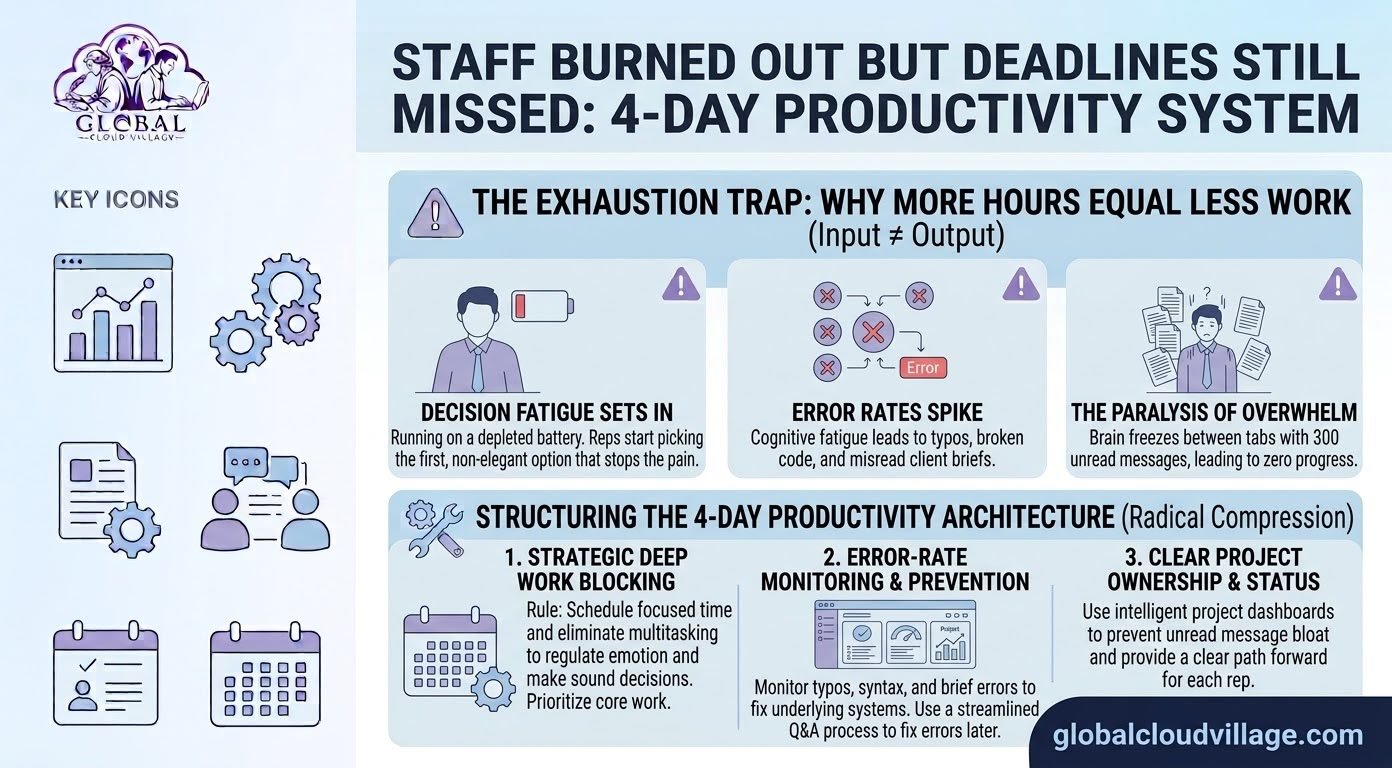
The Exhaustion Trap: Why More Hours Equal Less Work
Let’s look at the physics of cognitive fatigue. Knowledge work requires executive function—the prefrontal cortex’s ability to focus, solve complex problems, regulate emotion, and make sound decisions.
Executive function is a finite resource. It operates much like the battery on your smartphone. When you wake up, it’s at 100%. As you answer emails, handle crises, sit through redundant meetings, and stare at spreadsheets, that battery drains.
By hour 45 of a grueling workweek, that battery isn’t just low; it’s flashing red. When an employee operates on a depleted battery, what happens?
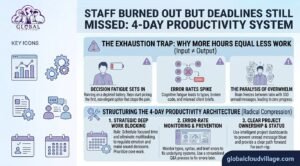
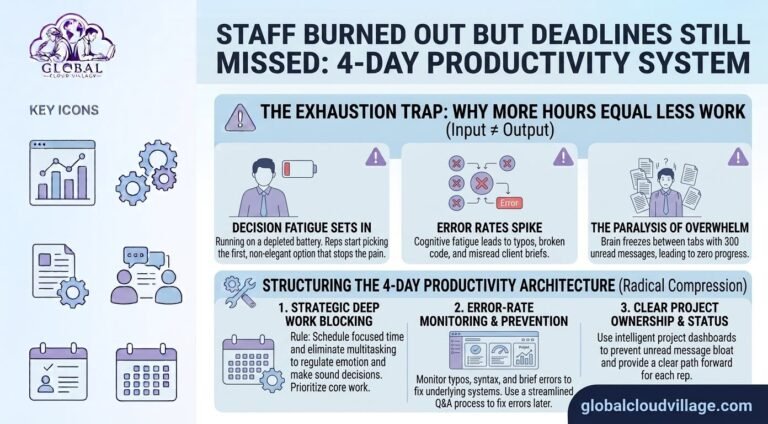
- Decision Fatigue Sets In: They stop looking for elegant solutions and start picking the first option that stops the pain.
- Error Rates Spike: Simple typos, broken code syntax, and misread client briefs multiply. Fixing those mistakes later consumes double the time the original task took.
- The Paralysis of Overwhelm: When an inbox has 300 unread messages and five projects are burning simultaneously, the brain freezes. Instead of deep work, the employee spends two hours clicking between tabs, accomplishing nothing while feeling intensely busy.
This is the cruel paradox of the 5-day, 50-hour grind: the extra hours are not productive hours. They are recovery hours masked as labor. Employees spend Monday through Thursday operating in a fog of exhaustion, then use Friday as a recovery day just to tread water, while deadlines slide into next week anyway.
Redefining the Equation: The 4-Day Productivity Architecture
A 4-day productivity system is not a reward you hand out when everything is running smoothly. It is the operating system upgrade that makes things run smoothly in the first place.
When you compress the standard workweek from five days to four (reducing operational hours from 40 to 32 while keeping pay intact), you introduce a powerful constraint. And constraints breed clarity.
Parkinson’s Law states that work expands to fill the time available for its completion. If you give a team five days to complete a project, it will sprawl across five days, absorbing useless meetings, endless revisions, and sluggish momentum. If you give them four days—and protect that fourth day fiercely—the fat evaporates.
Here is how a true 4-day productivity architecture operates in practice:
1. The Death of the Status-Update Meeting
In a traditional 5-day setup, up to 40% of the week is swallowed by meetings whose sole purpose is to ask people what they did in other meetings. In a 4-day system, synchronous meetings are treated like surgery: rare, precise, and necessary only for high-level creative alignment or complex decision-making. Status updates move to async bullet points.
2. Institutionalized Deep Work Blocks
Fatigued staff are constantly interrupted. A ping here, an urgent email there. A 4-day system mandates uninterrupted focus blocks—minimum three-hour windows where Slack is closed, email notifications are silenced, and people are actually allowed to build, write, design, or code without being yanked out of their flow state.
3. Ruthless Prioritization
With 32 hours on the clock, you cannot do everything. You are forced to perform triage on your task list. The distinction between what is urgent and what is merely loud becomes razor-sharp. Teams learn to say no to low-impact client requests and scope creep that would have previously eaten their Thursday nights.
The Chemistry of Momentum
When Dave’s agency finally piloted the 4-day productivity system, the initial reaction from middle management was sheer panic. “How can we hit our Q2 deliverables when we are cutting eight hours a week per person?”
Sarah held her ground. She instituted a rule: no internal meetings on Tuesdays and Thursdays, and a mandatory 3:00 PM hard stop every day.
The first two weeks were bumpy. People stumbled over their old habits of calling impromptu syncs. But by week four, a remarkable transformation occurred. The ambient anxiety in the Slack channels dropped. People started writing clearer briefs because they knew no one was around to jump on a quick call to clarify sloppy writing.
And the deadlines? They stopped slipping.
Why? Because when people know they have a three-day weekend waiting for them on Thursday evening, their relationship with time changes. The sluggish inertia of Wednesday afternoon—traditionally lost to web-surfing and low-level fatigue—disappeared. They locked in. They tackled the hardest problems first thing in the morning when their cognitive batteries were fully charged.
Output per hour skyrocketed. They produced the same volume of work—and in many cases, higher quality work—in 32 focused hours than they previously fumbled through in 55 fractured hours.
Building Your 4-Day System: A Step-by-Step Blueprint
Transitioning a burned-out, deadline-slipping team to a 4-day model requires treating the transition like a product launch. You don’t guess; you engineer it.
- Audit the Time Sinks: Run a two-week time audit. Find out where hours are bleeding. Is it client revisions? Unstructured brainstorming? Fix those leaks before cutting the hours.
- Establish Core Collaboration Hours: Define a tight window (e.g., 10:00 AM to 3:00 PM) where everyone is online and responsive. Outside those hours, let async rule the day.
- Train Managers to Manage Output, Not Presence: Train leadership to judge team members by completed deliverables, not by how fast they reply to a Slack ping at 8:00 PM.
- Protect the Rest Day: The fourth day (whether it’s Friday or Monday) must be sacred. No checking email “just in case.” If the system requires people to log in on their day off to hit deadlines, the system isn’t optimized; it’s still broken.
Conclusion: Recovery as a Competitive Advantage
The old way of working tells you that suffering is the price of success. It tells you that missing deadlines means you just need to whip the horses harder.
The 4-day productivity system offers a smarter truth: rest is the catalyst for rigor.
When your staff is no longer stumbling through an endless tunnel of exhaustion, they see the work clearly. They spot the broken logic in a project plan before it becomes a crisis. They write cleaner code, design sharper campaigns, and hit their targets with time to spare.
Dave isn’t typing messages at 11:42 PM anymore. At 4:55 PM on Thursday, he logs off. His projects are green, his clients are happy, and when Friday morning arrives, he’s not recovering from his job—he’s actually living his life. And on Monday morning? He’s ready to build.
Frequently Asked Questions About 4-Day Productivity Systems
Does compressing the workweek lead to frantic, error-prone rushing?
No. When implemented correctly, a 4-day system cuts out unnecessary meetings and administrative clutter rather than speeding up actual task execution. It trades performative busyness for intentional deep work, reducing errors caused by fatigue.
How do we handle unexpected mid-week emergencies in a 32-hour model?
Build a buffer by treating low-priority tasks as flexible backlog items. If an emergency arises, teams can deprioritize secondary projects rather than automatically defaulting to overtime or stretching into the rest day.
Can this system work for client-facing service teams?
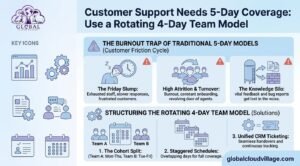
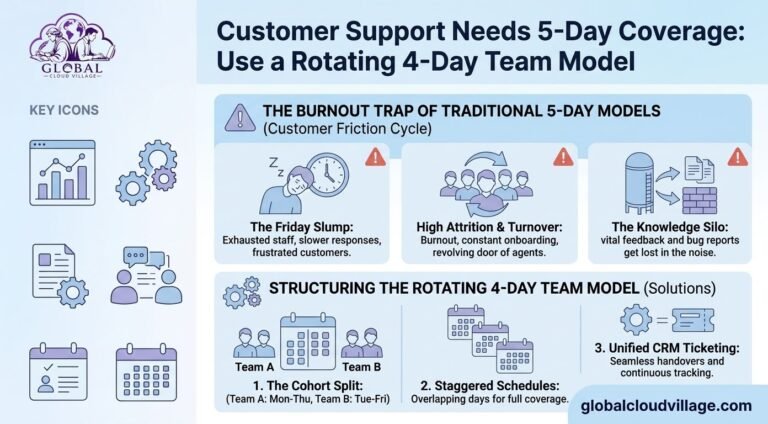
Yes. Service teams can use staggered scheduling, where one half of the team works Monday through Thursday, and the other works Tuesday through Friday, maintaining continuous client coverage.
How do we measure success after rolling out the system?
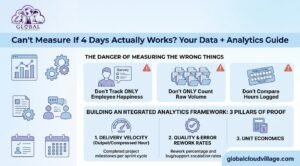
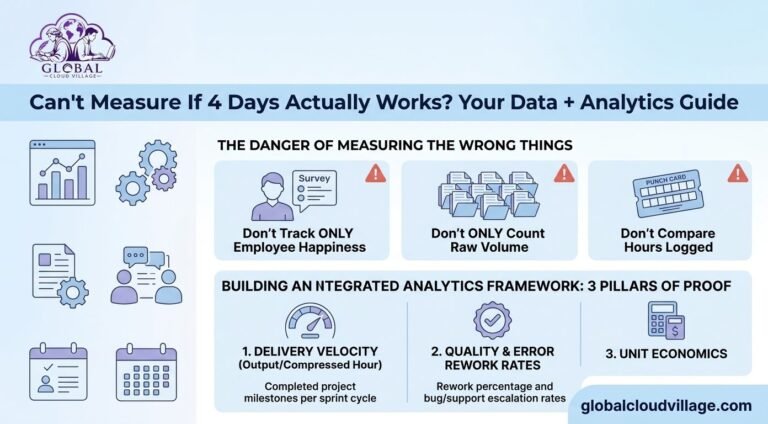
Track project delivery rates, milestone completion speed, and internal pulse surveys instead of hours logged. If projects are delivered on time and team well-being is high, the system is performing effectively.
Ready to Optimize Your Team’s Output?
Eliminating chronic bottlenecks and hitting your deadlines without sacrificing team sanity is the vital step toward scalable growth. Discover the complete human-centric blueprint for modern operational efficiency.
Get your copy of Global Cloud Village and 4 Day Work Week on Amazon:
About the Author: Global Cloud Village
Global Cloud Village translates complex digital tech systems into clear, human-centric strategies for growing SMEs, founders, and industry leaders. We help businesses replace clunky, fragmented legacy habits with automated, high-adoption cloud architectures that protect data and build operational scale. Explore our optimization insights at globalcloudvillage.com.
Tags: Productivity System, 4-Day Workweek, Burnout Prevention, Deadline Management, Deep Work, Operational Efficiency, Time Management