Deep Work in 4-Day Week instead of Too Many Distractions
It was 3:15 PM on a Wednesday, and Rachel, a senior software architect at a growing digital product studio, realized she hadn’t written a single line of clean, complex code all day.
Her day had been a relentless obstacle course of cognitive shrapnel. She started at 9:00 AM by answering 42 unread Slack pings. At 10:00 AM, she sat through a redundant status-update meeting that could have easily been an email. At 11:15 AM, a product manager dropped by her desk for a “quick question” that stretched into 45 minutes of circular debate. After lunch, she spent two hours context-switching between email threads, client review portals, and urgent bug triage.
By the time she logged off at 5:30 PM, Rachel felt completely drained, yet her core project deliverables hadn’t moved an inch.
Now, her leadership team was talking about compressing the workweek into four days (32 hours). Rachel felt a spike of pure terror. “If I can barely get my work done in 40 chaotic hours, how on earth are we going to survive in 32?”
It is the ultimate productivity paradox of modern office culture: The more hours you give a distracted team, the more distractions they invent to fill them.
When your company lacks structural focus, an 8-hour workday doesn’t equal 8 hours of output. It equals 90 minutes of actual execution surrounded by six and a half hours of administrative noise, notification anxiety, and constant interruptions.
If you want a 4-day workweek to succeed, you cannot simply chop eight hours off a chaotic schedule. You have to eradicate the distractions and build a sanctuary for Deep Work.
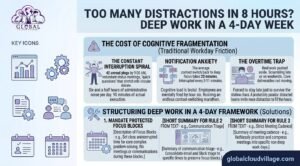
The Cost of Cognitive Fragmentation
To understand why traditional workdays feel so exhausting yet produce so little, you have to look at how the human brain handles attention.
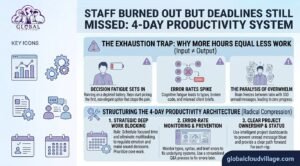
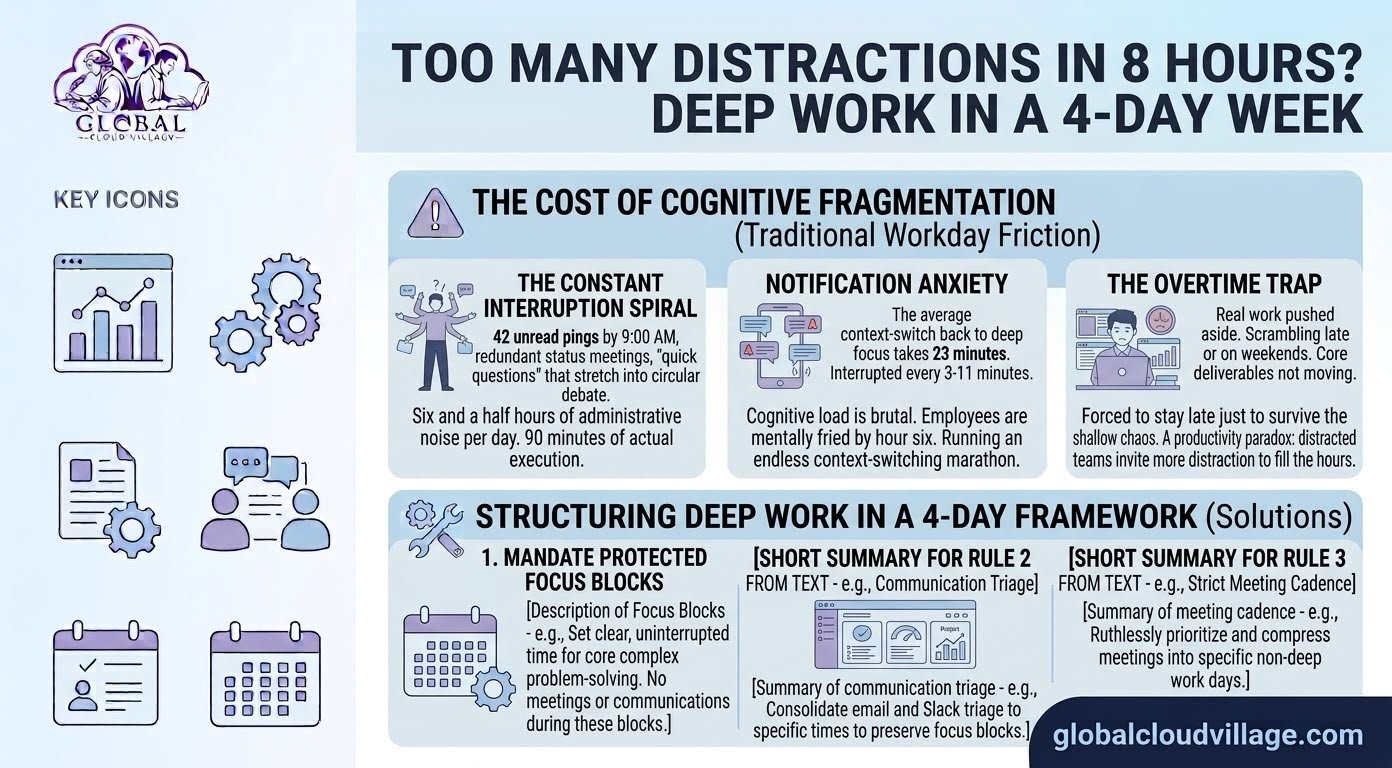
Every time a notification pings, a Slack message flashes, or a colleague taps you on the shoulder for a “quick chat,” your brain is forced to context-switch. Research shows that it takes an average of 23 minutes to return to a deep state of focus after a single interruption.
In a standard 5-day office environment, knowledge workers are interrupted every 3 to 11 minutes. The math is brutal:
- Constant Shifting: Employees spend their entire day bouncing between shallow tasks—checking email, chatting on Slack, attending meetings—never dropping below the surface into complex problem-solving.
- Exhaustion Without Achievement: Context-switching burns massive amounts of glucose in the prefrontal cortex. By hour six, employees are mentally fried, feeling like they ran a marathon while actually accomplishing very little.
- The Overtime Trap: Because real work gets pushed aside by daily distractions, employees are forced to stay late or log on during weekends just to finish their core deliverables in peace.
When you compress the workweek into 32 hours across four days, cognitive fragmentation becomes an immediate death sentence. If your team tries to sprint through a 4-day week while keeping their notification-heavy habits intact, burnout will skyrocket.
To make 4 days work, you must replace the culture of constant availability with a rigorous architecture of uninterrupted deep work.
Structuring Deep Work in a 4-Day Framework
Deep work is professional activities performed in a state of distraction-free concentration that push your cognitive capabilities to their limit. These efforts create new value, improve skill, and are hard to replicate.
To protect deep work in a 32-hour workweek, businesses must implement three structural guardrails:
1. Mandate Protected Focus Blocks
You cannot leave deep work up to personal willpower. You must engineer it into the corporate calendar. Designate mandatory, non-negotiable Deep Work Blocks—such as every morning from 9:00 AM to 12:00 PM, Monday through Thursday. During these windows, internal chat apps are silenced, email notifications are turned off, and synchronous meetings are strictly forbidden.
2. Establish Asynchronous Communication Norms
In a deep-work culture, instant replies are decoupled from competence. Teach your team that urgent is not the same as important. Move daily status updates, project brainstorming, and non-critical inquiries into asynchronous project management dashboards or threaded documentation channels. If someone sends a message, the expectation is not an immediate reply; the expectation is a considered response within a designated window.
3. Centralize Information to Kill “Quick Questions”
Most office interruptions happen because employees don’t know where to find information, forcing them to ask a colleague. When you centralize your operational data, project milestones, and client notes into a single cloud ERP and project hub, the need for “quick questions” evaporates. Employees can find answers in seconds without tapping their neighbor on the shoulder.
How Rachel Transformed Her Workday
When Rachel’s studio piloted the 4-day workweek, leadership took her fear of distractions seriously. Instead of letting teams flounder, they instituted a radical new operating rhythm.
They implemented mandatory “Silent Mornings” from 9:00 AM to 12:00 PM Monday through Thursday. During this window, Slack was closed network-wide, email tabs were minimized, and everyone—from junior developers to the CEO—dove straight into their primary project execution blocks.
At first, people felt jittery, addicted to the constant dopamine hit of incoming notifications. But by week three, the psychological shift was profound:
- Flow States Returned: Rachel found herself writing complex architectural code uninterrupted for three hours straight, accomplishing in one morning what used to take three fragmented days.
- Error Rates Plummeted: Because developers weren’t being yanked out of their focus zones every ten minutes, software bugs dropped significantly.
- The 4-Day Magic: By eliminating distraction drag, Rachel’s team easily completed their entire weekly output in 32 focused hours, leaving Thursday evening open for a clean, guilt-free three-day weekend.
Step-by-Step: Building Your Deep Work Protocol
If your team is drowning in distractions and you want to prepare your business for a high-performance 4-day week, follow this implementation blueprint:
- Audit the Daily Interruption Map: Track how many times your team is interrupted daily by pings, emails, and impromptu meetings. Identify the biggest corporate time-sinks.
- Institute Morning Deep Work Blocks: Block out a mandatory 3-hour window every morning where internal communication tools are muted and deep execution is prioritized.
- Move to Async-First Communication: Reframe company culture so that instant replies are no longer expected or rewarded. Value thoughtful, batched asynchronous communication instead.
- Centralize Knowledge Repositories: Ensure all company processes, project statuses, and client files live in a searchable cloud platform, eliminating the need for constant verbal interruptions.
Conclusion: Silence is the Engine of Scale
The old industrial mindset tells you that a busy office is a productive office—that noise, chatter, and constant notification pings are the sounds of money being made.
The 4-day deep work model proves the exact opposite: Silence is the ultimate accelerator.
When you ruthlessly eliminate distractions and protect your team’s cognitive bandwidth, you stop trading frantic busyness for actual results. You unlock extraordinary focus, superior quality, and sustainable, scalable growth.
Frequently Asked Questions About Deep Work in a 4-Day Week
How do we handle genuine emergency escalations during protected deep work blocks? Establish a single, designated emergency channel (such as a specific phone escalation protocol or a VIP notification tag) that bypasses silent modes only for true client crises.
Won’t team collaboration suffer if we restrict communication to specific windows? Actually, collaboration improves. When people are pulled out of shallow, fragmented chats and given dedicated blocks to think, their contributions during collaborative brainstorming sessions become significantly sharper and more valuable.
How do we convince team members who are addicted to constant multitasking? Show them the cognitive science and track their output. When employees experience the calm and satisfaction of completing a major project during a protected deep work block, they quickly abandon multitasking.
What tools help maintain deep work boundaries across a remote or hybrid team? Modern async collaboration platforms (like Notion, Linear, Asana, or unified ERP workspace tools) combined with status-setting and notification-batching apps are essential for protecting team focus.
Ready to Optimize Your Team’s Output?
Eliminating chronic operational friction and hitting your delivery targets without sacrificing team sanity is the vital step toward scalable growth. Discover the complete human-centric blueprint for modern operational efficiency.
Get your copy of Global Cloud Village and 4 Day Work Week on Amazon: Buy on Amazon Kindle
About the Author: Global Cloud Village
Global Cloud Village translates complex digital tech systems into clear, human-centric strategies for growing SMEs, founders, and industry leaders. We help businesses replace clunky, fragmented legacy habits with automated, high-adoption cloud architectures that protect data and build operational scale. Explore our optimization insights at globalcloudvillage.com.