4-Day Workweek Analytics Guide: Measure ROI and Performance
Arthur, the CEO of a mid-sized financial technology consultancy, was sitting across the table from his board of directors.
The company had been experimenting with a compressed four-day workweek, and employee feedback was positive.
But one board member asked a much more difficult question:
“How do we know the four-day workweek is actually working financially?”
Arthur realized that talking about employee morale was not enough.
The board needed evidence.
Were projects being completed on time? Was quality improving or declining? Were customers staying satisfied? Was the company generating enough value from its reduced working hours?
Without reliable data, the four-day workweek would remain an operational experiment rather than a measurable business strategy.
This is where a 4-Day Workweek Analytics Guide becomes valuable.
A shorter workweek should not be evaluated simply by asking whether employees are happier or whether they worked fewer hours.
It should be evaluated through business outcomes.
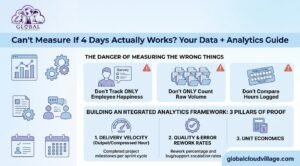
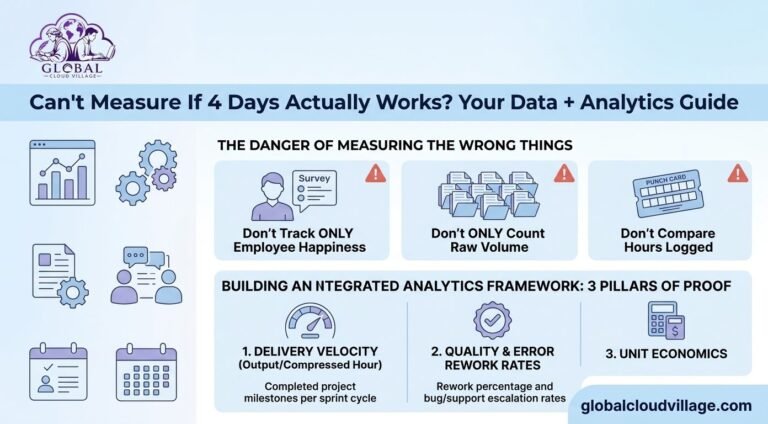
The most useful framework measures three areas:
Velocity. Quality. Unit economics.
Together, these metrics can help leadership understand whether a four-day model is supporting productivity and sustainable business performance.
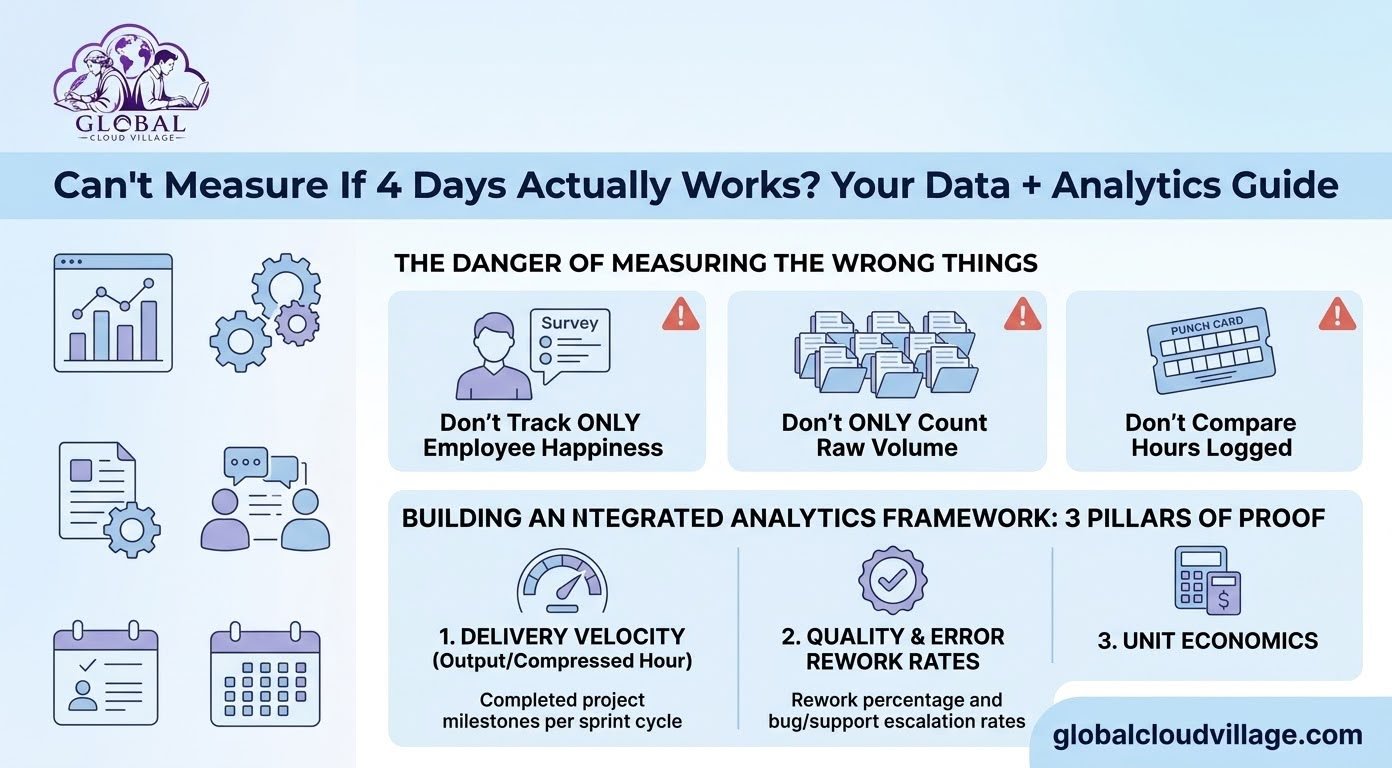
The Danger of Measuring the Wrong Things
One of the biggest mistakes companies can make during a four-day workweek transition is measuring the wrong indicators.
The goal is not to prove that employees are busy.
The goal is to understand whether the business is producing valuable outcomes within its available capacity.
Employee Happiness Alone Is Not Enough
Employee surveys and pulse checks can provide useful information about morale, workload, and engagement.
However, they should not be treated as the only evidence of success.
A team can report high satisfaction while projects are becoming slower or customer service is declining.
Likewise, employees may experience temporary disruption during implementation while the long-term operating model improves.
Employee sentiment should therefore be combined with operational and financial metrics.
Raw Output Can Be Misleading
Counting the number of tickets closed, tasks completed, or lines of code written can create misleading conclusions.
Higher volume is not necessarily better if it produces:
- More defects
- More customer complaints
- More rework
- Lower-quality deliverables
- Increased support requests
Output should always be considered alongside quality.
Hours Logged Are Not the Main Outcome
A four-day workweek intentionally changes the relationship between working time and performance.
Comparing 32 hours directly with 40 hours does not tell leadership whether the business is succeeding.
Instead, ask:
What valuable outcomes are being produced within the available working time?
That shift from measuring presence to measuring outcomes is central to a successful analytics strategy.
The 4-Day Workweek Analytics Guide: 3 Pillars of Measurement
A practical 4-Day Workweek Analytics Guide should organize its metrics around three core dimensions:
- Delivery velocity
- Quality and rework
- Financial and operational performance
These dimensions provide a more complete picture than any single KPI.
1. Delivery Velocity: Measure Output Within Available Capacity
The first question leadership usually asks is simple:
Are we getting enough work completed?
Instead of measuring hours alone, track the amount of meaningful work completed within each sprint or delivery cycle.
Useful metrics can include:
- Completed project milestones
- Projects delivered on time
- Average project cycle time
- Tasks completed within planned capacity
- Customer deliverables completed per sprint
- Average time from task start to completion
For example, suppose a team historically completed an average of 10 major deliverables during a comparable five-day cycle.
After moving to a four-day schedule, leadership could compare whether the team continues to deliver a similar level of valuable output.
The comparison should account for differences in project complexity and scope.
The objective is not simply to increase the number of tasks.
It is to understand whether the team is maintaining meaningful delivery performance with less scheduled time.
A Useful Productivity Calculation
One simple analytical measure is:
Output per Working Hour = Valuable Output ÷ Total Working Hours
This can help leadership compare productivity before and after the transition.
However, “valuable output” needs to be defined appropriately for each department.
For a software team, it could involve completed releases or approved features.
For a professional services team, it could involve completed client milestones.
For a sales team, it could involve qualified opportunities or revenue generated.
2. Quality and Rework: Speed Means Little Without Quality
A shorter workweek should never become a race to produce more work at lower quality.
This makes quality measurement one of the most important parts of your analytics framework.
Useful indicators include:
- Rework percentage
- Defect rates
- Bug or support escalations
- Customer complaints
- Failed quality checks
- Revision cycles
- Service-level agreement performance
Consider two teams.
Team A completes 100 tasks but requires significant rework.
Team B completes 85 tasks with minimal corrections and fewer customer complaints.
Team B may actually be producing greater business value.
That is why productivity analytics should combine quantity and quality.
Rework Has a Hidden Cost
Rework consumes capacity that is often invisible in basic productivity dashboards.
A task may appear to be completed, but if another employee has to spend several hours correcting it, the original completion metric becomes misleading.
A useful analytics dashboard should therefore identify how much capacity is being consumed by:
Initial work + corrections + additional reviews
Reducing unnecessary rework can create additional capacity without increasing working hours.
3. Financial Unit Economics and Operational ROI
Eventually, leadership will ask the most important question:
What is the business impact?
A four-day workweek should therefore be connected to financial and operational indicators where appropriate.
Potential metrics include:
- Revenue per employee
- Gross profit margin
- Revenue per working hour
- Cost per project
- Customer retention
- Employee turnover
- Overtime costs
- Recruitment costs
- Absence rates
- Client acquisition and retention economics
The right metrics depend on the business model.
For a consulting company, project margin and utilization may be particularly important.
For a software company, recurring revenue, customer retention, support costs, and development cycle time may provide more useful insights.
For a professional services business, billable output, delivery efficiency, client retention, and revenue per employee may be more relevant.
The important principle is to connect the four-day operating model to measurable business outcomes.
How Arthur Could Prove the ROI of 4 Days
When Arthur realized that employee sentiment alone would not answer the board’s questions, his operations team created a centralized analytics dashboard.
They compared performance data from before and after the four-day workweek transition.
Rather than relying on one number, they reviewed several categories:
Project Delivery
They compared milestone completion rates, delivery dates, and average project cycle times.
Quality
They reviewed rework, support escalations, defects, and customer issues.
Employee Retention
They tracked turnover and associated recruitment and onboarding costs.
Financial Performance
They compared revenue, margins, project profitability, and relevant operating costs.
The purpose of this analysis was not to prove that the four-day model must work.
It was to determine whether the model was producing acceptable business outcomes.
For an illustrative example, imagine that a company sees improved on-time delivery, stable quality, lower overtime, and improved employee retention after implementation.
Those results would provide a much stronger business case than employee satisfaction data alone.
Actual performance should always be calculated from the company’s own baseline and post-transition data.
Build a Baseline Before Changing the Workweek
One of the most important recommendations in any 4-Day Workweek Analytics Guide is to establish a baseline before implementation.
Without baseline data, it becomes difficult to determine whether the new model actually changed performance.
Before launching a pilot, collect relevant data from the existing five-day schedule.
Depending on your business, this could include:
- Average project cycle time
- On-time delivery rate
- Customer satisfaction
- Rework percentage
- Revenue per employee
- Gross margin
- Employee turnover
- Overtime hours
- Absence rates
- Meeting hours
- Customer complaints
The baseline does not need to contain dozens of metrics.
A smaller group of well-defined KPIs is usually more useful than a dashboard filled with numbers nobody acts upon.
Step-by-Step: Building Your 4-Day Workweek Data Dashboard
1. Establish Baseline Metrics
Measure the current five-day operating model before making changes.
Record enough historical data to create a meaningful comparison.
Where possible, use consistent definitions throughout the pilot.
2. Define Success Before Launch
Decide what success means before the results arrive.
For example:
- Maintain acceptable delivery performance.
- Maintain or improve quality.
- Protect customer satisfaction.
- Reduce unnecessary overtime.
- Maintain sustainable employee workload.
- Protect financial performance.
This prevents leadership from changing the definition of success after seeing the results.
3. Centralize Your Data Sources
Connect relevant systems where practical.
Your analytics environment may combine information from:
- Project management software
- CRM systems
- ERP platforms
- Financial systems
- Customer support tools
- HR systems
- Employee surveys
The goal is to create a reliable source of information for leadership.
4. Track Outcomes Instead of Presence
Avoid building the dashboard around employee activity alone.
Instead of asking:
“Were people online for eight hours?”
Ask:
“Were the planned outcomes achieved within the available capacity?”
This distinction is critical.
5. Compare Like With Like
When comparing five-day and four-day periods, account for differences in:
- Project complexity
- Seasonal demand
- Staffing levels
- Customer volume
- Major business changes
- Scope changes
- New technology
- Exceptional events
Otherwise, the dashboard may attribute unrelated changes to the workweek itself.
6. Review Results Regularly
Do not wait until the end of the year to evaluate the experiment.
Review the data regularly with managers and leadership.
A monthly operational review can identify problems early, while a quarterly review can provide a broader financial and strategic assessment.
What Should Your Executive Dashboard Show?
A useful executive dashboard does not need to contain every available metric.
It should answer a few critical questions quickly.
Delivery
Are projects and customer commitments being delivered on time?
Quality
Is quality stable, improving, or declining?
Capacity
Is the team completing planned work within available capacity?
Customer Experience
Are customer satisfaction and retention remaining healthy?
Financial Performance
Is the organization maintaining acceptable revenue and margins?
People
Are workload, turnover, overtime, and employee experience sustainable?
These categories provide a balanced view of the four-day model.
How Long Should You Run a Four-Day Workweek Pilot?
There is no universal pilot duration that guarantees reliable results.
A full quarter can be a useful evaluation period for many organizations because it provides enough time to observe multiple project cycles and operational patterns.
However, the appropriate duration depends on the business.
A company with weekly customer transactions may collect useful data quickly.
A consultancy with long project cycles may need a longer observation period.
The important point is to define the evaluation period before the pilot begins and use consistent measurement throughout it.
What If Performance Drops During the First Month?
An initial performance change does not automatically prove that the four-day model has failed.
Teams may need time to adjust communication practices, meeting structures, project planning, and workload management.
If performance declines, investigate the cause.
Ask:
- Are meetings still consuming too much time?
- Is the planned workload unrealistic?
- Are approval processes creating bottlenecks?
- Are customer response requirements compatible with the schedule?
- Are employees spending more time on administrative work?
- Has project scope remained unchanged despite reduced capacity?
Use the data diagnostically.
The purpose of analytics is not simply to produce a pass-or-fail score.
It is to identify what needs to change.
Conclusion: Data Eliminates Doubt
The traditional workplace often uses hours as a simple proxy for productivity.
But hours alone cannot tell leadership whether valuable work is being completed efficiently.
A 4-Day Workweek Analytics Guide provides a better approach.
Measure delivery velocity.
Measure quality and rework.
Measure customer outcomes.
Measure financial performance.
Measure employee sustainability.
Then compare those results against a reliable baseline.
When organizations measure outcomes rather than simply counting hours, leadership gets a clearer picture of whether a shorter workweek is creating business value.
Data does not guarantee that a four-day workweek will succeed. It gives you the evidence needed to understand whether it is working and what needs to change.
That is the foundation of a genuinely data-driven transition.
Frequently Asked Questions About 4-Day Workweek Analytics
What are the most important KPIs to track during a four-day workweek?
Start with a balanced set of metrics covering delivery, quality, customers, finances, and people.
Useful examples include on-time delivery, project cycle time, rework rates, customer satisfaction, revenue per employee, operating margin, overtime, and employee turnover.
The exact KPI set should reflect your business model.
How long should we run a four-day workweek pilot?
A full quarter can provide a useful evaluation period for many organizations, but there is no universal timeframe.
Choose a period that provides enough comparable operating cycles for your business and define the evaluation criteria before the pilot starts.
What if our analytics show a drop in output?
Do not immediately assume that the four-day model itself is responsible.
Investigate workflow bottlenecks, unrealistic scope, excessive meetings, approval delays, staffing issues, and customer-demand patterns.
Analytics should help identify the underlying cause.
Should we still track employee hours?
Yes, hours can remain useful for capacity planning, workload management, compliance, budgeting, and resource allocation.
However, hours should not be treated as the only measure of productivity.
The objective is to understand what outcomes are being produced within available capacity.
What software can support an executive four-day workweek dashboard?
Cloud ERP systems, project management platforms, CRM systems, financial software, and business intelligence tools can contribute data to an executive dashboard.
Tools such as Microsoft Power BI, Looker Studio, and reporting capabilities within project management or ERP platforms can help consolidate and visualize performance data.
The right technology depends on your existing systems, reporting requirements, and data architecture.
Ready to Optimize Your Team’s Output?
Eliminating chronic operational friction and measuring performance with reliable data can help businesses make better decisions about modern work models.
If your organization is considering a four-day workweek, establish your baseline first.
Define the KPIs that matter, centralize the data, measure outcomes, and review the results consistently.
Get your copy of Global Cloud Village and 4 Day Work Week on Amazon Kindle:
https://www.amazon.co.uk/dp/B0H3RDH78S
About the Author: Global Cloud Village
Global Cloud Village translates complex digital technology systems into clear, human-centric strategies for growing SMEs, founders, and industry leaders.
We help businesses replace fragmented processes with practical cloud architectures, automation, analytics, and technology strategies designed to improve operational efficiency and support sustainable growth.
Explore more insights at globalcloudvillage.com.
Author Profile
Explore the author’s books and publications on Amazon: