Team Seems Unmotivated on Fridays: Energy Management With 4-Days
If you walked through the digital corridors of most companies at 2:15 PM on any given Friday, you wouldn’t find a high-performing engine of innovation humming along. You would find a ghost town of flickering cursors and glazed expressions.
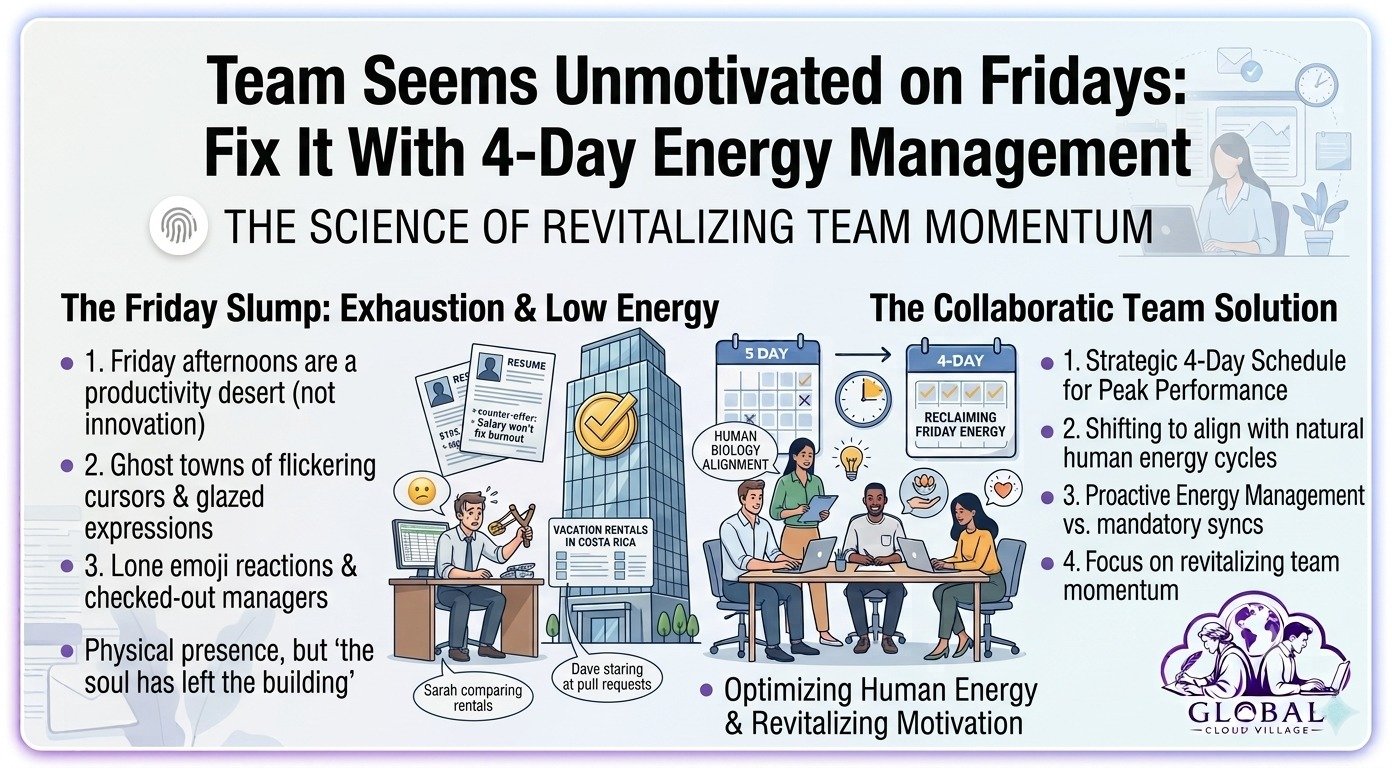
On Slack, the activity log looks like a desert. A solitary emoji reaction appears on an announcement from HR—a lone thumbs-up from a project manager who is also clearly halfway checked out. Dave is staring at a pull request he opened three hours ago, his cursor blinking rhythmically against a line of code he hasn’t altered since lunch. Sarah has opened the same spreadsheet four times, read the exact same row of figures, and then clicked over to a tab comparing vacation rentals in Costa Rica.
Everyone is physically present—or at least logged in and pingable—but the soul has left the building.
Managers look at this phenomenon with frustration, shaking their heads and muttering about a lack of work ethic or discipline. They schedule mandatory Friday afternoon “alignment syncs” or virtual happy hours to jump-start the energy, only to watch employees sit on camera with deadpan expressions, counting down the agonizing seconds until 5:00 PM.
Here is the fundamental mistake we make: we treat human energy like an infinite tap that we can leave running 24/7. We assume that if someone is at their desk on Friday afternoon, they should be producing at Monday-morning levels.
Human energy doesn’t work that way. It is cyclical, rhythmic, and deeply finite. Trying to extract creative problem-solving from an exhausted brain on a Friday afternoon isn’t management; it’s ecological vandalism.
The unmotivated Friday isn’t a character flaw in your team—it is a design flaw in your schedule. The remedy isn’t more motivational speeches; it is replacing the Friday void with an intentional 4-day energy management system.
The Science of Human Rhythms
To understand why Friday is a wasteland, we have to look at the ultradian rhythms of the human body. Throughout the day, our brains cycle through 90-to-120-minute periods of high focus followed by 20-minute troughs of lower energy.
Multiply that daily fatigue curve across an entire five-day week, and by Friday afternoon, the human organism has reached the end of its metabolic runway. The glycogen stores in the brain are depleted. The capacity for abstract thought, emotional patience, and complex decision-making is functionally zero.
When you force people to sit at their desks during this biological trough, you enter the realm of performative labor. Employees aren’t working; they are performing the ritual of working. They are moving the mouse every few minutes to keep their Slack status green, drafting emails that require three revisions on Monday morning anyway, and scrolling through news sites in a fog of guilt and exhaustion.
This Friday, inertia doesn’t just waste Friday afternoon; it bleeds backward. Because employees know Friday is going to be a low-energy slog where they accomplish nothing of value, they mentally check out as early as Thursday afternoon. The weekend gravity starts pulling on them 24 hours early.
Energy Management vs. Time Management
For decades, we’ve been obsessed with time management. We buy planners, color-code our calendars, and try to squeeze every microsecond into a neat little box.
But time management assumes that all hours are created equal—that an hour at 9:00 AM on Monday has the same cognitive value as an hour at 3:30 PM on Friday. It doesn’t.
High-performance leadership in the modern era requires energy management. You don’t manage the clock; you manage the vital spark of human attention and vitality. And energy management teaches us a stark, beautiful truth: sometimes the most productive thing you can do with an hour is to not work at all.
When you transition to a 4-day workweek, you aren’t just cutting hours off the calendar; you are aligning your operational rhythm with human biology.
Imagine how a team operates when Monday through Thursday are designed as high-velocity, deeply focused sprint blocks, and Friday is completely removed from the labor equation:
- The Monday Surge: People arrive on Monday with a fully restored battery from a two-day physical and mental recharge. They don’t need two hours of coffee-sipping and fog-clearing because they aren’t carrying a three-day sleep deficit.
- The Thursday Finish Line: Because Thursday is the final working day of the week, the psychological weight of the deadline sharpens focus. There is no lazy “I’ll finish this on Friday morning” procrastination. The work gets done now.
- The Clean Break: When Thursday evening arrives, the team logs off with a sense of genuine completion. They haven’t spent Friday pretending to work; they’ve executed, wrapped up, and closed their laptops.
Transforming the Friday Void into a Strategic Advantage
When Global Cloud Village consulted with a digital agency whose Friday afternoons were legendary for low morale and zero output, we didn’t give them a motivational seminar. We proposed a radical experiment: eliminate Friday work, and reallocate those eight hours of compressed focus across Monday through Thursday.
The leadership team was skeptical. “If we lose Friday, our creative output will plummet by 20%.”
We ran the numbers and proved them wrong. Before the shift, their time-tracking data showed that employees spent a cumulative 14 hours every week on Fridays and late Monday mornings just staring at screens, fumbling with minor administrative clutter, and recovering from burnout.
By formalizing the 4-day week, those administrative blocks were ruthlessly condensed. Team members were given clear, high-autonomy focus blocks.
The result? The unmotivated Friday vanished because Friday no longer existed as a miserable workday. Instead, Friday became a sacred space for personal restoration. And when the team logged back on Monday morning, the ambient dread that usually poisoned the first half of the week was gone. They didn’t drag their feet; they attacked their projects with a fresh, vibrant energy that stunned their clients.
Engineering High Energy in 4 Days
Moving to an energy-managed 4-day system requires changing how you structure the remaining four days. You cannot maintain a chaotic, meeting-heavy culture and simply lop off Friday.
- Protect the Peak Hours: Identify when your team’s cognitive energy is highest (usually mid-morning) and ban internal meetings during those windows. Reserve those hours for heavy creative or technical execution.
- Eliminate Friday Creep: Make a hard cultural rule: no work on the fifth day. If an emergency forces someone to log on Friday to fix a crisis, the system has failed, and the root cause must be fixed on Monday.
- Encourage Active Recovery: Teach your team how to disconnect during their three-day weekend. True energy management requires that the rest days are free from the low-level anxiety of checking Slack “just to see what’s happening.”
- Celebrate the Hard Stop: Train managers to praise people for logging off at 5:00 PM on Thursday. Make boundaries a badge of honor, not a sign of slacking.
Conclusion: Reclaiming the Rhythm of Work
We were never meant to run at a flat, grinding pace for five endless days. Nature operates in seasons, tides, and rhythms—periods of intense growth followed by periods of dormancy and renewal.
When you stop fighting human biology and start managing energy instead of pretending time is infinite, the unmotivated Friday disappears. You replace sluggish inertia with vibrant momentum.
Give your team the rest they need, protect their focus when they are on the clock, and watch how brightly they shine when they aren’t burning their energy in the empty void of a wasted Friday afternoon.
Frequently Asked Questions About Energy Management and 4-Day Schedules
Won’t cutting out Friday hours lower our weekly total creative output?
No. Data from global 4-day workweek trials show that output remains steady or increases because wasted, low-energy hours are pruned. People produce more when they are cognitively fresh rather than dragging through a 5-day fog.
How do we handle internal syncs that used to be scheduled for Friday afternoons?
Shift status updates and announcements to async channels. Reserve any necessary live syncs for early in the week when energy levels are high, and teams can take immediate action on decisions.
Is it difficult for employees to adjust their internal pacing to a 4-day sprint?
There is a brief adjustment period during the first few weeks, but the psychological incentive of the 3-day weekend naturally accelerates focus and eliminates mid-week procrastination.
What is the best way to handle team communication boundaries on Friday?
Establish a hard digital sunset on Thursday evening. Mute internal channels and instruct managers to respect the rest period so that recovery is total and uninterrupted.
Ready to Revitalize Your Team’s Energy?
Eliminating the Friday productivity slump and building a high-momentum team is the vital step toward sustainable enterprise performance. Discover the complete human-centric blueprint for modern operational efficiency.
Get your copy of Global Cloud Village and 4 Day Work Week on Amazon:
About the Author: Global Cloud Village
Global Cloud Village translates complex digital tech systems into clear, human-centric strategies for growing SMEs, founders, and industry leaders. We help businesses replace clunky, fragmented legacy habits with automated, high-adoption cloud architectures that protect data and build operational scale. Explore our optimization insights at globalcloudvillage.com.