The monthly utility statement arrives, and for many SME owners, the reaction is the same: absolute disbelief.
Between surging baseline electricity tariffs, unpredictable power generation costs, and the heavy, constant draw of legacy on-premise hardware, your utility overhead has quietly morphed from an operational utility line item into a major threat to your net margins.
For years, standard business advice told you to trim the fat by turning off conference room lights or lowering the thermostat by a single degree. But minor office behavioral tweaks cannot fix a fundamentally broken, power-hungry physical infrastructure. If your team is chained to physical office desks five days a week, powering energy-intensive local servers, cooling massive desktop hardware towers, and running climate control across under-utilized spaces, you are actively burning capital on structural inefficiencies.
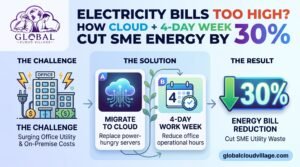
To lower your utility expenditure by a measurable 30%, you need a modern operational paradigm: merging decentralized cloud computing with a compressed 4-day work week.
The Hidden Energy Vampires Inside Your Office
Before you can slash your utility costs, you must identify where your physical office actually bleeds energy. In a standard five-day SME workspace, your power consumption is driven by three major culprits:
- The 24/7 On-Premise Server Room: Even when your staff goes home on Friday evening, your local server racks, cooling units, and backup battery systems stay fully powered all weekend, churning through kilowatt-hours to process minimal background tasks.
- The “Always-On” Desktop Ecosystem: Individual employee workstations, multi-monitor setups, and local printing stations draw phantom power even in sleep mode, creating an invisible, compounding drain on your monthly meter.
- The Five-Day HVAC Overhead: Keeping an entire commercial office space climate-controlled for five full days—regardless of fluctuating team attendance or hybrid schedules—results in massive energy waste during peak heating and cooling hours.
[Local Servers & Desktops] ──► [Continuous 5-Day Power Draw] ──► [Surging Utility Tariffs] ──► Compressed Profit Margins
│
└──► [HVAC Climate Control] ──► [Unoccupied Weekend Waste]
Phase 1: Migrating to the Cloud to Kill Local Server Power
The single fastest way to drop your baseline electricity usage is to eliminate the power-hungry metal boxes sitting in your office closet.
Running an on-premise server requires dedicated local air conditioning, uninterrupted power supplies (UPS), and constant utility draws just to keep the hardware from overheating. When you migrate your core business databases and enterprise workflows to a modern cloud architecture (such as Odoo or Zoho hosted on efficient public cloud networks), you completely outsource that heavy power footprint.
- Shared Infrastructure Efficiency: Modern cloud data centers utilize hyper-scale virtualization. Instead of thousands of small businesses running thousands of half-empty local servers, cloud providers pool workloads into ultra-optimized server farms powered by intelligent cooling and renewable energy grids.
- Elimination of Auxiliary Room Cooling: By shutting down your physical server room, you can permanently turn off the dedicated 24/7 air conditioning unit that kept that closet cool, instantly dropping your commercial electricity baseline.
Phase 2: The 4-Day Work Week as an Energy Strategy
While cloud computing cuts your digital power draw, introducing a structured 4-day work week attacks your physical facility overhead.
By compressing your operational output into four high-focus days (such as Monday through Thursday) and closing the physical office entirely on Friday, you achieve an immediate drop in operational energy consumption:
- Zero Facility Footprint for 3 Days: When you factor in the weekend, your office building sits completely unpowered, unheated, and uncooled for 72 straight hours every single week. That equates to a roughly 20% reduction in your facility’s weekly HVAC runtime.
- Eliminated Commute Emissions: While your carbon footprint improves, your team also saves hours of fuel and transit electricity, boosting overall company morale and lowering corporate travel overhead.
- Heightened Operational Velocity: Teams operating under a 4-day structure eliminate unnecessary meetings and distractions, focusing intensely on digital execution through streamlined cloud pipelines.
Step-by-Step Blueprint to Cut Your SME Energy 30%
Transitioning your business to a lean, low-energy model does not require a risky, overnight overhaul. Follow this structured four-step implementation guide:
- Audit Your Current Utility Draw: Pull your last 12 months of electricity bills. Separate your baseline constant power draw (night and weekend usage) from your peak operational hours to see exactly how much energy your office wastes when empty.
- Move Core Data to the Cloud: Audit your local software files. Migrate your customer management, accounting books, and inventory tracking to secure cloud platforms, and schedule the permanent shutdown of your local office server racks.
- Pilot the 4-Day Schedule: Test a 4-day operational model across one quarter. Keep total weekly working hours consistent by slightly extending daily shifts, while closing physical office doors completely on Fridays.
- Automate Power Management: Install smart office power strips that automatically cut electricity to non-essential desk peripherals, printers, and breakroom appliances at the end of every workday.
The Energy & Cost Comparison Matrix
| Operational Factor | Traditional 5-Day On-Premise Setup | Modern Cloud + 4-Day Model | The Efficiency Gain |
| Server Cooling | Dedicated 24/7 server room AC running constantly. | Zero local hardware; cloud data center handles load. | 100% elimination of local server cooling costs. |
| Facility HVAC | Running climate control 5 full days a week. | Active climate control restricted to 4 focused days. | ~20% drop in weekly commercial HVAC energy use. |
| Hardware Draw | Hundreds of idle desktop computers pulling phantom power. | Leaner hardware footprint with strict weekend shutoff protocols. | Significant reduction in baseline phantom wattage. |
| Utility Impact | High, unpredictable monthly power bills eating margins. | Stabilized, predictable overhead with lower utility tiers. | Cumulative 30% reduction in total energy overhead. |
Conclusion: Modernize Infrastructure, Protect Your Bottom Line
Sky-high electricity bills are no longer just an unfortunate cost of doing business; they are a direct symptom of outdated digital and physical infrastructure.
By letting go of power-hungry local servers and embracing the clean efficiency of cloud architectures combined with a compressed 4-day work week, you protect your company from volatile utility tariffs while building a leaner, more agile enterprise.
Take control of your operating overhead, reduce your carbon footprint, and position your SME for sustainable, long-term growth.
Frequently Asked Questions About SME Energy Reduction
Will moving our ERP and files to the cloud actually lower our total utility bill?
Yes. While you pay a subscription fee for cloud software, you completely eliminate the massive electricity draw of running physical office servers, maintaining backup generators, and running dedicated 24/7 cooling units in your office building. The net reduction in your commercial electricity meter typically outweighs the software subscription cost.
How does a 4-day work week affect daily business productivity and customer service?
When properly structured using modern cloud collaboration tools and asynchronous workflows, a 4-day work week actually increases output. Employees work with higher focus and less burnout, while automated cloud workflows handle customer inquiries and data logging smoothly even when physical offices are closed.
Is a 4-day work week difficult to implement for customer-facing service teams?
Not at all. Many SMEs successfully implement staggered team schedules (e.g., Team A works Monday–Thursday, Team B works Tuesday–Friday) to ensure continuous 5-day client coverage while individual employees still enjoy a compressed 4-day schedule.
Scale Your Operations With Absolute Clarity
Escaping high utility overhead and legacy inefficiencies is the vital first step toward maximizing your enterprise profitability. Discover the complete blueprint for running a highly productive, streamlined business without technical roadblocks.
Get your copy of Global Cloud Village and 4 Day Work Week on Amazon:
About the Author: Global Cloud Village
Global Cloud Village translates complex digital tech systems into clear, human-centric strategies for growing SMEs, founders, and industry leaders. We help businesses replace clunky, fragmented legacy habits with automated, high-adoption cloud architectures that protect data and build operational scale. Explore our optimization insights at globalcloudvillage.com.
Tags: SME Energy Reduction, Cloud Computing, 4 Day Work Week, Green IT, Office Power Saving, Enterprise Efficiency, Tech Procurement Strategy