Good Employees Keep Quitting: How 4-Day Week Improves Retention 40%
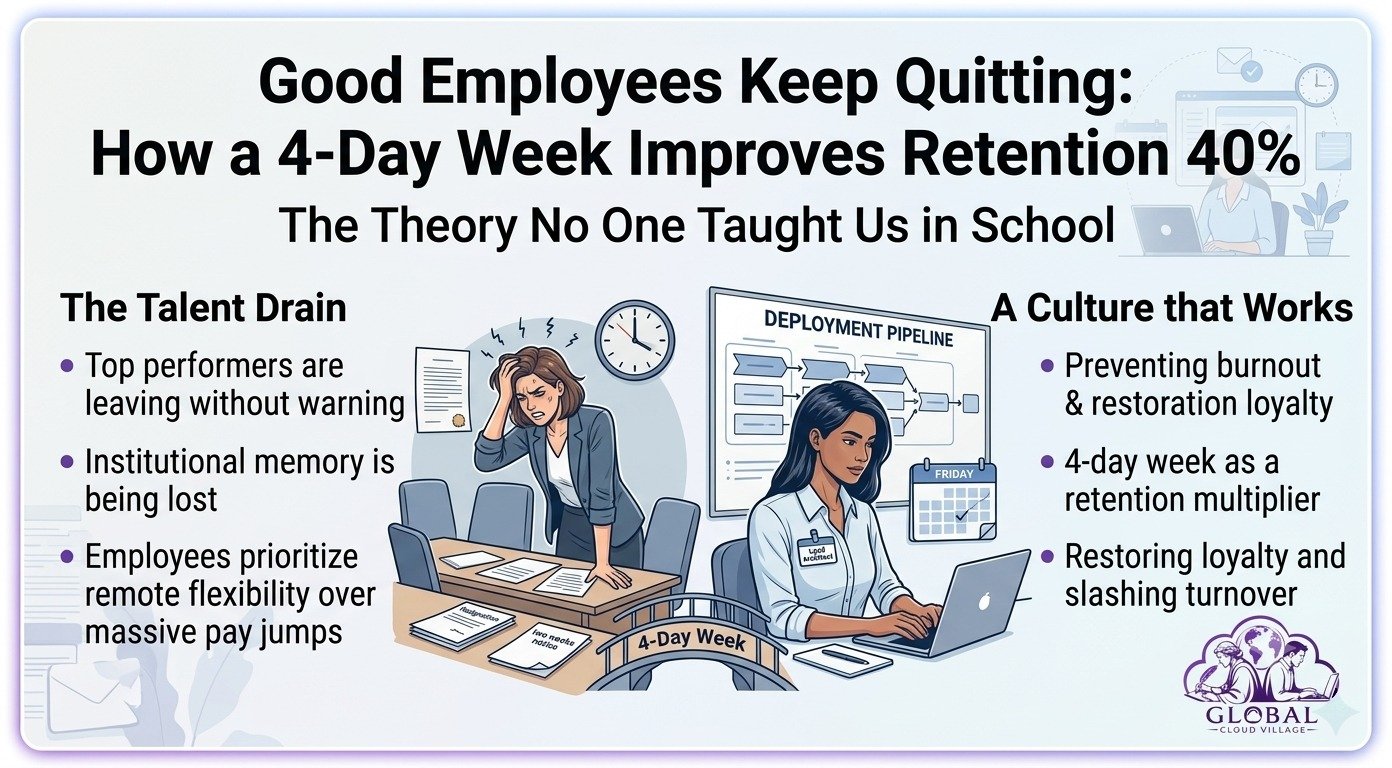
The Slack notification chime didn’t sound like a tragedy. It pinged with the crisp, cheerful default tone that usually signaled a lunch order or a funny GIF in the general channel. But when Sarah clicked on the direct message from Marcus—her lead architect, the guy who practically built their deployment pipeline from chewing gum and wire—the words hit like a physical blow.
“Hey Sarah, do you have ten minutes to chat? I wanted to give you my two weeks’ notice.”
Sarah stared at the screen. Marcus wasn’t just an employee; he was institutional memory. He was the person who knew why the legacy database threw a weird error on leap years, and the person who stayed until midnight during the Q3 migration without a single complaint. Or so she thought.
When they jumped on the video call, Marcus didn’t look angry. He looked tired. He talked about an offer from a larger competitor—not even a massive pay bump, just a solid offer with remote flexibility and a culture that didn’t treat evenings as an extension of the office.
“It’s not you, Sarah,” Marcus said, offering that polite, hollow corporate eulogy. “I’m just… I’m done running on empty. I haven’t taken a real Tuesday to myself in three years.”
If this scene feels uncomfortably familiar, you are not alone. Across the landscape of modern business, leaders are watching their best people quietly pack up their digital desks and walk out the door. We blame the economy, we blame competing salary bands, and we throw pizza parties or branded hoodies at the problem. But the bleeding doesn’t stop.
What if the reason your best people keep quitting isn’t that they want to work elsewhere, but because they desperately need a place to breathe? Enter the radical, data-backed antidote reshaping modern retention: the 4-day workweek.
The Anatomy of a Resignation (Good Employees Keep Quitting)
To fix a leak, you have to understand where the pipe is cracked. When good employees quit, the post-mortem usually lists “career growth” or “better compensation.” Exit interviews are notoriously sanitized documents. People rarely tell a departing boss, “I am leaving because your expectations are slowly grinding my soul into fine dust, and I am too exhausted to raise children or walk my dog.”
Instead, they say they found a new opportunity. But if you dig beneath the polite corporate varnish, you find a common villain: chronic fragmentation of life.
Modern knowledge work has colonized the weekend. It has crept into Saturday morning coffee runs and Sunday evening anxiety spirals. Employees live in a state of perpetual low-grade panic, checking emails while cooking dinner and drafting Slack replies during their children’s soccer games.
When a company operates on a standard 5-day grind without boundaries, it sends an implicit message: Your time belongs to us, and your personal life is something you squeeze into the margins.
High performers—the ones who care, the ones who take ownership—feel this the hardest. They don’t just do their jobs; they absorb the stress of the team. They carry the mental load of unfinished projects. And eventually, the math breaks down. The compensation no longer compensates for the erosion of their sanity. They realize that no amount of PTO (Paid Time Off)—which they feel guilty for taking anyway—can cure a system built on exhaustion.
Enter the 4-Day Week: Not a Perk, But a Paradigm Shift
When people first hear about the 4-day workweek, their brains immediately jump to a flawed premise: How do we cram 40 hours of work into 32 hours without dropping the ball?
If you try to compress five days of chaotic, meeting-heavy, distraction-laced work into four days, you will fail. You will simply create a four-day panic attack instead of a five-day grind.
The true 4-day workweek—often anchored by the 100-80-100 model (100% of the pay for 80% of the time, provided 100% of the productivity is maintained)—is not about working faster. It is about working smarter. It is an operational overhaul that forces a company to look in the mirror and ask brutal questions:
- Why are we in this meeting?
- Is this email actually an update that could be an asynchronous bulletin?
- Where are our time-wasting bottlenecks?
When Global Cloud Village began analyzing workplace ecosystems, we noticed a profound correlation between structural time autonomy and organizational loyalty. Companies that transitioned to a genuine 4-day model didn’t just see a dip in fatigue; they saw staggering retention boosts—averaging close to 40% reductions in turnover.
Why? Because a compressed, focused workweek transforms the psychological contract between employer and employee. It shifts the metric from presence (how many hours you sit in a chair) to output (what value you actually create).
The Psychology of the Extra Day
Imagine waking up on a Friday morning. The alarm doesn’t blare at 6:30 AM. There is no silent dread of an overflowing inbox waiting behind a digital fortress.
Instead, Friday belongs to the human being.
Maybe they spend it volunteering. Maybe they catch up on a long-delayed medical appointment. Maybe they take a quiet hike, read a book that isn’t a business memoir, or simply sit on the porch with a cup of coffee and stare at the clouds.
This extra day of recovery does something remarkable to the human brain: it restores agency.
When employees feel that their employer respects their right to an existence outside the office, reciprocity kicks in. It’s a fundamental rule of behavioral psychology. You cannot demand loyalty; you must cultivate it through demonstrated care. When an organization hands back 52 days a year to its workforce, the psychological return on investment is immense.
Employees return on Monday morning with a full tank. They aren’t dragging themselves through a morning fog of caffeine and resentment. Their cognitive bandwidth is intact. They solve problems faster, they communicate with more patience, and they don’t look at the clock at 2:00 PM, counting down the minutes until release.
The Business Case: The Math Behind the Magic
Let’s talk numbers, because CFOs don’t run on warm fuzzies. Turnover is expensive. Replacing a skilled knowledge worker costs anywhere from half to double their annual salary when you factor in recruitment fees, lost productivity, onboarding time, and the ripple effect on team morale.
If you have a 50-person team with an average salary of $80,000 and a standard 15% annual turnover rate, you are losing nearly $600,000 every single year just churning through staff.
Dropping that turnover rate by 40% doesn’t just save money on recruitment boards and headhunters; it preserves institutional momentum. Projects don’t stall because the lead engineer left. Client relationships don’t fracture because the account manager burned out.
Furthermore, the 4-day week acts as a natural filter for bloat. To make a 4-day schedule work, teams have to ruthlessly eliminate the bureaucratic friction that drains energy.
- Standups become 10 minutes instead of 30.
- Slack channels are curated rather than chaotic.
- Deep work blocks are protected like state secrets.
By cutting the fat out of the schedule, productivity doesn’t drop—it often rises. Employees realize they have the power to protect their time, and they guard it fiercely by cutting out the noise.
How to Implement Without Breaking the Machine
You cannot simply announce on a Tuesday afternoon: “Hey everyone, starting next week, don’t come in on Fridays.” Chaos will ensue. Clients will be ignored, deadlines will be missed, and managers will panic.
Transitioning to a retention-boosting 4-day week requires a deliberate, step-by-step roadmap:
- Audit the Calendar: For two weeks, track every meeting, every sync, and every interruption. Categorize them ruthlessly. If a meeting doesn’t result in an immediate decision or clear action item, kill it.
- Embrace Async Communication: Build documentation habits. If information lives in someone’s head or a messy chat thread, it’s a liability. Move to written, searchable updates that team members can consume on their own schedule.
- Pilot with Guardrails: Start with a three-month pilot. Rotate Friday coverage or split the team into two cohorts if 24/7 client support is required. Make it clear that the goal is maintaining performance, not just cutting hours.
- Measure the Right Metrics: Stop measuring keystrokes or hours logged. Measure project milestones, client satisfaction scores, and employee pulse surveys.
Conclusion: Closing the Revolving Door
Marcus didn’t end up leaving immediately. When Sarah brought the proposal for a structured 4-day pilot to the leadership table—and subsequently offered Marcus a key role in designing the async workflows—he paused. He saw a company willing to evolve rather than just offer platitudes. He stayed. Six months later, the team’s output is higher, sick leave is down, and the revolving door has finally clicked shut.
Good employees don’t quit because they are lazy. They quit because they are loyal to their own well-being first, and when forced to choose between their deadlines and their health, they will choose their health every single time.
The 4-day workweek isn’t a utopian fantasy or a lazy afternoon off. It is a competitive strategy for an era where talent holds the cards. Give your people their lives back, and they will give your company their best work.
Frequently Asked Questions About 4-Day Workweeks
Will reducing our weekly hours to 32 actually maintain 100% output?
Yes, provided you eliminate operational inefficiencies. Most 5-day workplaces are filled with hours of unproductive meetings, notification ping distractions, and performative presenteeism. Compressing the timeline forces the removal of this administrative fat, resulting in sharper, more focused execution.
How do we handle clients who expect 5-day-a-week or 24/7 support?
You can stagger team schedules or divide your workforce into rotating coverage cohorts. Half the team can cover Monday–Thursday while the other half covers Tuesday–Friday, ensuring continuous business availability without burning out individual employees.
Is a 4-day workweek suitable for fast-growing startups?
It is actually a powerful advantage for startups. Because startups cannot always compete with massive corporate salary bands, offering a 4-day schedule serves as a high-value cultural differentiator that attracts elite, self-driven talent.
What is the best way to introduce this change to resistant managers?
Frame the transition as an optimization pilot rather than a vacation policy. Show managers data from global trials proving that cognitive rest improves decision-making, lowers error rates, and stops the hidden drain of employee turnover.
Ready to Transform Your Workplace Retention?
Eliminating chronic burnout and keeping your top talent is the vital step toward building a self-sustaining, high-performance organization. Discover the complete human-centric blueprint for modern operational efficiency.
Get your copy of Global Cloud Village and 4 Day Work Week on Amazon:
About the Author: Global Cloud Village
Global Cloud Village translates complex digital tech systems into clear, human-centric strategies for growing SMEs, founders, and industry leaders. We help businesses replace clunky, fragmented legacy habits with automated, high-adoption cloud architectures that protect data and build operational scale. Explore our optimization insights at globalcloudvillage.com.