
4 Day Work Week for SMEs: Increase Productivity and Reduce Burnout
The 4 Day Work Week for SMEs Could Be the Smartest Business Decision You Make
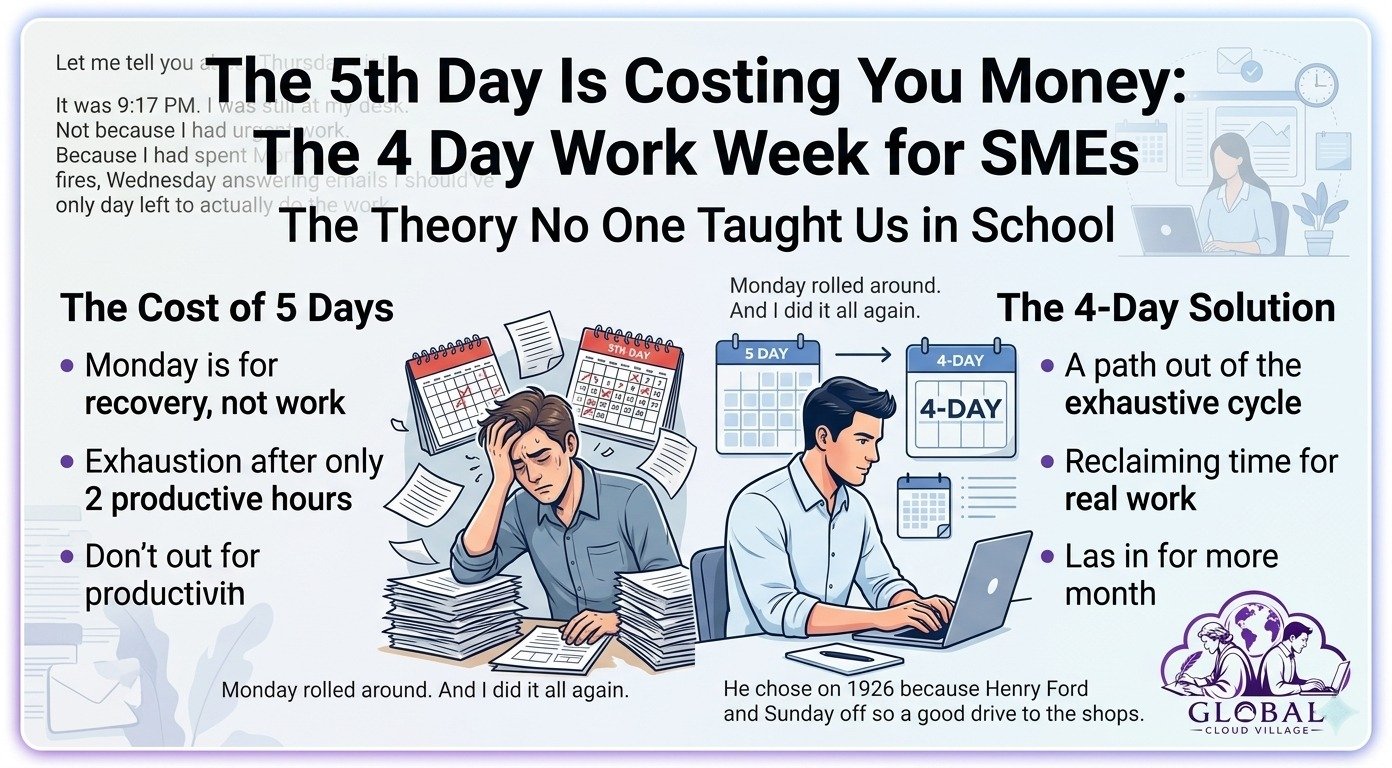
Let me tell you about Thursday night.
It was 9:17 PM. I was still at my desk.
Not because I had urgent work. Because I had spent Monday in meetings, Tuesday putting out fires, Wednesday answering emails I should have answered Monday, and now Thursday was the only day left to actually do the work.
Friday came.
I was exhausted.
I did two hours of real work and spent the rest of the day pretending to be busy.
Then the weekend arrived, and I was too tired to enjoy it.
Monday came around, and I repeated the same cycle.
If you run a small or medium-sized business, this story probably feels familiar.
The truth is that the fifth working day often becomes a recovery day instead of a productive one. That hidden cost affects your team, your profits, and your long-term growth.
The 4 Day Work Week for SMEs offers a practical alternative.
Why the 4 Day Work Week for SMEs Makes Business Sense
The five-day workweek wasn’t created because research proved it was the most productive model.
It became popular nearly a century ago when manufacturing businesses followed industrial-era working patterns.
Today’s businesses operate in a completely different environment.
Email never sleeps.
Customers expect instant replies.
Teams collaborate online across different time zones.
Yet many businesses still follow a schedule designed for factory work.
The core idea behind the 4 Day Work Week for SMEs is simple.
Productivity depends on energy, focus, and priorities, not simply the number of hours spent at work.
Most knowledge workers only achieve a few hours of deep, meaningful work each day.
The remaining hours are often consumed by meetings, interruptions, unnecessary emails, and administrative tasks.
When businesses remove these distractions, employees accomplish more in less time.
The Hidden Costs the 4 Day Work Week for SMEs Eliminates
Burnout
Decision quality drops as the week progresses.
Tired employees make costly mistakes.
A missed client email, incorrect invoice, or rushed hiring decision can cost far more than one day’s salary.
Employee Turnover
People rarely leave only because of money.
They leave because they want better balance.
Replacing experienced employees costs time, money, and productivity.
Retaining talented staff is often cheaper than recruiting new ones.
Wasted Time
Many Fridays become catch-up days.
Meetings replace meaningful work.
Reports are created but never read.
Tasks expand simply because extra time exists.
The 4 Day Work Week for SMEs focuses on eliminating unnecessary work instead of reducing business performance.
What the 4 Day Work Week for SMEs Really Means
Many people misunderstand the concept.
It does not mean squeezing five days of work into four.
Instead, it follows a simple principle:
100% Pay
80% Time
100% Output
Businesses achieve this by reducing waste.
That includes:
- Fewer meetings
- Clear priorities
- Better communication
- Less multitasking
- More focused work sessions
The result is better productivity without increasing employee stress.
Real Evidence Supporting the 4 Day Work Week for SMEs
One of the most widely discussed workplace experiments came from Microsoft Japan.
The company introduced a four-day workweek while maintaining employee salaries.
The results were impressive.
- Productivity increased by nearly 40%
- Electricity usage decreased
- Printing costs were reduced
- Employee satisfaction improved
The lesson wasn’t that people worked harder.
They simply worked smarter.
Many SMEs can implement similar improvements much faster because they have fewer management layers.
Common Concerns About the 4 Day Work Week for SMEs
“Our clients expect five-day availability.”
Your clients care about fast responses, not how many days someone sits in an office.
Staggered schedules allow businesses to remain available throughout the week.
“Our workload will increase.”
Work naturally expands to fill available time.
Removing unnecessary meetings and approvals often creates several additional productive hours every week.
“Employees will become lazy.”
Successful businesses measure outcomes instead of hours.
When expectations are clear, accountability actually improves.
“We’ll lose money.”
Reduced burnout.
Lower turnover.
Fewer mistakes.
Lower operating costs.
Higher productivity.
These savings often offset the reduced working hours.
Why SMEs Benefit More Than Large Companies
Large corporations require months of planning to change workplace policies.
SMEs have a significant advantage.
They move faster.
They communicate directly.
They adapt quickly.
Business owners can test new ideas, measure results, and make adjustments without waiting for multiple approvals.
This flexibility makes the 4 Day Work Week for SMEs particularly effective.
How to Implement a 4 Day Work Week for SMEs
Rather than making immediate changes, start with a structured pilot.
Step 1: Audit Your Time
Track where every working hour goes for two weeks.
Most businesses discover surprising amounts of wasted time.
Step 2: Remove Low-Value Activities
Reduce unnecessary meetings.
Automate repetitive tasks.
Simplify approval processes.
Improve internal communication.
Step 3: Test With One Team
Measure:
- Productivity
- Revenue
- Customer satisfaction
- Employee feedback
Focus on business outcomes instead of hours worked.
Step 4: Expand Gradually
If the pilot succeeds, introduce the model across other departments while continuously measuring performance.
Final Thoughts on the 4 Day Work Week for SMEs
The 4 Day Work Week for SMEs is not about working less.
It is about working better.
Businesses that prioritize focus over busyness often discover higher productivity, happier employees, lower costs, and stronger long-term growth.
The five-day workweek is a tradition.
It is not a rule.
Forward-thinking SMEs have an opportunity to rethink how work gets done and create a healthier, more productive workplace.
If your business wants to improve performance without increasing payroll, the 4 Day Work Week for SMEs may be the competitive advantage you’ve been looking for.
Frequently Asked Questions
Is a 4 Day Work Week suitable for every SME?
Not every business can immediately transition, but many can start with pilot programs, staggered schedules, or department-specific trials.
Will employees work longer hours?
Not necessarily. Most successful implementations focus on eliminating wasted time instead of extending daily working hours.
Does a 4 Day Work Week reduce salaries?
No. The most successful models maintain full salaries while improving productivity through better workflows.
What industries benefit the most?
Professional services, marketing agencies, software companies, consultancies, creative firms, finance, and many office-based SMEs often see the quickest results.
External References
Microsoft Work-Life Choice Challenge
Ready to See Whether a 4-Day Work Week Could Work for Your Business?
This article covers the big ideas, but the complete framework includes implementation templates, rollout plans, productivity scorecards, real SME case studies, and practical checklists.
Get your copy of 4 Day Work Week for SMEs on Amazon: