Overtime Costs Killing Profit: Get Same Output in 4 Days
The weekly payroll report landed on the managing director’s desk like an unexploded ordnance. She did not even need to scroll to the bottom summary to spot the problem. The red ink in the overtime ledger was impossible to ignore.
For the third straight month, labor costs had outpaced top-line revenue growth. The reason was becoming clear. The operations department had quietly normalized a sprawling ecosystem of time-and-a-half wages.
Weekend shifts, late-night troubleshooting sessions, and emergency project extensions had become standard practice just to keep production goals on track.
When the managing director called an emergency meeting with plant supervisors and project leads, the explanation came with a heavy sigh:
“We are just slammed with orders. If we do not authorize the extra hours, the deliverables will slip, and our clients will walk.”
The company tried the classic cost-control reaction. Management issued a strict memo capping overtime approvals at five hours per employee per week without direct executive sign-off.
The result?
Overtime numbers dipped slightly on paper, but actual output declined. Deadlines were missed, employee resentment increased, and some employees simply found ways to hide extended hours or pushed themselves toward burnout trying to compress an inefficient workflow into fewer hours.
This exposed the real problem.
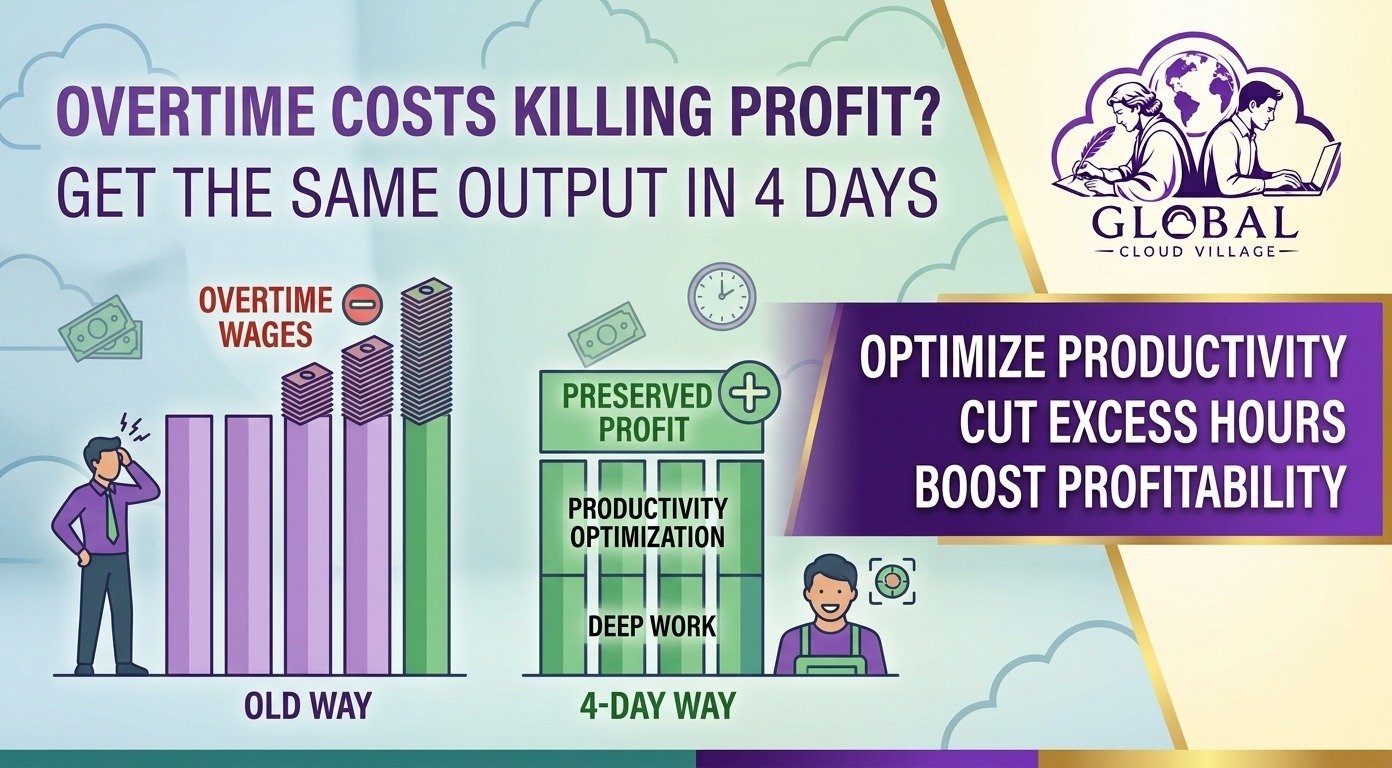
Paying for overtime does not necessarily mean you are buying additional value.
When employees work 50 hours a week to produce what should comfortably fit into 40, or potentially even 32, the business is not necessarily purchasing more output. It may be paying a premium for operational inefficiency, cognitive fatigue, poor scheduling, unnecessary meetings, and fragmented workflows.
If overtime costs are quietly suffocating your profit margins, simply capping hours is not the answer.
The better approach is to identify where time is being wasted, redesign the workflow, protect focused work, and determine whether the same output can be achieved through a disciplined 4-day workweek.
The Economics of Overtime Costs Killing Profit
To understand why overtime can damage profitability, look beyond the hourly wage.
An employee’s 41st, 42nd, or 48th hour does not automatically produce the same value as their earlier hours. Fatigue accumulates. Attention declines. Decisions become slower. Mistakes become more likely.
This creates several hidden costs.
The Error Multiplier
An exhausted technician, developer, designer, or operations employee can make subtle but expensive mistakes.
A miscalculated inventory balance, faulty line of code, incorrect client specification, or missed production detail can create additional work for another employee.
The business may then pay twice:
First for the original overtime.
Then for the time required to correct the resulting error.
Parkinson’s Law and Overtime
Parkinson’s Law suggests that work tends to expand to fill the time available.
If employees know that Friday evenings, weekends, or overtime hours are always available, the organization can unintentionally create less urgency during normal working hours.
Why finish a task efficiently on Thursday afternoon if additional paid hours are already expected later?
The problem is not that employees are lazy.
The problem is that the system has created little incentive to eliminate unnecessary work.
The Wage Premium Trap
Overtime can also create a significant wage premium.
If an employee normally earns $20 per hour and overtime is paid at 1.5 times the standard rate, each overtime hour costs $30.
Ten unnecessary overtime hours therefore cost $300 instead of $200.
Multiply that across 20 employees and several months, and the impact becomes substantial.
The deeper issue is that the business may be paying a premium for work produced under increasingly difficult conditions.
Overtime is not automatically a sign of high demand. It can also be a warning that your operational machinery is leaking time, focus, and energy.
Overtime Costs Killing Profit? Look at the 4-Day Workweek
A 4-day workweek is not simply about giving employees an additional day off.
For businesses dealing with excessive overtime, it can become an opportunity to redesign how work gets done.
The objective should not be:
“Work fewer hours and somehow hope the same amount gets finished.”
The objective should be:
“Remove low-value work so the essential work gets completed more efficiently.”
For some organizations, this may mean moving from a traditional 40-hour schedule toward a focused 32-hour model while maintaining productivity targets.
However, this should not be implemented blindly.
The right schedule depends on the business model, customer requirements, staffing levels, production cycles, and applicable employment laws.
The 4-day model works best when it is treated as an operational redesign rather than simply a scheduling experiment.
1. Eliminate Performative Work
When employees have a fixed and protected working window, unnecessary activities become easier to identify.
Long meetings.
Repeated status updates.
Unclear approvals.
Constant notifications.
Duplicated reporting.
Poorly organized requests.
These activities consume working hours without necessarily producing proportional value.
A 4-day model forces management to ask a difficult but valuable question:
What work can we eliminate?
The answer can have a direct impact on productivity.
2. Protect the Profit Margin on Human Capital
Labor is one of the largest operating costs for many businesses.
The goal should therefore be to maximize the value generated by every paid working hour.
Reducing unnecessary overtime can lower labor waste without requiring the company to simply reduce headcount.
The money previously consumed by avoidable overtime can potentially be redirected toward:
- Business development
- Automation
- Better technology
- Employee development
- Customer acquisition
- Process improvement
- Profit distribution
The key metric is not simply hours worked.
It is valuable output per paid hour.
3. Restore Cognitive Sharpness
Rest is not the enemy of productivity.
Fatigue is.
Employees who repeatedly work late nights and weekends have less opportunity to recover. Over time, this can affect concentration, decision-making, motivation, and quality.
A properly designed 4-day schedule creates a clearer boundary between work and recovery.
When employees know that their working window is limited, management must become more disciplined about priorities.
That discipline can improve both productivity and work quality.
Engineering an Overtime-Free Operation
A company cannot simply announce a 4-day workweek and expect its existing workflow to magically become efficient.
If the current system is chaotic, compressing the schedule without fixing the underlying problems can make things worse.
The transition requires deliberate operational redesign.
1. Conduct a Time-Waste Audit
Start by measuring where working hours actually go.
Ask:
- How many hours are spent in internal meetings?
- How much time is lost waiting for approvals?
- How often are employees interrupted?
- How frequently do priorities change?
- How much work is duplicated?
- Which tasks repeatedly require overtime?
- Where do client requests create bottlenecks?
The objective is to identify the activities consuming time without creating equivalent value.
2. Redefine the Capacity Baseline
Stop measuring productivity only by hours logged.
Instead, measure actual output.
For example:
- Completed projects
- Production units
- Customer tickets resolved
- Campaigns launched
- Orders processed
- Revenue generated
- Client milestones completed
If a task consistently requires overtime, investigate why.
Perhaps it is over-scoped.
Perhaps the process is inefficient.
Perhaps the team is understaffed.
Perhaps the approval system is too slow.
Perhaps automation could eliminate part of the workload.
The solution should address the cause rather than repeatedly paying for the symptom.
3. Create a Digital and Physical Sunset
A shorter workweek only works if the organization respects it.
If Thursday is the final working day, employees should not be expected to continue responding to routine messages on Friday.
Leaders must set the example.
The organization should stop celebrating the employee who stays online until midnight and start recognizing the employee who finds a better way to complete the work.
That cultural shift is critical.
How to Reduce Overtime Without Reducing Output
Reducing overtime should not mean simply telling employees to work faster.
Instead, businesses should redesign the system around priorities.
Prioritize High-Value Work
Not every task contributes equally to business performance.
Identify the activities that directly influence revenue, customer satisfaction, production, or strategic objectives.
Protect those activities from unnecessary interruptions.
Reduce Meeting Overload
Meetings can easily consume large portions of a workweek.
Replace unnecessary meetings with concise written updates where possible.
For essential meetings, establish a clear agenda, defined participants, and a specific outcome.
Automate Repetitive Tasks
Technology can remove repetitive administrative work.
Automation can support:
- Reporting
- Data entry
- Customer notifications
- Scheduling
- Lead management
- Invoice processing
- Internal approvals
- Routine communications
Every repetitive task removed from an employee’s workload creates additional capacity.
Improve Work Intake
Uncontrolled requests are a major source of operational inefficiency.
Create a clear system for submitting, prioritizing, and assigning work.
Employees should not constantly switch between urgent requests simply because the latest message arrived in their inbox.
Build Capacity for Demand Spikes
A 4-day schedule does not mean every business will have identical staffing requirements every week.
Seasonal businesses and customer support operations may need rotating teams or staggered schedules.
For example, one cohort could work Monday through Thursday while another works Tuesday through Friday.
This can preserve broader business coverage without requiring every employee to work excessive hours.
Measuring Whether a 4-Day Workweek Is Working
Do not judge the model based on employee enthusiasm alone.
Measure business outcomes.
Track metrics such as:
Overtime Hours: Are additional hours declining?
Cost Per Unit of Output: Is the business producing the same output at a lower labor cost?
Error Rate: Are mistakes increasing or decreasing?
Rework Hours: Is less time being spent correcting previous work?
Employee Turnover: Are retention and stability improving?
Customer Satisfaction: Is service quality being maintained?
Revenue Per Employee: Is the organization generating more value from its available capacity?
Project Completion Rate: Are deadlines still being achieved?
The objective is not simply fewer hours.
The objective is better economics per working hour.
When a 4-Day Workweek May Not Work
A 4-day workweek is not a universal solution.
Some businesses operate around continuous production, emergency response, healthcare, transportation, hospitality, or customer support requirements.
Others may have insufficient staffing to reduce individual working hours without increasing coverage costs.
In these situations, a traditional Monday-to-Friday schedule may still be appropriate.
The underlying principle remains the same:
Optimize the workflow before increasing the hours.
A business may ultimately choose rotating schedules, staggered shifts, flexible hours, or another operating model instead of a universal 4-day week.
Conclusion: Trade Excess Wages for Clean Execution
If overtime costs are killing profit, simply restricting overtime approvals will not solve the underlying problem.
The business must understand why overtime exists in the first place.
Is demand genuinely exceeding capacity?
Are meetings consuming productive hours?
Are processes inefficient?
Are employees constantly interrupted?
Are approval systems slowing work down?
Is technology being underused?
Is the team correctly staffed?
Once those questions are answered, management can redesign the operating model around productive output rather than hours worked.
A disciplined 4-day workweek can be one possible solution when the business can maintain customer coverage and required output through better processes.
The goal is not to glorify fewer working hours.
The goal is to eliminate wasted hours.
When businesses stop treating overtime as the default answer to operational problems, they can begin protecting margins, improving quality, reducing burnout, and creating a more sustainable way to grow.
Work should create value. More hours should not automatically be mistaken for more value.
Frequently Asked Questions About Overtime Costs and 4-Day Workweeks
Won’t a 4-Day Workweek Force Us to Use Overtime When Production Volume Spikes?
Not necessarily.
A well-designed 4-day system can create capacity by eliminating unnecessary meetings, interruptions, duplicated work, and inefficient processes.
When seasonal demand spikes occur, businesses can use temporary staffing, rotating cohorts, staggered schedules, or other capacity-planning strategies instead of making overtime the permanent solution.
How Can Finance Teams Measure the Benefits of Reducing Overtime?
Finance teams should look beyond the overtime line on the payroll report.
Measure the total cost of overtime, including wage premiums, rework, errors, absenteeism, turnover, delays, and productivity losses caused by fatigue.
Then compare those costs against the investment required to improve processes, automation, staffing, and scheduling.
Can Customer Support Teams Use a 4-Day Workweek?
Yes, but coverage must be designed carefully.
One possible approach is to use rotating cohorts.
For example, one group could work Monday through Thursday while another works Tuesday through Friday.
This can maintain business coverage across the week while giving individual employees a consistent additional recovery day.
What Is the Best Indicator That a Company Is Ready to Reduce Overtime?
Start by examining where working hours are being consumed.
If employees spend significant time in unnecessary meetings, administrative tasks, repeated approvals, context switching, or manual processes, the business may have substantial productivity capacity that can be recovered before adding overtime.
Is a 4-Day Workweek the Same as Working 10 Hours a Day for 4 Days?
No.
A 4-day workweek can take several forms.
Some businesses compress 40 hours into four 10-hour days. Others move toward a reduced-hours model, such as 32 hours across four days.
The appropriate model depends on the organization’s goals, workforce, customer requirements, and legal obligations.
About the Author: Global Cloud Village
Global Cloud Village translates complex digital technology systems into clear, human-centric strategies for growing SMEs, founders, and industry leaders.
We help businesses replace fragmented legacy processes with practical cloud architectures, automation, digital transformation, and operational strategies that support sustainable growth.
Explore more business optimization insights at Global Cloud Village.