ERP-Based 4-Day Framework: Fix Output After a 4-Day Workweek
A four-day workweek can improve employee focus, reduce burnout, and create a healthier work-life balance. However, reducing working hours does not automatically improve business performance.
Some companies experience the opposite result. Deadlines begin to slip, customer response times increase, internal communication becomes slower, and teams struggle to complete the same amount of work in less time.
This is where an ERP-Based 4-Day Framework can help.
The problem is not always the four-day workweek itself. In many cases, the real issue is an outdated operational system that depends on manual updates, scattered information, repeated meetings, and unclear ownership.
An ERP-based framework connects people, processes, data, and workflows in one coordinated environment. It helps businesses protect productivity while moving toward a shorter working week.
Why Output Can Drop After Moving to Four Days
When a company moves from a 40-hour, five-day schedule to a 32-hour, four-day schedule, it loses eight working hours per employee each week.
If the business processes remain unchanged, the same workload must be completed in less time.
This creates pressure in areas such as:
- Customer support
- Project delivery
- Sales follow-ups
- Internal approvals
- Inventory management
- Reporting
- Finance and administration
- Team communication
The reduction in hours exposes weaknesses that were previously hidden.
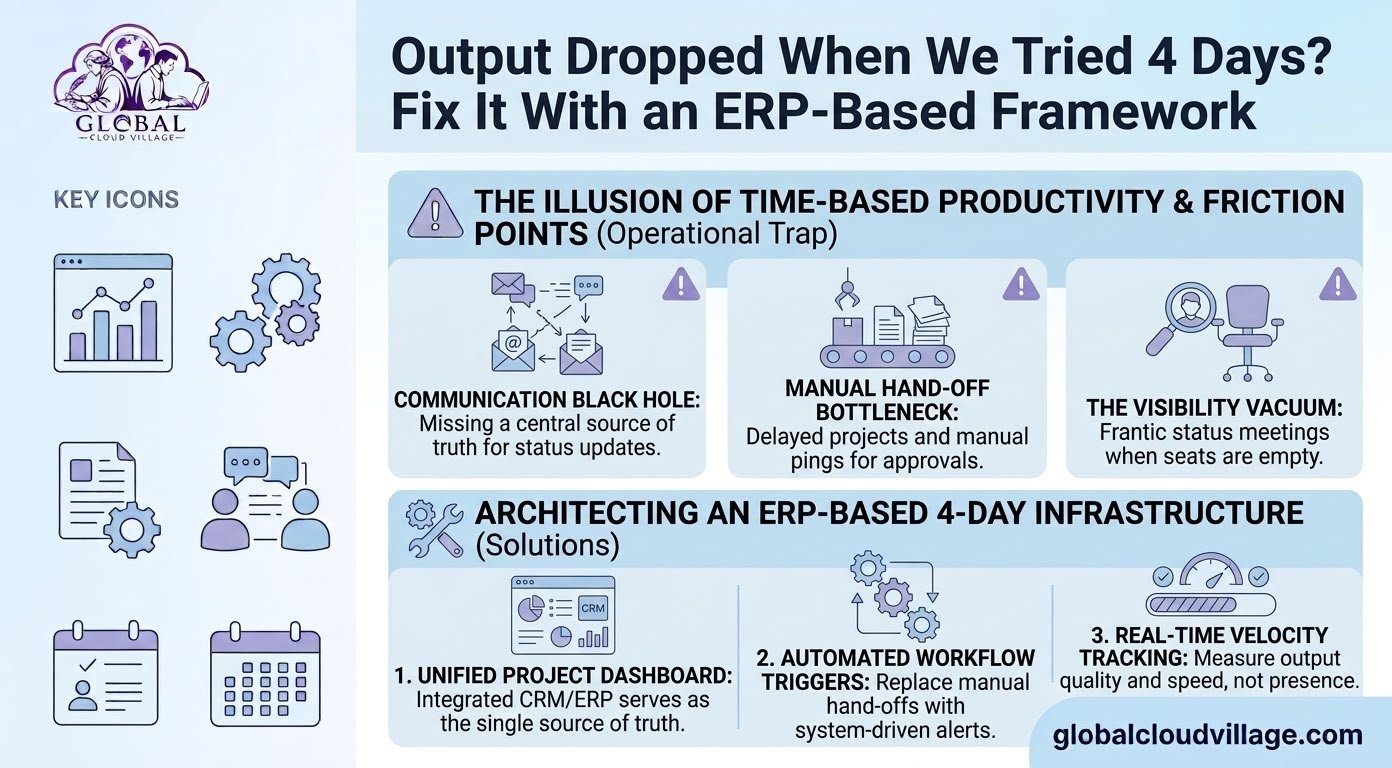
For example, a team may have spent several hours each week searching for documents, waiting for approvals, updating spreadsheets, or asking colleagues for project status. Under a five-day schedule, these inefficiencies may have gone unnoticed.
Under a four-day schedule, they can directly affect output.
The solution is not simply asking employees to work faster. The solution is to remove unnecessary friction from the operating system.
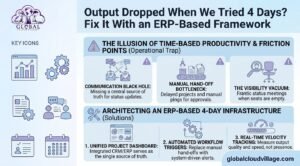
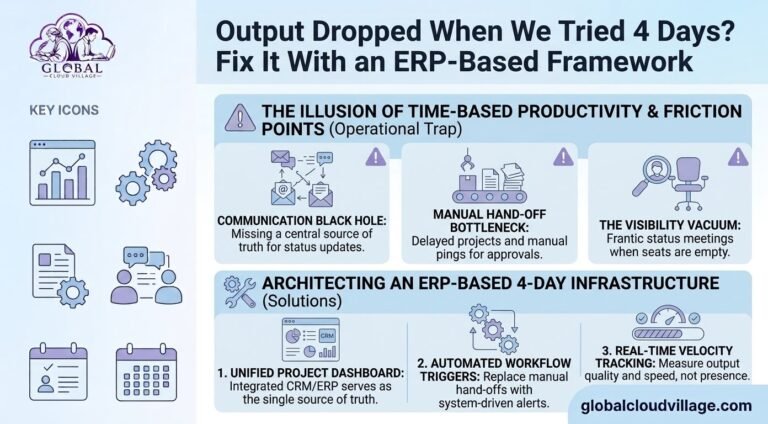
The Illusion of Time-Based Productivity
Many businesses still measure productivity by attendance, working hours, and online presence.
These measurements are easy to track, but they do not always show real business performance.
An employee may remain online for eight hours while spending a significant part of the day:
- Searching for information
- Waiting for a manager’s approval
- Repeating the same data entry
- Following up with different departments
- Attending meetings without clear outcomes
- Correcting errors caused by disconnected systems
This creates the illusion of productivity.
A better approach is to measure completed work, customer outcomes, delivery speed, quality, and revenue-related activity.
The goal of an ERP-Based 4-Day Framework is to make productive work easier by reducing the time lost between tasks.
What Is an ERP-Based 4-Day Framework?
An ERP-Based 4-Day Framework is an operating model that combines a four-day workweek with an integrated cloud-based ERP, CRM, and workflow system.
ERP stands for Enterprise Resource Planning. A modern ERP system can connect different business functions, including:
- Sales
- Customer relationship management
- Finance
- Human resources
- Inventory
- Procurement
- Projects
- Customer support
- Reporting and analytics
Instead of managing business activity through disconnected spreadsheets, emails, chat messages, and separate software tools, the company creates a shared source of operational information.
A suitable ERP platform may include solutions such as Odoo ERP or Zoho, depending on the company’s size, processes, budget, and technical requirements.
An ERP system is not a magic solution. It creates value when the business first understands its processes, removes unnecessary steps, and configures the system around real operational needs.
The Three Pillars of an ERP-Based 4-Day Framework
Centralized Data Visibility
The first pillar is visibility.
When information is stored across spreadsheets, email accounts, personal notebooks, and different software platforms, employees spend too much time searching for the latest update.
A centralized ERP and CRM environment allows authorized team members to access relevant information from one place.
For example, a sales manager should be able to see:
- New leads
- Follow-up status
- Sales pipeline value
- Pending proposals
- Customer communication
- Expected closing dates
- Assigned sales representatives
A project manager should be able to review:
- Active projects
- Pending tasks
- Deadlines
- Assigned team members
- Budget status
- Client approvals
- Delivery risks
This visibility reduces unnecessary status meetings and helps managers identify problems before they become urgent.
Workflow Automation
The second pillar is automation.
Manual handoffs are one of the biggest causes of delay in growing businesses. A task may remain incomplete because one employee forgot to send an email, update a spreadsheet, or notify another department.
An ERP-based workflow can automate routine activities such as:
- Lead assignment
- Customer follow-up reminders
- Invoice notifications
- Task creation
- Approval requests
- Employee onboarding steps
- Project status updates
- Inventory alerts
- Service ticket escalation
Automation does not eliminate the need for people. It removes repetitive administrative work so employees can focus on activities that require judgment, communication, and expertise.
In a four-day workweek, this difference becomes especially important.
Capacity-Based Resource Allocation
The third pillar is capacity management.
A four-day workweek requires realistic planning. Businesses cannot continue assigning work as if every employee still has five full working days available.
Managers need to understand:
- How many hours each employee can realistically contribute
- Which tasks are urgent
- Which tasks create the most business value
- Where workloads are unbalanced
- Which deadlines are achievable
- Where additional support is required
An ERP-based system can help managers view workload, task ownership, deadlines, and resource availability.
This makes it easier to prevent overloading high-performing employees while other team members have unused capacity.
The objective is not to fill every available hour. The objective is to allocate available capacity to the work that matters most.
An Illustrative Business Example
Consider a supply chain consulting company that moves from a five-day schedule to a four-day workweek.
At first, the company notices:
- Slower customer responses
- Delayed project milestones
- More internal follow-ups
- Increased administrative pressure
- Confusion about task ownership
The management team initially assumes that the shorter workweek is responsible.
After reviewing the workflow, they discover that employees are spending too much time on manual coordination. Client information is stored in different systems, approvals depend on individual messages, and project updates are not visible to everyone.
The company introduces an ERP-Based 4-Day Framework with four changes:
Asynchronous-First Communication
Routine updates are recorded inside the relevant project or CRM record instead of being discussed repeatedly in meetings.
Employees can review updates when they are available instead of waiting for everyone to attend the same call.
Automated Client Pipelines
New leads, follow-up reminders, proposals, and customer tasks are managed through an integrated CRM workflow.
This reduces the chance of missed follow-ups and improves sales visibility.
Output-Based Performance Metrics
The company measures completed deliverables, customer response times, project quality, and business outcomes instead of relying only on online presence.
Clear Capacity Limits
Managers assign work according to actual team capacity. New tasks are reviewed against existing commitments before being added to the schedule.
This example shows that the four-day workweek becomes more manageable when the operating system is redesigned around visibility, automation, and realistic capacity.
How to Implement an ERP-Based 4-Day Framework
Audit the Current Bottlenecks
Before purchasing or configuring an ERP system, identify where time is being lost.
Review the complete workflow from lead generation to delivery and payment.
Ask questions such as:
- Where do tasks remain blocked?
- Which approvals take too long?
- Which reports are prepared manually?
- Where is information duplicated?
- Which meetings could be replaced with written updates?
- Which tasks are repeated every day?
- Where do customer requests get lost?
- Which employees carry too much operational responsibility?
The audit should focus on actual business processes rather than software features.
Consolidate the Technology Stack
Many SMEs use multiple tools that do not communicate with one another.
For example, a company may use one platform for sales, another for project management, spreadsheets for finance, and email for approvals.
This creates duplicate data and inconsistent reporting.
The business should identify which tools are essential and which can be consolidated.
A practical ERP implementation may begin with the most important functions, such as CRM, project management, invoicing, or inventory. Additional modules can be introduced after the core system becomes stable.
Automate Repetitive Handoffs
Once the processes are mapped, automate repetitive steps.
Examples include:
- Creating a task when a deal reaches a specific stage
- Sending reminders before a deadline
- Assigning new leads to the appropriate team member
- Notifying finance when a project is approved
- Escalating unresolved customer tickets
- Updating management dashboards automatically
Automation should be introduced carefully. Poorly designed automation can create new problems if the underlying process is unclear.
Start with simple, high-volume tasks that create measurable time savings.
Establish Clear Ownership
Every important task should have a clear owner.
A system can show that a task is pending, but it cannot solve unclear responsibility by itself.
For each workflow, define:
- Who receives the task
- Who is responsible for completion
- Who approves the result
- What the deadline is
- What happens if the task becomes overdue
- Which performance indicator measures success
Clear ownership reduces repeated follow-ups and prevents tasks from being passed between departments without resolution.
Set Realistic Capacity Limits
A four-day workweek requires disciplined workload planning.
Managers should avoid assigning more work simply because employees appear available online.
Instead, use a capacity-based approach.
Prioritize tasks according to:
- Business impact
- Customer urgency
- Revenue potential
- Legal or compliance requirements
- Project dependencies
- Available employee capacity
Low-value tasks should be automated, postponed, delegated, or removed.
Measure the Right Results
The success of an ERP-Based 4-Day Framework should be measured through meaningful operational indicators.
Useful metrics include:
- Project completion rate
- Customer response time
- Sales conversion rate
- Revenue per employee
- Number of overdue tasks
- Customer satisfaction
- First-contact resolution
- Administrative hours
- Error and rework rate
- Employee workload balance
The exact metrics depend on the business model.
A consulting company may focus on project delivery and client satisfaction. An eCommerce business may prioritize order processing, fulfillment speed, and customer support. A professional services company may focus on billable utilization, lead conversion, and invoice collection.
The important point is to measure output and quality, not just time spent online.
Common Mistakes to Avoid
Treating ERP as a Quick Fix
ERP software cannot repair every operational problem.
If processes are unclear, data is inaccurate, or employees are not trained, the system may create additional complexity.
Successful implementation requires process ownership, training, testing, and continuous improvement.
Automating Broken Processes
Automation should not be used to speed up a process that should be removed or redesigned.
First simplify the workflow. Then automate the steps that remain necessary.
Measuring Presence Instead of Performance
Online status, login hours, and meeting attendance do not always reflect business value.
Use outcome-based metrics that show whether customers are served, projects are delivered, and revenue-generating work is completed.
Ignoring Employee Feedback
Employees understand operational problems that may not be visible to senior management.
Ask teams where they lose time, which tools create frustration, and which processes should be improved.
Employee feedback can make ERP adoption more practical and effective.
Reducing Hours Without Reducing Workload
A shorter workweek cannot succeed if the business keeps the same unrealistic workload and deadlines.
Leaders must prioritize work, remove low-value activities, and plan according to available capacity.
Final Thoughts: Fix the Operating Engine, Not Just the Calendar
A four-day workweek can be an effective business model, but it requires more than reducing working hours.
When business processes depend on manual coordination, disconnected tools, and unclear ownership, output can decline quickly.
An ERP-Based 4-Day Framework helps businesses create a more reliable operating environment through:
- Centralized data
- Automated workflows
- Clear task ownership
- Capacity-based planning
- Outcome-focused performance measurement
The goal is not to force employees to do more in less time.
The goal is to remove unnecessary work so teams can focus on valuable activities that improve customer experience, delivery, and business growth.
For SMEs, the right ERP strategy can support a shorter workweek while improving operational visibility and long-term scalability.
Fix the operating engine first. Then change the calendar.
Frequently Asked Questions
Why did output drop after moving to a four-day workweek?
Output may drop when businesses reduce working hours without redesigning workloads and processes. Manual handoffs, unnecessary meetings, poor visibility, and unclear ownership can consume a large portion of available capacity.
How does an ERP-Based 4-Day Framework support a 32-hour workweek?
An ERP-Based 4-Day Framework connects business data, automates repetitive tasks, improves workload visibility, and helps managers prioritize work according to available capacity.
Is ERP software too complex for a small or medium-sized business?
ERP software can be complex if implemented without a clear plan. SMEs should begin with the most important workflows, select suitable modules, train employees, and expand the system gradually.
Which ERP features are most useful for a four-day workweek?
Useful features include CRM, task management, workflow automation, reporting dashboards, approval systems, employee capacity tracking, project management, and automated notifications.
How should a company measure the success of a four-day workweek?
Businesses should measure project completion, customer response time, quality, sales performance, customer satisfaction, overdue tasks, administrative workload, and revenue-related outcomes.
Can ERP software replace all meetings?
ERP software cannot replace every meeting. However, it can reduce repetitive status meetings by making project updates, task ownership, deadlines, and performance information visible to the right people.
What is the biggest risk during ERP implementation?
The biggest risks include unclear requirements, poor data quality, insufficient employee training, excessive customization, and attempting to automate processes that have not been properly designed.
Ready to Improve Your Business Productivity?
A shorter workweek requires a smarter operating system.
If your team is struggling with missed deadlines, repetitive administration, poor visibility, or disconnected tools, an ERP-based approach can help you identify and remove the friction affecting performance.
Explore more practical insights in Global Cloud Village and 4 Day Work Week.
You can also explore the author’s work through the Amazon Author Profile.
About the Author
Atif Iqbal is the author of Global Cloud Village and 4 Day Work Week, focusing on digital transformation, cloud technology, modern business operations, productivity, and future-ready work models.
His work explores how businesses can use technology, automation, and better management practices to improve efficiency while creating more flexible and sustainable workplaces.