Remote Hiring with Cloud Tools: Build a Borderless Workforce for Your SME
Why Remote Hiring with Cloud Tools Is the Future of SME Recruitment
It’s Monday morning.
You’re reviewing applications for a Senior Performance Marketing role.
Forty candidates have applied.
Thirty-five are immediately rejected.
Not because they lack experience.
Because they live in Karachi, Lahore, or Faisalabad while your office is in Rawalpindi.
The remaining applicants are either underqualified or expect salaries beyond your budget.
Meanwhile, competitors are hiring talent from across the country, launching campaigns faster, and growing their businesses.
The problem isn’t a shortage of skilled professionals.
The problem is limiting your hiring strategy to people who live within commuting distance.
That’s exactly why Remote Hiring with Cloud Tools has become one of the biggest competitive advantages for modern SMEs.
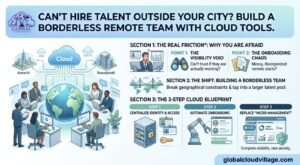
Why Businesses Struggle with Remote Hiring
Many business owners believe they prefer office-based employees.
In reality, they’re worried about control.
Limited Visibility
Managers often ask:
“How do I know someone is actually working?”
Without proper systems, remote work feels uncertain.
The solution isn’t more meetings.
It’s better digital infrastructure.
Poor Remote Onboarding
Many companies hire remote employees but provide no structured onboarding.
New hires spend their first week asking for passwords, software access, and missing documents.
Confusion replaces productivity.
Security Concerns
Company files.
Client information.
Financial reports.
Advertising accounts.
How do you protect sensitive business data when employees work from another city?
Cloud technology solves this challenge through centralized identity management and secure access controls.
Why Remote Hiring with Cloud Tools Changes Everything
Cloud-based businesses hire talent based on skills instead of geography.
Instead of searching within one city, businesses recruit from across Pakistan—or around the world.
The result is a significantly larger talent pool.
With a cloud-first workplace:
- Location becomes irrelevant.
- Work is measured by outcomes instead of attendance.
- Company data stays inside secure cloud platforms.
- Teams collaborate from anywhere.
This isn’t simply remote work.
It’s a smarter way of building businesses.
Three Steps to Successful Remote Hiring with Cloud Tools
Step 1: Secure Devices with Cloud Management
Every remote employee should receive a properly configured company device.
Cloud-based endpoint management solutions such as Microsoft Intune or Google Endpoint Management allow businesses to:
- Control software installation
- Enforce security policies
- Require multi-factor authentication
- Remotely lock lost devices
- Erase company data when employment ends
Security no longer depends on physical office walls.
Step 2: Automate Employee Onboarding
Great onboarding begins before the employee’s first day.
Cloud platforms automatically create:
- Company email accounts
- Microsoft Teams or Slack access
- Shared calendars
- Project management accounts
- Cloud document permissions
Employees become productive immediately.
Step 3: Measure Results Instead of Attendance
Remote teams don’t need hourly check-ins.
They need clear deliverables.
Cloud project management platforms such as ClickUp, Asana, Jira, or Monday.com provide complete visibility into:
- Assigned work
- Deadlines
- Progress
- Accountability
Managers stop asking whether people are working.
The work speaks for itself.
Real Business Example
A software company based in Peshawar struggled for months to recruit experienced UI and UX designers locally.
Growth slowed.
Projects became delayed.
After implementing a cloud-first recruitment model, the company expanded hiring nationwide.
Within three weeks they recruited:
- A Senior UI Designer from Karachi
- Two Software Developers from Faisalabad
The results were impressive.
- Vacant positions filled in 21 days
- Project delivery improved by 15%
- Revenue increased by 40% within two quarters
The company didn’t simply hire remotely.
It removed geography from its hiring strategy.
The Benefits of Remote Hiring with Cloud Tools
Modern SMEs gain several competitive advantages.
Access to Better Talent
Hire the best candidate rather than the closest candidate.
Faster Recruitment
Larger talent pools reduce hiring time significantly.
Lower Operating Costs
Reduced office space.
Lower utility bills.
Less equipment duplication.
Better Employee Satisfaction
Remote flexibility improves retention and work-life balance.
Business Continuity
Cloud-based teams continue working during weather disruptions, transport issues, or office outages.
Building Your Cloud-Based Hiring Framework
Successful remote hiring begins with planning.
Week 1
Select your cloud platform.
Set security policies.
Configure identity management.
Week 2
Prepare digital onboarding.
Create employee documentation.
Build training materials.
Week 3
Implement collaboration tools.
Set communication standards.
Launch project management workflows.
Week 4
Recruit nationally.
Measure productivity.
Improve continuously.
The goal isn’t simply remote work.
The goal is building a location-independent business.
Why Remote Hiring with Cloud Tools Is the Future
The best employee for your business may never live in your city.
They don’t need to.
Cloud technology has removed geographical barriers.
Businesses that embrace remote hiring gain access to larger talent pools, stronger teams, and greater flexibility.
Businesses that continue hiring only within commuting distance will increasingly struggle to compete.
Final Thoughts on Remote Hiring with Cloud Tools
Talent is everywhere.
Opportunity shouldn’t depend on geography.
Remote Hiring with Cloud Tools helps SMEs build secure, productive, and scalable teams without sacrificing visibility or control.
Whether you’re hiring your first remote employee or building a distributed workforce across Pakistan, cloud technology provides the infrastructure needed to succeed.
If you want practical onboarding frameworks, cloud security checklists, hiring templates, and implementation guides designed specifically for SMEs, explore the complete Global Cloud Village book.
Get the Book
Global Cloud Village includes remote hiring frameworks, cloud workplace implementation plans, security checklists, digital collaboration strategies, and practical case studies for small and medium-sized businesses.
Available now on Amazon Kindle:
https://www.amazon.com/dp/B0H3SF414R
Frequently Asked Questions
Is remote hiring suitable for SMEs?
Yes. Modern cloud tools make remote hiring affordable, secure, and manageable for businesses of all sizes.
Which cloud tools are recommended?
Microsoft 365, Google Workspace, Microsoft Intune, ClickUp, Asana, Jira, Slack, Microsoft Teams, and Notion are popular choices.
How can businesses protect company data?
Using company-managed devices, cloud identity management, role-based permissions, and endpoint security significantly reduces risk.
Can remote employees remain productive?
Yes. Businesses that measure outcomes through cloud project management often experience equal or higher productivity than traditional office environments.
Suggested Internal Links
- Books
- Global Cloud Village
- Cloud Computing
- Digital Transformation
- Remote Work
- Business Strategy
- Leadership
- Contact
External References
- Microsoft Intune
- Microsoft 365
- Google Workspace
- ClickUp
- Asana
- Atlassian Jira
- Notion
- Gartner Future of Work Research