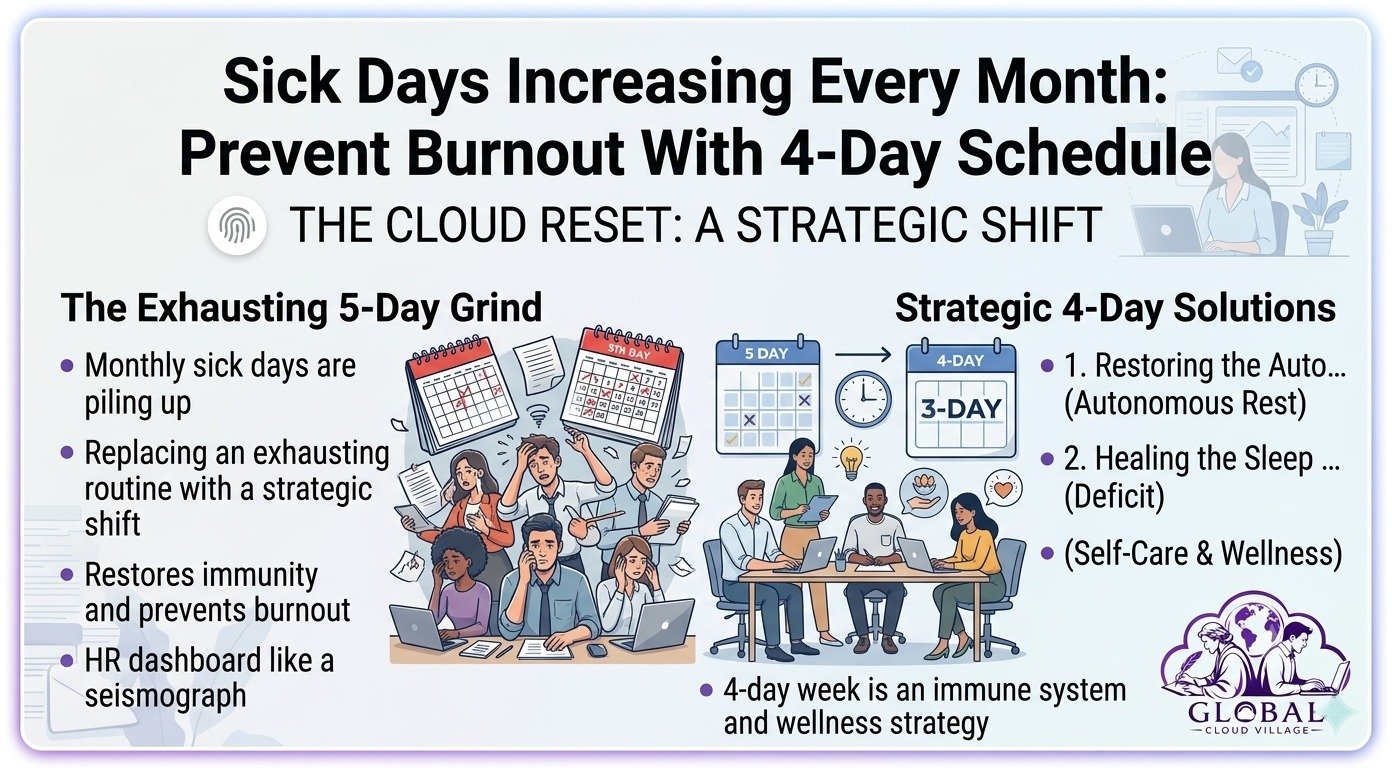
Sick Days Increasing Every Month: Prevent Burnout With 4-Day Schedule
It started in January with a mild sinus infection for the head of customer success. By February, two data analysts were out with debilitating migraines. By March, half the engineering department was rotating through mysterious bouts of insomnia, stress-induced stomach flus, and a general, bone-deep exhaustion that employees sheepishly referred to as “just feeling under the weather.”
The HR dashboard looked like a seismograph during an earthquake. The curve of sick leave requests wasn’t just climbing; it was vertical.
When the CEO called an emergency meeting with the people operations lead, the diagnosis was immediate and superficial: “Must be a bad flu season. We should send out another memo about handwashing and ergonomics.”
They ordered standing desks and stocked the virtual pantry with wellness app subscriptions. They encouraged people to take a five-minute stretch break between video calls. Yet, come April, the sick days ticked upward again.
Here is the uncomfortable truth that wellness memos and ergonomic chairs cannot hide: you cannot medicate away a structural exhaustion.
The physical ailments draining your team—the migraines, the IBS flare-ups, the compromised immune systems, the crushing mental fatigue—are not random acts of biology. They are the body’s physical rebellion against an unsustainable lifestyle. When organizations push human beings past their biological limits week after week, the body eventually pulls the emergency brake.
If your sick days are increasing every month, stop looking at the pharmacy and start looking at the calendar. The most powerful preventative medicine for organizational burnout isn’t a wellness stipend—it is a 4-day work schedule.
The Biology of Breakdown
To understand why sick days multiply in a toxic work culture, we have to look at what chronic stress does to the human organism.
When you face a short-term crisis—a difficult client, a tight deploy, an unexpected bug—your sympathetic nervous system triggers the fight-or-flight response. Adrenaline and cortisol surge through your veins. Your heart rate accelerates, your blood pressure rises, and your immune system suppresses non-essential functions to deal with the immediate threat. This is a brilliant evolutionary design for outrunning a predator.
But what happens when the predator doesn’t go away? What happens when Monday’s crisis rolls into Tuesday’s meeting, which rolls into Wednesday’s deadline, which bleeds into the weekend?
The body stays in a chronic state of emergency activation. Cortisol levels remain elevated for months on end. And here is where the machinery breaks down: chronic high cortisol is toxic to the immune system. It causes systemic inflammation, disrupts sleep architecture, erodes digestive health, and leaves the body defenseless against pathogens.
An employee working 50+ hours a week in a high-stress, boundary-free environment isn’t just tired; their immune system is essentially working the night shift in a hazmat zone without a mask.
So when a mild cold circulates through the office or the household, the burned-out employee doesn’t fight it off in 48 hours. Their body crashes. A simple sniffle turns into a five-day sinus infection. A headache turns into a migraine that puts them in a dark room with an ice pack. They aren’t faking it. Their biological machinery has simply run out of buffer capacity.
The False Economy of Presenteeism and Sick Leave
Most companies track absenteeism—the days people actually call in sick. But they rarely calculate the hidden financial bleed of presenteeism: the days employees drag their sick, exhausted bodies to work anyway.
They show up with a fever, staring blankly at a spreadsheet, coughing into their elbow during a Zoom call, and typing at half-speed. They aren’t producing value; they are occupying space and spreading their viral load (and their demoralizing energy) to everyone else on the team.
Why do they do it? Because they feel guilty. They look at the backlog of unread emails and fear the judgment of a manager who equates physical absence with a lack of dedication.
This creates a vicious, compounding cycle:
- The employee works while exhausted to clear the backlog.
- The immune system collapses under the weight of chronic stress.
- The employee finally breaks down and takes three sick days.
- Work piles up during their absence.
- Employee returns, sees the mountain of work, and immediately overworks to catch up, triggering the next collapse.
It is an infinite loop of biological degradation. And no amount of corporate yoga classes or fruit baskets in the breakroom is going to fix a loop that is fundamentally powered by time deprivation.
The 4-Day Reset: How 32 Hours Heal the Body
When forward-thinking organizations transition to a 4-day workweek, the most immediate and shocking metric to drop isn’t just turnover—it’s sick leave utilization.
In major global trials of the 4-day workweek, researchers recorded dramatic drops in reported illness and burnout symptoms. Employees didn’t just feel happier; they visited the doctor less often, reported fewer musculoskeletal pains, and experienced significant drops in anxiety and sleep disturbances.
How does an extra day off each week achieve what modern medicine struggles to treat?
1. Restoring the Autonomic Nervous System
An extra 24 hours of uninterrupted recovery allows the body to downshift from the sympathetic (fight-or-flight) state to the parasympathetic (rest-and-digest) state. Cortisol levels normalize. Blood pressure stabilizes. The immune system is given the downtime it desperately needs to repair cellular damage and manufacture antibodies.
2. Healing the Sleep Deficit
Chronic sleep deprivation is the cornerstone of modern morbidity. When people work five long days, their evenings are spent recovering from work rather than sleeping—they stay up late doom-scrolling or watching TV just to claw back a sense of personal time (a phenomenon sleep psychologists call bedtime procrastination). A 4-day schedule gives people a full night of deep sleep on Thursday night, followed by two more nights of biological restoration, resetting their circadian rhythm.
3. Proactive Self-Care Time
When you have a three-day weekend, you can actually schedule your dentist appointments, preventative physicals, mental health therapy sessions, and grocery shopping without having to sneak away from a desk or work until midnight to make up the hours. Preventive care becomes accessible rather than a logistical nightmare.
The Cultural Shift: Making Health Non-Negotiable
Implementing a 4-day schedule as a health intervention requires leadership to stop treating employee well-being as a PR talking point and start treating it as an operational constraint.
When Global Cloud Village consulted with a mid-sized fintech firm struggling with chronic absenteeism, we instituted a “health-first workflow audit.” We found that employees were spending their evenings answering non-urgent client pings, destroying their sleep cycles.
The fix wasn’t complicated, but it required spine:
- The Digital Sunset: At 5:00 PM every Thursday, all internal communication channels enter a quiet mode until Monday morning. No exceptions for “just one quick message.”
- No Catch-Up Guilt: Employees returning from a day off or a sick leave are given explicit permission to archive low-priority notifications rather than panicking.
- Redefining Productivity: Managers were coached to celebrate when an employee logged off on time, rather than rewarding the martyr who works through a fever.
Within four months of transitioning to the 4-day model, the fintech firm’s monthly sick leave claims dropped by over 45%. The HR director noted that the office vibe shifted from a triage ward to a high-performance creative studio.
Conclusion: Reclaiming Human Vitality
Your employees are not disposable batteries that you can drain, throw away, and replace with a fresh batch from the university hiring pool. They are living, breathing human beings whose biological architecture requires balance to function at its peak.
When you refuse to give them the time to heal, they will take it in the form of sick days, mental health leaves, and diminished capacity. You can pay for their recovery on the front end by structuring a humane, focused 4-day work schedule, or you can pay for their collapse on the back end through lost productivity, insurance claims, and constant turnover.
The choice is clear. Stop waiting for the sick leave graph to flatten on its own. Give your team the time to rest, and watch their vitality—and your business—come back to life.
Frequently Asked Questions About 4-Day Schedules and Health
How does a 4-day workweek reduce physiological stress markers like cortisol?
An extra day of uninterrupted downtime gives the autonomic nervous system adequate time to shift from a sympathetic stress response to parasympathetic recovery, lowering chronic inflammation and stabilizing hormone production.
Will cutting a day off the work schedule cause a backlog of unread emails that stresses employees out upon return?
Not if you establish strict async communication protocols and boundary enforcement. The goal of the schedule change is to eliminate unnecessary noise so that tasks are completed efficiently within the 4-day window without creating a toxic backlog.
Can healthcare or customer support departments utilize a health-focused 4-day schedule?
Yes. Organizations use rotation and cohort models where staff split coverage, ensuring that client or patient needs are fully met while individual employees still receive a consistent 3-day recovery block every week.
What is the best way to track the health impact of a 4-day transition?
Monitor monthly absentee metrics, health insurance claim volumes, and anonymous employee pulse surveys tracking sleep quality and energy levels before and after implementation.
Ready to Protect Your Team’s Health and Productivity?
Stopping chronic absenteeism and building a vibrant, healthy workforce is the vital step toward sustainable enterprise performance. Discover the complete human-centric blueprint for modern operational efficiency.
Get your copy of Global Cloud Village and 4 Day Work Week on Amazon:
About the Author: Global Cloud Village
Global Cloud Village translates complex digital tech systems into clear, human-centric strategies for growing SMEs, founders, and industry leaders. We help businesses replace clunky, fragmented legacy habits with automated, high-adoption cloud architectures that protect data and build operational scale. Explore our optimization insights at globalcloudvillage.com.