Climate & Environment for SMEs:
How Digital Transformation Reduces Costs and Builds Sustainable Businesses
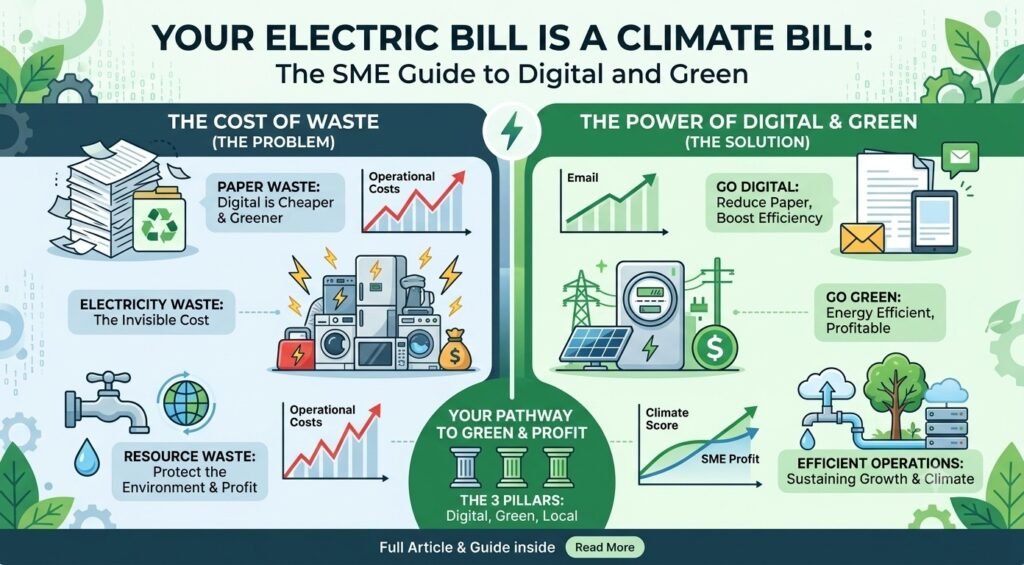
Why Climate & Environment for SMEs Starts with Your Electricity Bill
Let me tell you about a bill.
Not a client invoice.
An electricity bill.
It was July. The temperature outside had crossed 42°C.
The office air conditioners were running all day.
A server in the corner hummed 24 hours a day, even when nobody was working.
Printers stayed powered on.
Lights remained on in empty rooms.
Laptop chargers were plugged in overnight.
The monthly electricity bill arrived.
PKR 85,000.
The owner blamed rising fuel prices.
But fuel wasn’t the whole story.
Most of that bill represented wasted energy.
And wasted energy isn’t just an environmental issue.
It’s a business problem.
It’s a profitability problem.
That’s exactly why I wrote Climate & Environment for SMEs. Sustainability isn’t only for multinational corporations. Every business that pays electricity bills, buys office supplies, prints documents, or operates inefficiently has an opportunity to become greener while saving money.
Why Climate & Environment for SMEs Is a Business Strategy
Many people think climate change only affects governments, large manufacturers, or global corporations.
For SMEs, climate change appears in three practical ways.
Rising Operating Costs
Every unnecessary kilowatt of electricity, every unnecessary printed page, and every wasted litre of fuel reduces business profits.
Lower waste means healthier margins.
Increasing Business Risks
Heatwaves interrupt operations.
Floods damage inventory.
Power outages delay production.
Businesses that rely on perfect operating conditions become increasingly vulnerable.
Changing Customer Expectations
Large companies are beginning to ask suppliers about sustainability practices and carbon emissions.
Banks and investors are also paying closer attention.
In the coming years, sustainability will become part of doing business rather than an optional initiative.
The question isn’t whether climate change matters.
The question is whether your business is prepared.
The Four Silent Profit Leaks Every SME Should Eliminate
One of the biggest lessons in Climate & Environment for SMEs is recognizing hidden operational waste.
Energy Waste
Many businesses continue running office servers around the clock despite operating only eight or nine hours each day.
Older air conditioners, desktop computers, and unnecessary lighting quietly increase monthly expenses.
Every hour of wasted electricity reduces profits.
Paper Waste
Invoices.
Contracts.
Meeting notes.
Approval forms.
Many businesses continue printing documents that could easily remain digital.
Digital information is easier to organize, search, secure, and reuse.
Paper often ends up in storage or the recycling bin.
Travel Waste
How many meetings could have been a video call?
How many client visits ended with sharing a PDF presentation?
Remote collaboration saves both time and fuel while reducing operating costs.
Digital Waste
Unused software subscriptions.
Duplicate files.
Old hardware replaced too early.
Poor digital management increases costs without creating additional value.
Cloud-based systems often eliminate much of this unnecessary expense.
Climate & Environment for SMEs and the Power of Cloud Computing
One of the central ideas in Climate & Environment for SMEs is that digital transformation supports environmental sustainability.
Cloud technology reduces waste in several ways.
Less Office Hardware
Instead of maintaining local servers, businesses can use professionally managed cloud infrastructure designed for maximum efficiency.
Less Commuting
Allowing employees to work remotely one day each week reduces fuel consumption while improving work-life balance.
Less Paper
Digital invoices.
Electronic approvals.
Online document management.
Cloud collaboration naturally reduces paper usage throughout the business.
Cloud computing is often the simplest and most affordable environmental improvement an SME can make.
Can One Small Business Really Make a Difference?
Many business owners ask this question.
The answer is yes.
If one SME reduces electricity consumption by just 20 percent, the annual environmental impact is meaningful.
Multiply that improvement across millions of SMEs worldwide and the result becomes transformational.
More importantly, customers increasingly value businesses that demonstrate operational responsibility.
Sustainability has become a competitive advantage rather than simply a marketing message.
The Three Pillars of Climate & Environment for SMEs
The book introduces a simple framework that any business can begin implementing immediately.
Digital First
Move paper-based processes online.
Invoices.
Employee records.
Client proposals.
Purchase approvals.
Digital workflows reduce costs while improving productivity.
Energy Smart
Start with simple improvements.
- Turn equipment off after business hours.
- Replace local servers with cloud services.
- Upgrade to energy-efficient laptops.
- Encourage remote work where appropriate.
Small changes often produce immediate savings.
Waste Conscious
Before purchasing anything, ask three questions.
- Do we really need it?
- Can we reuse it?
- Can this be digital instead?
This mindset reduces unnecessary spending across the business.
A Real SME Success Story
One case study featured in Climate & Environment for SMEs follows a printing business employing eighteen people.
Although printing remained their core service, they successfully reduced waste by modernizing internal operations.
They implemented three simple improvements.
- Client proofs moved entirely online.
- Printers defaulted to double-sided printing.
- Design staff worked remotely two days each week.
After ninety days:
- Electricity costs fell by 28%.
- Paper expenses dropped by 35%.
- Employees reported lower stress and higher productivity.
The business didn’t become an environmental organization.
It became a more efficient and profitable company.
Why Climate & Environment for SMEs Matters More Than Ever
The next decade will bring significant business challenges.
Energy prices will continue changing.
Extreme weather events will become more common.
Customers will increasingly evaluate suppliers based on sustainability practices.
Businesses that begin adapting today will gain a competitive advantage.
Those that delay may face higher costs and greater disruption later.
How to Start Your Green Business Journey
You don’t need expensive equipment or major investments.
Start with measurable improvements.
Measure
Track monthly spending on electricity, fuel, paper, and printing.
Identify your largest sources of waste.
Digitize
Choose one paper-based business process and move it completely online.
Reduce
Conduct a simple energy audit.
Switch equipment off.
Use cloud services.
Encourage occasional remote work.
Communicate
Share genuine improvements with customers.
Authenticity builds trust far better than exaggerated environmental claims.
Final Thoughts on Climate & Environment for SMEs
Climate & Environment for SMEs isn’t simply about protecting the environment.
It’s about building stronger businesses.
Reducing waste lowers costs.
Digital transformation improves efficiency.
Smarter operations increase profitability.
Sustainability isn’t about perfection.
It’s about making better decisions every day.
Businesses that become more efficient today will be more competitive tomorrow.
If you’re ready to reduce costs, improve operations, and build a business prepared for the future, Climate & Environment for SMEs provides practical frameworks, real-world examples, implementation checklists, and step-by-step guidance.
You can explore the book and start reading on Amazon Kindle:
https://www.amazon.com/dp/B0H3SF414R
Frequently Asked Questions
Is Climate & Environment for SMEs only for manufacturing businesses?
No. Every SME can reduce waste, improve efficiency, and lower operating costs regardless of industry.
Will becoming more sustainable increase business costs?
Many improvements require little or no investment and often reduce operating expenses immediately.
What’s the easiest first step?
Track electricity, fuel, paper, and printing costs for one month. These figures usually reveal the biggest opportunities for savings.
Is cloud computing environmentally friendly?
Modern cloud infrastructure is generally far more energy efficient than maintaining individual office servers, while also improving security, collaboration, and scalability.