Employees Secretly Job Hunting: Keep Them With a Better Schedule
It doesn’t happen with a dramatic confrontation or an angry letter left on your desk. The quiet disengagement of a valued team member always arrives in micro-behaviors that are easy to miss if you aren’t paying attention.
Dave minimizes his browser window with lightning speed every time you walk past his desk. Sarah’s LinkedIn profile suddenly shows her status updated to “Open to Work” behind a privacy filter, and her camera has remained suspiciously turned off during the last three routine project syncs because she’s taking interview calls in her kitchen.
When you ask them how things are going, they offer the standard, sanitized corporate reassurance: “Oh, everything is great! Just working through the Odoo migration backlog.”
They aren’t telling you the truth. Underneath the polite exterior, they are spending their Tuesday lunch breaks scrolling through remote job boards, tweaking their resume bullets, and planning their quiet exit strategy.
When leaders discover an employee was secretly job hunting, they feel a sharp sting of betrayal. We assume the person was simply tempted by a bigger paycheck elsewhere. We scramble to counter-offer after the damage is already done, tossing money at a candidate who has already mentally checked out of our ecosystem.
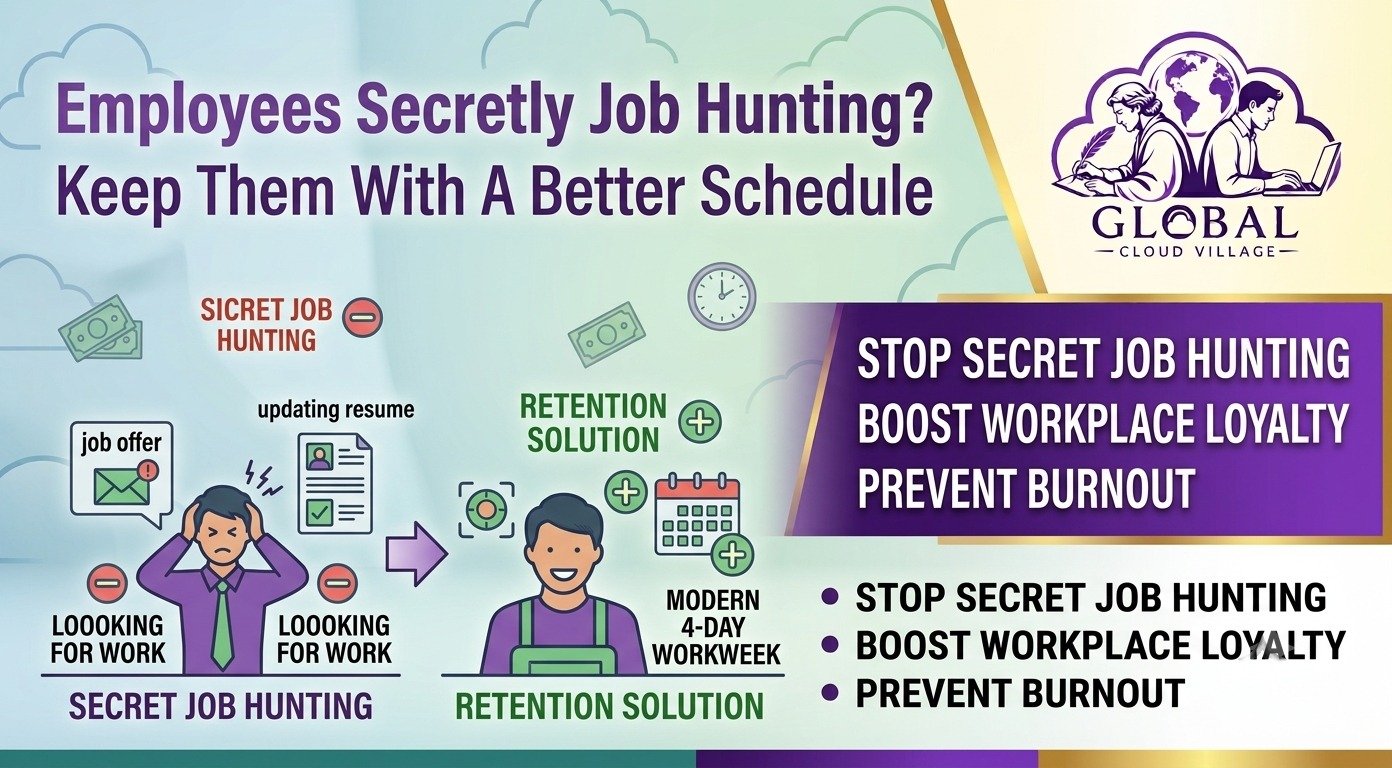
Here is the uncomfortable reality: people do not secretly hunt for jobs when they feel respected, rested, and fulfilled. They look for the exit when their current environment slowly drains their life force without offering a pathway to balance.
If you suspect your best people are quietly updating their resumes, stop waiting for the resignation letter. The ultimate antidote to secret job hunting isn’t a higher salary—it is a better, more human schedule anchored by a 4-day workweek.
The Psychology of the Quiet Exit (Employees Secretly Job Hunting)
Secret job hunting is an adaptive survival tactic. When an employee feels that their workload is crushing their personal time, their first instinct isn’t to complain to a busy manager—they know from experience that complaining usually results in more work or empty validation.
Instead, they withdraw their emotional investment. They enter what organizational psychologists call the detachment phase.
In this phase, the employee stops going the extra mile. They stop pointing out structural flaws in your deployment pipelines. They complete their baseline tasks with cynical, robotic compliance and reserve their true creative energy for their evening job applications.
Why do they keep it a secret? Because they are protecting their current paycheck while they test the market. They know that revealing their dissatisfaction prematurely makes them a target for early layoffs or unnecessary management friction.
The tragic part is that many of these employees want to stay. They like your team, they care about the projects they built, and they don’t want the friction of starting over at an unknown company with a new set of politics. But the math of their exhaustion eventually breaks their loyalty. When forced to choose between your endless 5-day grind and their personal sanity, their sanity wins every single time.
The 4-Day Antidote: Making Leaving Unnecessary
When forward-thinking organizations transition to a structured 4-day workweek (100% of the pay for 80% of the time, driven by rigorous output expectations), they perform a powerful psychological reset on the entire team.
An extra day of uninterrupted personal recovery changes the equation of employment:
- Restoring Personal Sovereignty: When employees receive 52 extra days a year to live their lives, pursue creative passions, or simply rest, the ambient desperation that drives them to browse job boards at midnight vanishes. They realize they don’t need to jump ship to find a humane existence.
- Demonstrated Institutional Care: You cannot demand loyalty with corporate pizza parties or empty wellness memos. Loyalty is reciprocal. When an organization hands back time to its workforce, it demonstrates real, tangible respect for human well-being.
- Pruning Administrative Bloat: A 4-day week forces a company to kill meandering meetings and messy communication habits. By removing the daily friction that drains cognitive energy, work becomes deeply satisfying rather than a chaotic chore.
Closing the Revolving Door
Stopping secret job hunting before it turns into a stack of resignation letters requires shifting your leadership strategy from surveillance to optimization.
- Listen to the Silence: If your team has gone quiet during retrospectives or Slack interactions have become rigidly performative, treat it as a warning sign. Do not wait for the exit interview to find out your culture is exhausting them.
- Redefine the Contract: Introduce time autonomy as a core operational strategy. Show your team that you measure their value by their finished deliverables during a focused 4-day schedule, not by how many hours they warm a chair.
- Protect the Rest Day: Make the fifth day sacred. If your team has to log in on their day off to handle client pings, your schedule isn’t a 4-day week—it’s a compressed panic attack. Total disconnection is what restores loyalty.
Conclusion: Building a Place People Want to Stay
You can continue playing detective, monitoring activity statuses, and wondering why your best people quietly vanish every twelve months. Or you can build an operational environment that makes leaving you an unappealing downgrade.
Give your team their time back, clean up your internal processes, and watch how quickly the secret job hunting stops when your workplace is the best place for them to grow and live.
Ready to Navigate Your Digital Transition with Absolute Certainty?
Escaping legacy software vulnerabilities and building a high-retention, human-centric organization is the vital final step toward reclaiming your operational momentum. Discover the complete blueprint for running a highly productive enterprise without technical roadblocks.
Get your copy of Global Cloud Village and 4 Day Work Week on Amazon:
About the Author: Global Cloud Village
Global Cloud Village translates complex digital tech systems into clear, human-centric strategies for growing SMEs, founders, and industry leaders. We help businesses replace clunky, fragmented legacy habits with automated, high-adoption cloud architectures that protect data and build operational scale. Explore our optimization insights at globalcloudvillage.com.