Client Communication Template: How to Explain a 4-Day Workweek
Marcus stared at his screen, looking at an email from one of his agency’s biggest enterprise clients.
His company had recently moved to a compressed four-day, 32-hour workweek. Internally, the transition was going well. The team had more focused working time, fewer unnecessary interruptions, and better energy throughout the week.
Then an urgent client request arrived late on Thursday afternoon.
Under the previous five-day schedule, Marcus’s team would probably have stayed late and delivered the request on Friday morning.
Under the new operating model, Friday was a scheduled non-working day.
Marcus immediately worried about the client’s reaction.
Would the client think the agency was less committed?
Would they interpret the four-day workweek as reduced availability?
Could the change affect the relationship?
These concerns are common when service businesses introduce a four-day workweek.
The challenge is not simply changing the company’s schedule.
It is communicating the change clearly enough that clients understand what will remain the same, what will change, and how urgent requests will be handled.
A strong Client Communication Template can help businesses establish those expectations before misunderstandings occur.
Why Client Communication Matters During a 4-Day Workweek
Clients usually need predictability.
They want to know:
- When can they contact your team?
- When will they receive a response?
- When will projects be delivered?
- How are urgent requests handled?
- Who should they contact if something goes wrong?
- Will existing service levels change?
A four-day workweek does not automatically answer these questions.
That is why communication should happen before the new schedule begins.
The objective is not to apologize for the change.
It is to clearly explain the new operating model and demonstrate that service quality, accountability, and delivery remain important.
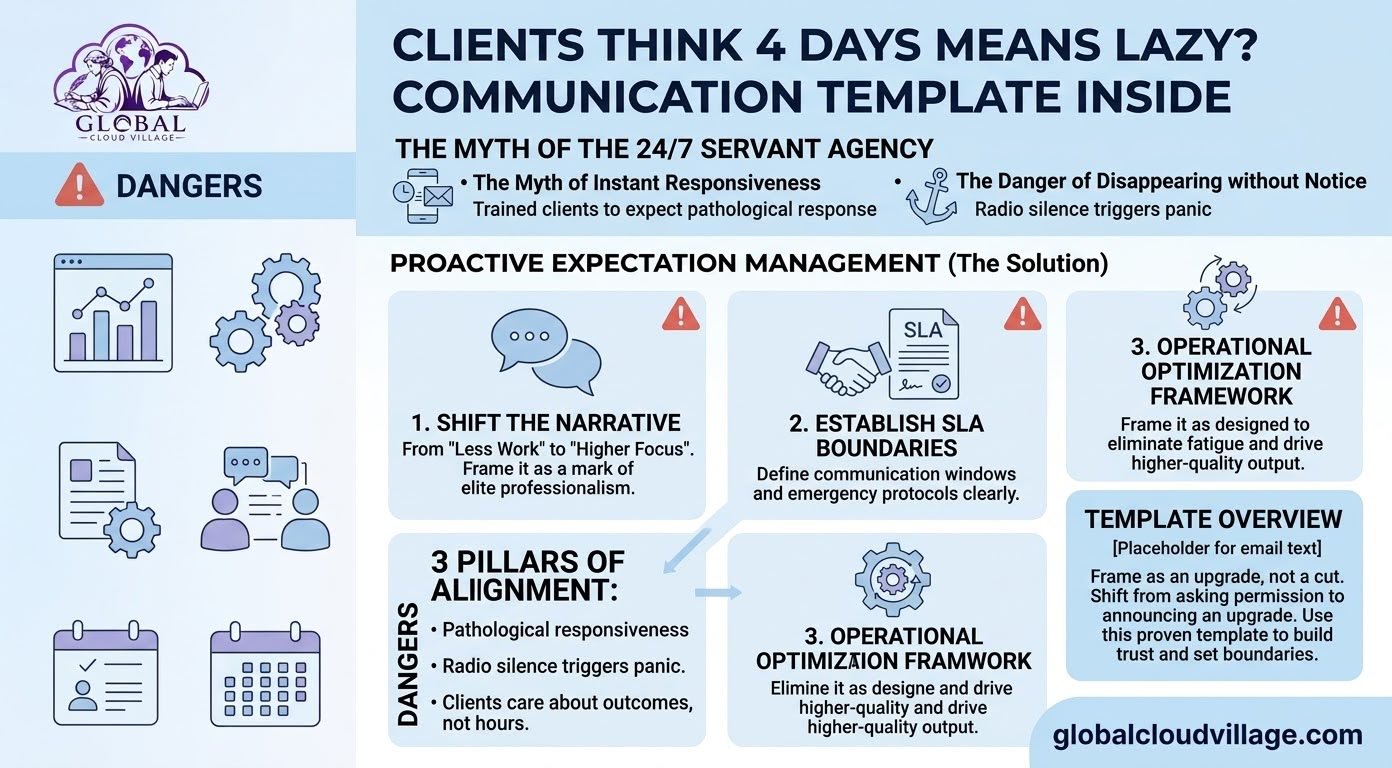
The Myth of the 24/7 Service Provider
Some businesses unintentionally train clients to expect constant availability.
An email receives a response at 9:00 PM.
A weekend message receives an immediate reply.
A minor request is treated as an emergency.
Over time, this creates an expectation that availability equals commitment.
The problem becomes obvious when the company introduces a four-day workweek.
If clients have been accustomed to receiving responses at any time, a sudden change in availability can feel like a service reduction.
The solution is not necessarily to return to constant availability.
The solution is to establish clear expectations.
A professional service business can communicate:
- Standard working hours
- Expected response times
- Project delivery schedules
- Emergency procedures
- Communication channels
- Escalation processes
This creates predictability for both sides.
Reframe the 4-Day Workweek Around Service Quality
The way a four-day workweek is introduced matters.
Businesses should avoid making the announcement sound like:
“We are working less, so please wait until Monday.”
Instead, explain the operational purpose.
For example:
“We are introducing a four-day operating framework designed to create more focused working time, reduce unnecessary interruptions, and maintain high-quality project delivery.”
This communicates that the schedule is part of an operating model rather than simply an additional day off.
However, businesses should avoid making guarantees they cannot support.
A four-day workweek does not automatically produce better results.
The important point is to explain how the organization has adjusted workflows, responsibilities, response windows, and project planning to support the new schedule.
Three Rules for Client Alignment
1. Focus on Outcomes, Not Hours
Clients generally care about the work being delivered rather than the number of hours employees spend at their desks.
Your communication should therefore emphasize:
- Deliverables
- Project milestones
- Service quality
- Response expectations
- Communication channels
- Accountability
For example:
Instead of saying:
“Our team is working fewer hours.”
Say:
“We are restructuring our operating schedule around focused four-day delivery while maintaining clear project milestones and agreed service expectations.”
This keeps the conversation focused on business outcomes.
2. Define Clear Service Boundaries
Clients become uncomfortable when they do not know what happens after the new schedule begins.
Provide specific information about:
- Working days
- Working hours
- Standard response times
- Project communication
- Urgent requests
- Emergency escalation
If your company operates Monday through Thursday, make that clear.
If certain clients require Friday support, explain whether an on-call arrangement or alternative process exists.
Do not create an emergency policy that your business cannot realistically maintain.
3. Communicate Before the Transition
Do not wait until the first Friday closure to tell clients about the new schedule.
Advance communication gives clients time to ask questions and adjust their own planning.
The exact notice period will depend on the client relationship, contract, industry, and service requirements.
For established clients, providing several weeks of notice can give account managers enough time to discuss any concerns and update project schedules.
The Exact Client Communication Template
The following Client Communication Template can be adapted for agencies, consultancies, professional service companies, technology firms, and other businesses moving toward a four-day workweek.
Dear [Client Name],
At [Your Company Name], we regularly review how we work so we can deliver consistent, high-quality results for our clients.
As part of this process, we are introducing an optimized 4-day operating framework, effective [Date].
Our standard operating hours will be Monday through Thursday, from [Insert Hours].
What This Means for You
Focused Delivery: Our team will organize project work around clearly defined priorities, milestones, and deadlines.
Clear Communication: Your usual communication channels will remain available during our standard operating hours, with response expectations clearly defined.
Project Continuity: Existing project milestones, scheduled meetings, and agreed deliverables will continue to be managed through our normal workflow.
Transparent Support: For urgent matters, please use [Insert Emergency Contact or Process]. Requests received outside our standard operating hours will be handled according to the agreed response process.
We believe this operating model will help us create more focused working time while maintaining the service standards and accountability you expect from us.
If you have any questions about how the new schedule affects your projects, please contact [Account Manager Name] at [Contact Details].
Thank you for your continued trust and partnership.
Best regards,
[Your Name]
[Your Title]
[Your Company]
Why This Client Communication Template Works
A good announcement should answer the client’s most important questions without creating unnecessary anxiety.
This Client Communication Template focuses on four areas:
Clear Schedule
The client knows when the team is available.
Defined Expectations
The client understands how communication and responses will work.
Continuity
The client is reassured that existing project commitments are still being managed.
Escalation
The client knows what to do if an urgent issue occurs.
This is much more effective than simply announcing that the company will be closed on Fridays.
How Marcus Handled an Urgent Client Request
Instead of ignoring the request or secretly working outside the new schedule, Marcus reviewed the client’s request against the agency’s documented service process.
He responded promptly and clearly:
Hi Sarah, I’ve received your request and understand the urgency. Our data team is completing its scheduled project work ahead of the end of our operating week. I’ve prioritized this audit for Monday morning, and we will begin work at 9:00 AM. I’ll keep you updated through our normal project channel.
The important part of the response was not the exact wording.
It was the clarity.
The client knew:
- The request had been received.
- The team understood the requirement.
- The work had an owner.
- A specific start time had been established.
- The request had not disappeared.
This is the foundation of good client communication during a four-day workweek.
What If the Client Needs Friday Support?
Not every business can operate without Friday coverage.
Some industries have:
- Time-sensitive customer support
- International clients
- Critical infrastructure
- Financial deadlines
- Healthcare requirements
- Emergency services
- Contractual response obligations
In these cases, the business may need a different model.
Possible approaches include:
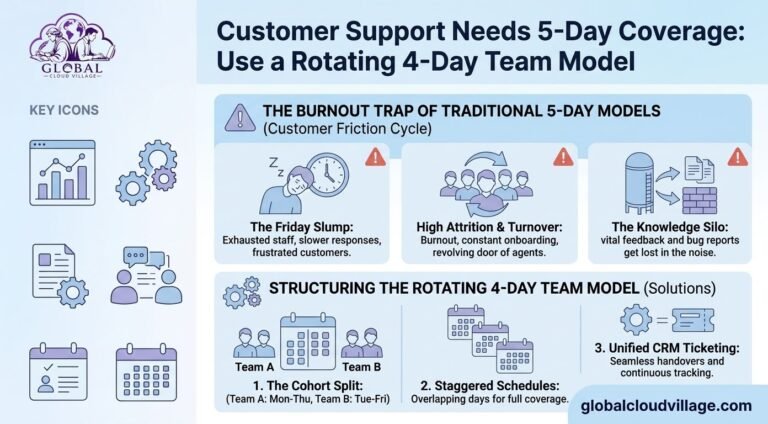
Rotating Coverage
A designated team member handles genuinely urgent requests according to an agreed schedule.
Staggered Working Days
Different employees take different non-working days while maintaining overall service coverage.
Automated Support
Chatbots, ticketing systems, knowledge bases, and automated notifications can handle routine requests outside standard hours.
Defined SLA Coverage
Contracts can specify response times and escalation procedures without requiring the entire team to work five days.
The right model depends on the business and its contractual obligations.
Use Technology to Support Client Transparency
A four-day workweek becomes easier to manage when clients have visibility into their projects.
Useful systems can include:
- Client portals
- CRM platforms
- Project management software
- Shared dashboards
- Automated ticketing
- Task management systems
- Cloud document systems
For example, a client portal can show:
- Project status
- Completed milestones
- Pending approvals
- Upcoming deadlines
- Assigned responsibilities
- Outstanding client actions
This reduces the need for clients to send repeated status requests.
Technology does not replace communication.
It makes important information easier to access.
Step-by-Step Client Communication Plan
1. Audit Your Client Portfolio
Identify clients who may be particularly affected by the schedule change.
Consider:
- Contractual response requirements
- Time zones
- Project deadlines
- Industry requirements
- Existing support arrangements
- Client communication preferences
High-dependency clients may need individual conversations rather than a generic announcement.
2. Review Your Existing Agreements
Before announcing the new schedule, review your contracts and service-level commitments.
Make sure the proposed working model does not conflict with agreed:
- Response times
- Support coverage
- Delivery schedules
- Availability requirements
- Escalation procedures
If changes are required, discuss them with the client before implementation.
3. Send the Communication in Advance
Give clients enough time to understand the change.
Do not make the first announcement on the final working day before the new schedule begins.
Use the Client Communication Template above as a starting point, then personalize it for important accounts.
4. Establish an Emergency Process
Define what actually qualifies as an emergency.
Not every urgent request is a business emergency.
A useful emergency process should identify:
- What qualifies as critical
- Who receives the escalation
- Which communication channel is used
- Expected response time
- Who has decision-making authority
This protects both the client and the team.
5. Monitor Client Feedback
After implementation, review client feedback and service metrics.
Track:
- Response times
- Delivery performance
- Client satisfaction
- Escalation volume
- Missed deadlines
- Support requests
- Renewal or retention indicators
If problems appear, adjust the operating process rather than simply assuming the four-day schedule is responsible.
Common Client Communication Mistakes
Making the Announcement About Employee Benefits
Employee wellbeing can be part of the reason for the change, but the client communication should also explain how service delivery will work.
Promising Perfect Availability
Do not promise 24/7 emergency coverage unless you actually have the resources and processes to provide it.
Being Vague About Response Times
“Someone will get back to you soon” creates uncertainty.
Use clear response windows where appropriate.
Changing the Schedule Without Reviewing Contracts
Existing agreements may contain service requirements that need to be considered before implementation.
Treating Every Client the Same
A local small-business client and a multinational enterprise may have very different service requirements.
Segment your communication where necessary.
Hiding the Change
Trying to quietly change operating hours can create more concern than communicating openly.
Transparency gives clients an opportunity to adjust.
Conclusion: Boundaries Build Client Trust
A four-day workweek does not have to mean poor client service.
It requires a more deliberate approach to communication, scheduling, project management, and expectations.
The goal is not to convince clients that availability does not matter.
The goal is to show them exactly how your business will remain accountable while operating under a new schedule.
A strong Client Communication Template can help you explain:
- When your team works
- When clients can expect responses
- How projects will remain on track
- How urgent requests are handled
- Where clients can access information
- Who to contact when escalation is required
Clients need predictability more than constant access.
When expectations are clear and delivery remains consistent, a four-day workweek can become a structured operating model rather than a source of confusion.
Communicate early. Set clear boundaries. Deliver consistently.
Frequently Asked Questions About Client Communication for 4-Day Workweeks
How do I tell clients about a four-day workweek?
Explain the new schedule, effective date, working hours, communication channels, expected response times, project continuity, and emergency procedures. Focus on how the change will be managed rather than simply announcing an additional day off.
Will clients think a four-day workweek means my business is less committed?
Client reactions will vary. Clear communication can reduce uncertainty by showing exactly when the team is available and how projects and urgent requests will be handled.
How much notice should I give clients?
The appropriate notice period depends on your contracts, industry, client relationships, and operational requirements. For established clients, several weeks can provide useful time for communication and planning.
What should I do if a client demands Friday availability?
First determine whether Friday coverage is contractually or operationally necessary. Depending on the business, options may include rotating coverage, staggered schedules, automated support, or a defined emergency escalation process.
Should I guarantee that project deadlines will never change?
Avoid guarantees that your business cannot realistically support. Instead, communicate agreed milestones, service expectations, escalation procedures, and the processes you use to manage delivery risks.
Can a four-day workweek work with international clients?
It can, but international clients may require additional planning because of time-zone differences. Use clear communication windows, asynchronous project management, shared dashboards, and appropriate coverage where necessary.
Should I mention employee wellbeing in the client announcement?
You can mention employee wellbeing, but the main focus should remain on service delivery, project continuity, communication, and client expectations.
Ready to Optimize Your Team’s Output?
A successful four-day workweek is not simply about changing the calendar.
It requires better processes, clearer communication, stronger boundaries, and reliable visibility.
If your business is considering a four-day operating model, start by reviewing how clients currently communicate with your team, how urgent requests are handled, and which service expectations need to be documented.
Discover more practical strategies for modern business productivity in Global Cloud Village and 4 Day Work Week.
You can also explore the author’s work through the Amazon Author Profile.
About the Author
Global Cloud Village translates complex digital technology systems into clear, human-centric strategies for growing SMEs, founders, and industry leaders.
The platform explores cloud technology, automation, digital transformation, productivity, data-driven management, and modern workplace strategies that help businesses replace fragmented processes with scalable systems.