ERP-CRM Digital World for SMEs: Why Your Business Runs on Sticky Notes and Hope
Why ERP-CRM Digital World for SMEs Starts with Everyday Business Chaos
It’s the last week of the month.
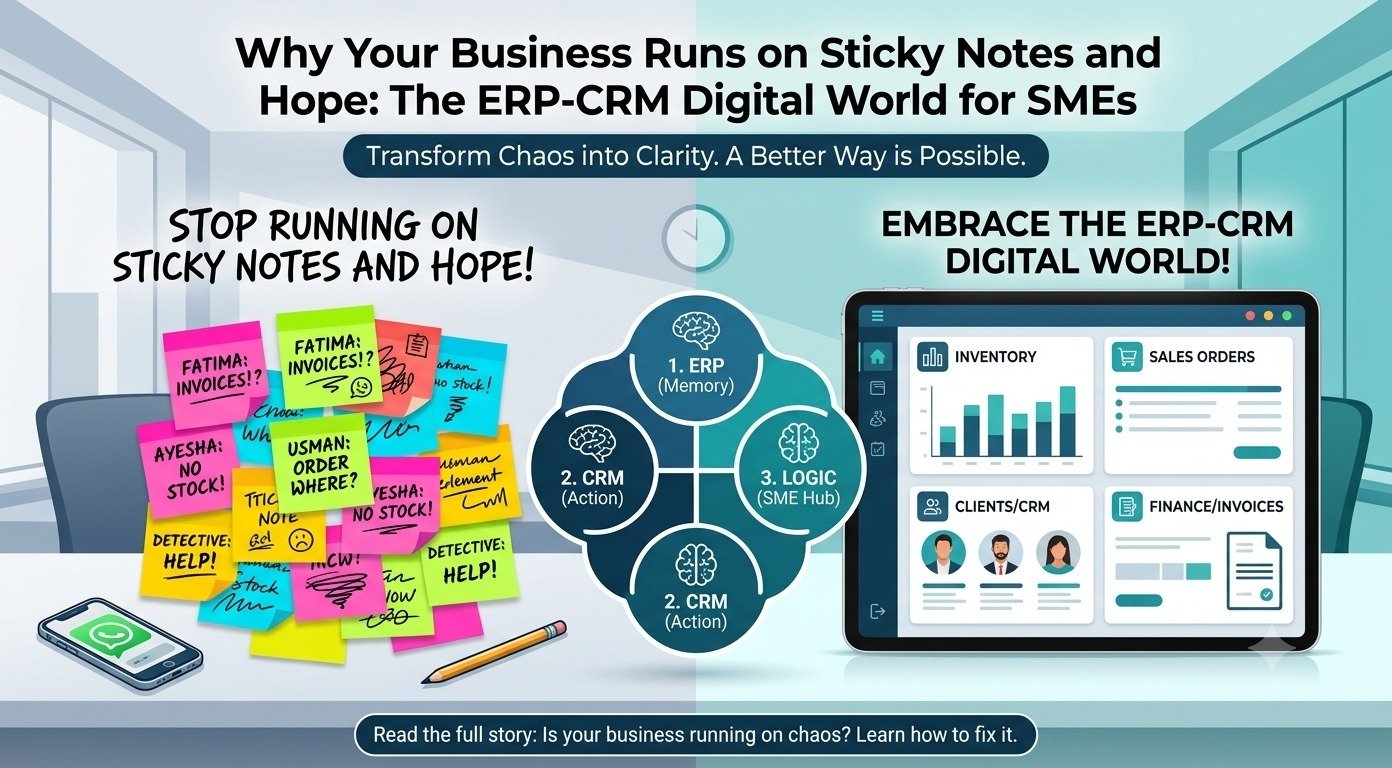
Your finance team is chasing invoice numbers through WhatsApp.
Your salesperson is trying to answer a customer asking where their order is.
Your inventory manager discovers your best-selling product is out of stock.
Meanwhile, you’re answering everyone’s questions because no one has the complete picture.
If this sounds familiar, you’re not alone.
I’ve seen businesses across industries experience the same challenge.
The problem isn’t your people.
The problem is disconnected systems.
That’s why I wrote ERP-CRM Digital World for SMEs. Modern businesses don’t need more spreadsheets. They need connected information that helps teams work together efficiently.
What Is the ERP-CRM Digital World for SMEs?
Every successful business depends on three connected systems.
Your Operational Brain: ERP
Enterprise Resource Planning (ERP) manages everything happening inside your business.
It tracks:
- Inventory
- Purchasing
- Accounting
- Finance
- Payroll
- Human Resources
- Production
Without ERP, departments operate independently instead of working together.
Your Customer Brain: CRM
Customer Relationship Management (CRM) manages everything related to customers.
It stores:
- Leads
- Sales opportunities
- Customer history
- Follow-ups
- Support requests
- Communication records
CRM helps businesses build stronger customer relationships while increasing sales.
Your Connected Business
The real value comes when ERP and CRM work together.
Sales instantly sees available inventory.
Finance knows payment status.
Purchasing receives automatic stock alerts.
Management sees accurate reports in real time.
Instead of acting like separate departments, your business functions as one connected system.
Common Myths About ERP-CRM Digital World for SMEs
Many SMEs delay digital transformation because of outdated assumptions.
Myth 1: ERP Is Only for Large Companies
Large organizations use ERP because of complexity.
Small businesses use ERP to eliminate complexity.
Growing businesses often benefit even more because they have fewer resources to waste.
Myth 2: ERP and CRM Are Too Expensive
Manual work costs money.
Duplicate data entry costs money.
Lost orders cost money.
Missed follow-ups cost money.
Today’s cloud ERP and CRM solutions are far more affordable than many business owners expect.
Myth 3: Employees Won’t Use New Systems
People resist complicated systems.
They happily adopt software that makes their jobs easier.
Successful implementation depends on training, simplicity, and good processes.
Myth 4: We’re Too Small
Small businesses actually have an advantage.
They can implement change faster than large corporations.
The Cost of Operating Without ERP and CRM
Disconnected businesses create information delays.
Sales promises products that aren’t available.
Inventory doesn’t know future demand.
Finance doesn’t know overdue customers.
Purchasing reacts too late.
Everyone spends time solving problems instead of preventing them.
An ERP-CRM Digital World for SMEs removes these delays by giving everyone access to accurate information at the right time.
The Power of One Source of Truth
One of the most important ideas in ERP-CRM Digital World for SMEs is creating a single source of truth.
Many businesses maintain information in multiple places.
Excel files.
WhatsApp messages.
Email threads.
Printed documents.
Individual employee notebooks.
When different versions exist, nobody knows which information is correct.
Connected ERP and CRM systems eliminate confusion by storing business data in one trusted location.
Reliable information leads to better decisions.
Three Stages of Digital Business Growth
Most SMEs follow a similar journey.
Stage One: Manual Operations
Paper records.
Sticky notes.
Phone calls.
WhatsApp.
Business depends heavily on people remembering information.
Stage Two: Spreadsheet Management
Businesses move information into Excel.
While better than paper, spreadsheets become increasingly difficult to manage as companies grow.
Errors become expensive.
Stage Three: ERP-CRM Digital World
Operations become connected.
Sales.
Finance.
Inventory.
Customer service.
Management.
Everyone works from the same real-time information.
This is where businesses become scalable.
Choosing the Right ERP and CRM Solution
One of the biggest mistakes businesses make is choosing software before improving processes.
Technology cannot repair broken workflows.
Start by mapping your core business activities.
- Sales to Cash
- Purchase to Payment
- Inventory Management
- Customer Service
- Human Resources
Then choose software that supports your processes instead of overwhelming your business with unnecessary features.
The goal isn’t complexity.
The goal is simplicity.
A Real SME Success Story
One case study featured in ERP-CRM Digital World for SMEs involved a twelve-person furniture manufacturer.
Every quotation required nearly two days.
Customers constantly called asking for order updates.
The company implemented a cloud ERP for inventory and production while connecting it with a simple CRM.
Within thirty days:
- Quotation time dropped from two days to twenty minutes.
- Customer order status calls fell by 80%.
- The owner regained evenings and weekends.
Technology didn’t change the business.
Better processes did.
Why ERP-CRM Digital World for SMEs Matters Today
Customer expectations continue rising.
People expect real-time updates.
Fast communication.
Accurate delivery dates.
Reliable service.
At the same time, Artificial Intelligence is transforming business.
AI depends on clean, organized data.
Without connected systems, AI cannot deliver meaningful business insights.
ERP and CRM create the foundation for future automation.
Your 45-Day ERP-CRM Roadmap
Digital transformation doesn’t require massive IT projects.
Start small.
Weeks 1-2
Clean your customer data.
Organize products.
Map business processes.
Weeks 3-4
Implement ERP and CRM for your highest-priority activities.
Sales.
Inventory.
Customer management.
Weeks 5-6
Train employees.
Create simple operating procedures.
Measure adoption.
Improve continuously.
Progress matters more than perfection.
Final Thoughts on ERP-CRM Digital World for SMEs
Businesses shouldn’t depend on sticky notes, spreadsheets, and memory.
They should depend on connected information.
ERP manages operations.
CRM manages relationships.
Together they create a business that operates more efficiently, serves customers better, and prepares for future growth.
That’s the vision behind ERP-CRM Digital World for SMEs.
If you’re ready to simplify operations, automate routine work, and build a business that’s ready for AI, the complete framework is available in the book.
Get the Book
ERP-CRM Digital World for SMEs includes implementation checklists, business process templates, ERP selection frameworks, CRM best practices, real SME case studies, and a practical 45-day roadmap designed specifically for small and medium-sized businesses.
Available now on Amazon Kindle:
https://www.amazon.com/dp/B0H3SF414R
Frequently Asked Questions
Is ERP only for manufacturing businesses?
No. Retailers, service companies, distributors, agencies, healthcare providers, and professional firms all benefit from ERP.
Do I need both ERP and CRM?
If your business manages operations and customers, both systems complement each other and provide greater value together.
Can small businesses afford ERP?
Yes. Modern cloud ERP and CRM platforms offer affordable subscription pricing suitable for SMEs.
How long does implementation take?
Most SMEs can begin seeing results within four to eight weeks using a phased implementation approach.
Suggested Internal Links
- Books
- Digital Transformation
- Cloud Computing
- Business Automation
- AI for SMEs
- Business Strategy
- Productivity
- Leadership
- Contact
External References
- Microsoft Dynamics 365
- Salesforce
- Zoho CRM
- Odoo ERP
- SAP Business One
- Oracle NetSuite
- Gartner ERP Research
- Microsoft 365