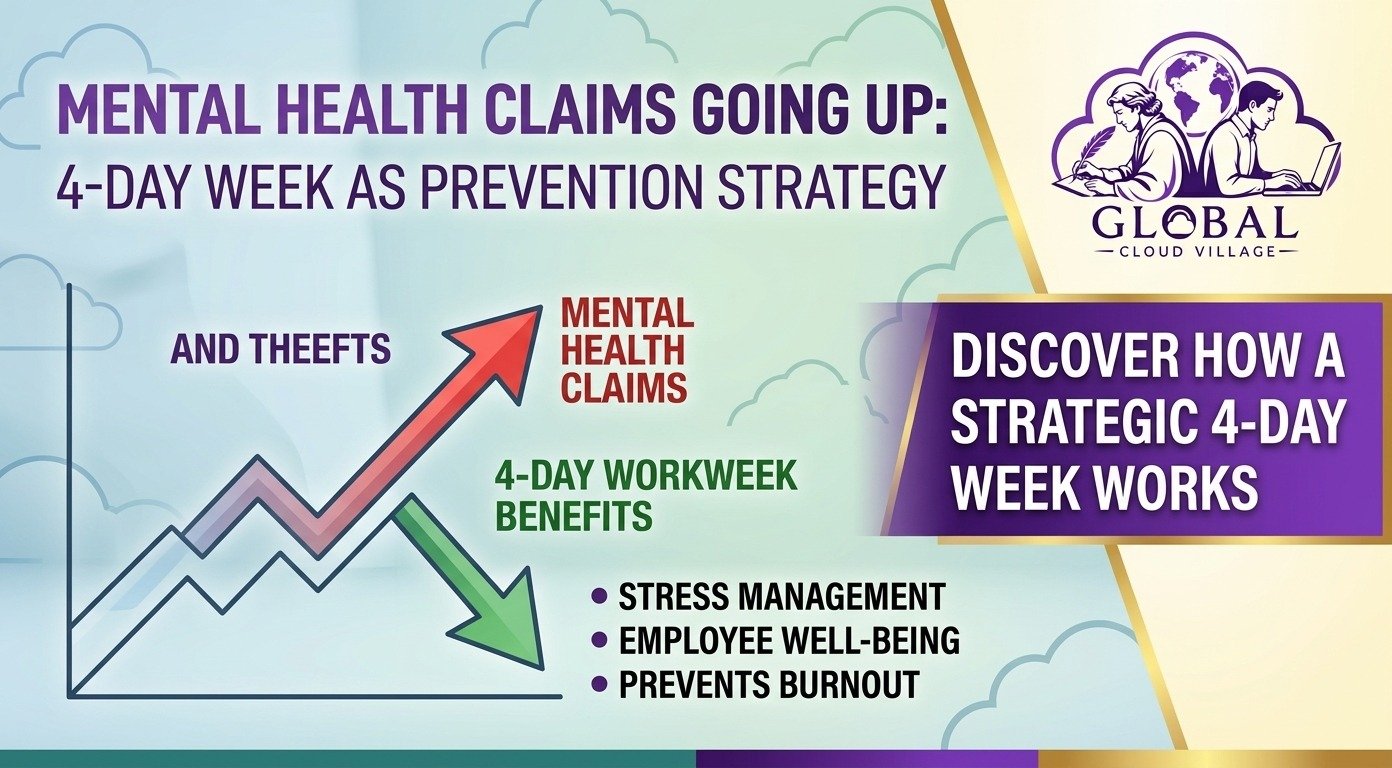
Mental Health Claims Going Up: 4-Day Week as Prevention Strategy
The monthly financial binder arrived on the desk of the leadership team with a quiet but devastating addendum from the insurance provider.
Hidden beneath the routine line items for dental coverage and physical therapy was a category that was becoming increasingly difficult to ignore: mental health claims.
Over the past three quarters, several employees had taken extended medical leave after experiencing severe exhaustion, anxiety, depression, or other health-related challenges.
The executive team met behind closed doors to address the situation.
Their response followed the standard corporate wellness playbook.
They subscribed to an enterprise mental health app, brought in a consultant to host a mindfulness and resilience seminar, and placed corporate-branded stress balls on everyone’s desk.
Yet the underlying problem remained.
Three months later, mental health claims were still rising. Another key manager was overwhelmed by an unrelenting workload and struggling to maintain normal performance.
This highlights an important problem with workplace wellness.
You cannot always solve a structural workload problem with individual wellness perks.
When an organization creates an environment of constant connectivity, excessive workloads, unnecessary meetings, and blurred boundaries between work and personal life, employee stress can become a systemic issue.
If your mental health claims are going up, it may be time to look beyond wellness apps and temporary interventions.
A structured 4-day workweek is one potential organizational strategy for reducing excessive work pressure, improving recovery time, and addressing some of the workplace conditions that contribute to burnout.
Why Mental Health Claims Are Going Up
Mental health problems in the workplace rarely have a single cause.
Workload, lack of control, poor management, insufficient recovery time, organizational culture, job insecurity, and personal circumstances can all contribute to employee stress.
That is why companies should be careful about assuming that a shorter workweek alone will solve every mental health problem.
However, changing the structure of work can address several important workplace risk factors.
Modern knowledge workers often face an endless barrage of notifications, changing project scopes, aggressive delivery timelines, and constant interruptions.
When work is distributed across five long days and regularly spills into evenings and weekends, employees may struggle to mentally disconnect.
This can create a cycle in which work consumes both working hours and recovery time.
The True Architecture of Workplace Stress
One useful framework for understanding workplace stress is the Demand-Control-Support Model.
The basic idea is that psychological strain can increase when employees experience high demands while having limited control and insufficient support.
Modern workplaces can unintentionally create exactly this combination.
Employees may have:
- High workloads
- Tight deadlines
- Constant notifications
- Frequent priority changes
- Limited control over schedules
- Excessive meetings
- Poor work-life boundaries
- Pressure to remain constantly available
When these conditions continue for long periods, employee well-being can suffer.
Cognitive Overload
Continuous interruptions make it harder for employees to concentrate on complex work.
Instead of completing one task deeply, employees may switch between emails, messaging platforms, meetings, customer requests, and internal approvals.
This constant context switching consumes mental energy.
Loss of Personal Time
When work occupies five long days and continues into evenings, employees have less time for family, hobbies, exercise, social relationships, and recovery.
The problem is not simply the number of hours worked.
It is the lack of meaningful time away from work.
The Sleep and Stress Cycle
Work-related stress can interfere with recovery and sleep.
Poor recovery can then make it more difficult to concentrate and regulate stress during the following workday.
This creates a cycle that can gradually reduce resilience and increase the risk of burnout.
Mental Health Claims Going Up? Consider the 4-Day Workweek
A 4-day workweek is not a replacement for professional mental health care, employee assistance programs, or appropriate medical support.
It is an organizational design strategy.
The commonly discussed 100:80:100 model means employees receive 100% of their pay for 80% of their previous working time while maintaining 100% of their expected output.
The objective is not simply to remove a working day.
The objective is to redesign work so that unnecessary activities are removed and employees can focus on the work that actually creates value.
Recent research provides encouraging evidence.
A major 2025 study covering 141 organizations and 2,896 employees across six countries found that a six-month 4-day workweek trial was associated with improvements in burnout, job satisfaction, and mental and physical health.
The UK’s earlier 4-day-week pilot also reported a 71% reduction in employees’ reported burnout levels, alongside improvements in mental health and reductions in anxiety.
These findings do not mean every company will achieve identical results.
They do show that reducing working time while redesigning how work is performed can have measurable benefits.
1. Break the Stress-Cycle Inertia
A traditional two-day weekend can disappear quickly.
Saturday may be consumed by household responsibilities, errands, appointments, and recovery from the working week.
Sunday can then become dominated by the anticipation of Monday.
An additional day away from work can provide more space for genuine recovery.
Employees can use that time for family, exercise, personal projects, appointments, hobbies, or simply rest.
That additional recovery time can help create a healthier boundary between professional and personal life.
2. Restore Time Sovereignty
One of the most valuable benefits of a shorter workweek can be greater control over personal time.
Employees may gain more opportunities to:
- Exercise
- Spend time with family
- Attend appointments
- Pursue hobbies
- Sleep
- Socialize
- Handle personal responsibilities
- Fully disconnect from work
This does not automatically eliminate anxiety or depression.
However, greater control over time can improve work-life balance and reduce some of the pressure created by an always-on workplace.
Research from the UK four-day-week pilot found improvements in mental health, work-life balance, and life satisfaction that were maintained in the follow-up period.
3. Eliminate the Culture of Hyper-Urgency
A successful 4-day workweek forces organizations to examine how work actually gets done.
Meandering meetings.
Repeated status updates.
Constant notifications.
Unnecessary approvals.
Duplicated reporting.
These activities consume time without necessarily creating proportional value.
When management removes this administrative bloat, employees can spend more of their available working hours on meaningful work.
The result is not simply a shorter week.
It is a more focused week.
The Economic Reality: Preventing the Cost of Burnout
When mental health claims are going up, companies should also examine the broader financial impact of workplace stress.
An employee experiencing serious burnout or another health problem can create multiple organizational costs.
1. Direct Costs
Depending on the organization and local employment and insurance arrangements, medical leave and employee benefits can create direct financial costs.
2. Productivity Loss
When an experienced employee is absent, projects can slow down.
Other employees may need to absorb the workload, potentially increasing their own stress.
This can create a dangerous cycle.
3. Recruitment and Replacement Costs
If an employee leaves permanently, the company may need to spend money on recruitment, onboarding, training, and lost productivity while the replacement becomes effective.
4. Loss of Institutional Knowledge
Experienced employees carry knowledge that is often difficult to replace quickly.
When they leave because of unsustainable working conditions, the business loses more than a position.
It loses experience.
Mental Health Claims Going Up? Build Prevention Into Work Design
If mental health claims are going up, companies should not rely exclusively on wellness programs.
They should also examine the workplace itself.
Ask:
- Are employees regularly working beyond scheduled hours?
- Are managers sending messages outside working hours?
- Are meetings consuming large portions of the week?
- Are priorities constantly changing?
- Are employees expected to respond immediately?
- Are teams understaffed?
- Are repetitive tasks still being performed manually?
- Can technology eliminate administrative work?
- Do employees have meaningful recovery time?
These questions can reveal whether the organization is treating symptoms while leaving the underlying workflow unchanged.
Implementing the Guardrails for Better Mental Health
Changing the number of working days is only the first step.
A 4-day schedule requires clear operational boundaries.
1. Create a Digital Sunset
Establish clear communication boundaries outside working hours.
For example, organizations can define a period during which routine workplace communication is paused.
Managers should lead by example.
A company cannot claim to protect employee recovery while executives continue sending routine messages throughout the weekend.
2. Normalize Output Over Face Time
Stop measuring commitment by online presence.
Instead, evaluate employees based on:
- Deliverables
- Milestones
- Quality
- Customer outcomes
- Project completion
- Business objectives
This reduces the incentive to remain visibly online simply to demonstrate commitment.
3. Design for Asynchronous Focus
Not every update requires a meeting.
Use documentation and asynchronous communication where possible.
Employees should have protected periods in which they can close communication applications and focus on complex work without constant interruptions.
4. Monitor Employee Well-Being
Track organizational indicators rather than assuming the new schedule is working.
Useful measures include:
- Burnout survey scores
- Absenteeism
- Employee turnover
- Overtime
- Sick leave
- Employee engagement
- Project completion
- Customer satisfaction
- Workload perception
The goal is to determine whether the new operating model is actually improving both employee well-being and business performance.
A 4-Day Week Is Not a Universal Mental Health Solution
A shorter workweek can be useful, but it should not be presented as a universal treatment for mental health conditions.
Employees experiencing anxiety, depression, severe stress, or other health concerns may require appropriate professional assessment and support.
Companies should maintain access to appropriate healthcare, employee assistance programs, reasonable workplace accommodations, and professional support where needed.
The 4-day workweek should be viewed as a work-design intervention, not a medical treatment.
The evidence is promising, but organizations still need to test the model against their own operational requirements.
How to Measure Whether the Strategy Is Working
Before introducing a 4-day schedule, establish a baseline.
Track current:
- Overtime hours
- Absenteeism
- Sick leave
- Employee turnover
- Employee engagement
- Burnout indicators
- Project delivery
- Customer satisfaction
- Productivity
- Revenue per employee
Then compare the results after implementation.
This allows leadership to determine whether the shorter schedule is genuinely improving the organization or simply shifting workload into fewer working days.
Conclusion: Design a Business That Protects People and Performance
If mental health claims are going up, the answer should not automatically be another wellness app, seminar, or corporate perk.
Look at the system that employees experience every day.
Look at workload.
Look at schedules.
Look at meetings.
Look at communication.
Look at staffing.
Look at management expectations.
Look at whether employees have enough time to recover.
A 4-day workweek can be one powerful way to redesign that system when implemented with realistic output targets, clear boundaries, proper staffing, and measurable performance indicators.
The goal is not simply to give employees an extra day away from work.
The goal is to create an organization where focused work, recovery, and sustainable performance can coexist.
When businesses design healthier operating systems, they can potentially reduce burnout, strengthen retention, improve employee experience, and build a more resilient workforce.
For more business and technology insights, explore the Amazon Author Profile and discover related publications and resources.
Frequently Asked Questions About Mental Health Claims and 4-Day Workweeks
Will a 4-Day Schedule Cause More Stress if Employees Have Less Time to Complete Their Work?
It can if management simply compresses the same inefficient workflow into fewer days.
A successful 4-day workweek requires organizations to remove unnecessary meetings, interruptions, administrative work, and low-value activities.
The objective is to improve focus and workflow rather than simply demand faster work.
How Do We Pitch a 4-Day Mental Health Strategy to the Board of Directors?
Frame the discussion around both employee well-being and business performance.
Present baseline data covering absenteeism, overtime, employee turnover, productivity, engagement, and workload.
Then establish measurable targets for the pilot.
Evidence from major four-day-week trials can also help boards understand the potential relationship between reduced working time, burnout, and employee well-being.
Can a 4-Day Workweek Help Reduce Burnout?
Research suggests that it can.
The UK four-day-week pilot reported that 71% of participating employees reported a decrease in burnout, while broader research has also found improvements in mental and physical health.
However, outcomes depend on implementation.
A shorter week will not solve excessive workload if the organization simply forces the same volume of work into fewer hours.
Can This System Reduce the Hidden Drain of Burnout and Disengagement?
It can potentially help by creating stronger boundaries between work and personal time.
Employees may have more opportunity to recover, spend time outside work, and return with greater energy.
However, burnout has multiple causes, so organizations should address workload, management, job design, psychological safety, and employee support alongside scheduling.
What Metrics Should We Track to Evaluate the 4-Day Week?
Track both employee and business outcomes.
Important measures include:
- Burnout indicators
- Employee stress
- Absenteeism
- Sick leave
- Turnover
- Overtime
- Productivity
- Project completion
- Customer satisfaction
- Employee engagement
Compare these metrics against the baseline established before the pilot.
About the Author: Global Cloud Village
Global Cloud Village translates complex digital technology systems into clear, human-centric strategies for growing SMEs, founders, and industry leaders.
We help businesses replace fragmented legacy processes with practical cloud architectures, automation, digital transformation, and operational strategies that support sustainable growth.
Explore more business optimization insights at Global Cloud Village.