Presenteeism: Staff Stay 9 Hours But Only Work 5: Fix It With 4 Days
It is 4:45 PM on a Tuesday in a standard corporate office—or worse, across a sprawling, always-on Slack workspace. The glowing monitors cast a steady light over rows of posture-fatigued professionals. Dave has been logged into his workstation since 8:00 AM. His status dot is a reassuring, vibrant green. If you check his activity log, you will see a steady trickle of minor keystrokes, a few red-pen edits on a secondary slide deck, and participation in three separate meetings that could have easily been resolved with a single bulleted email.
By any archaic corporate metric, Dave is putting in a stellar 9-hour shift.
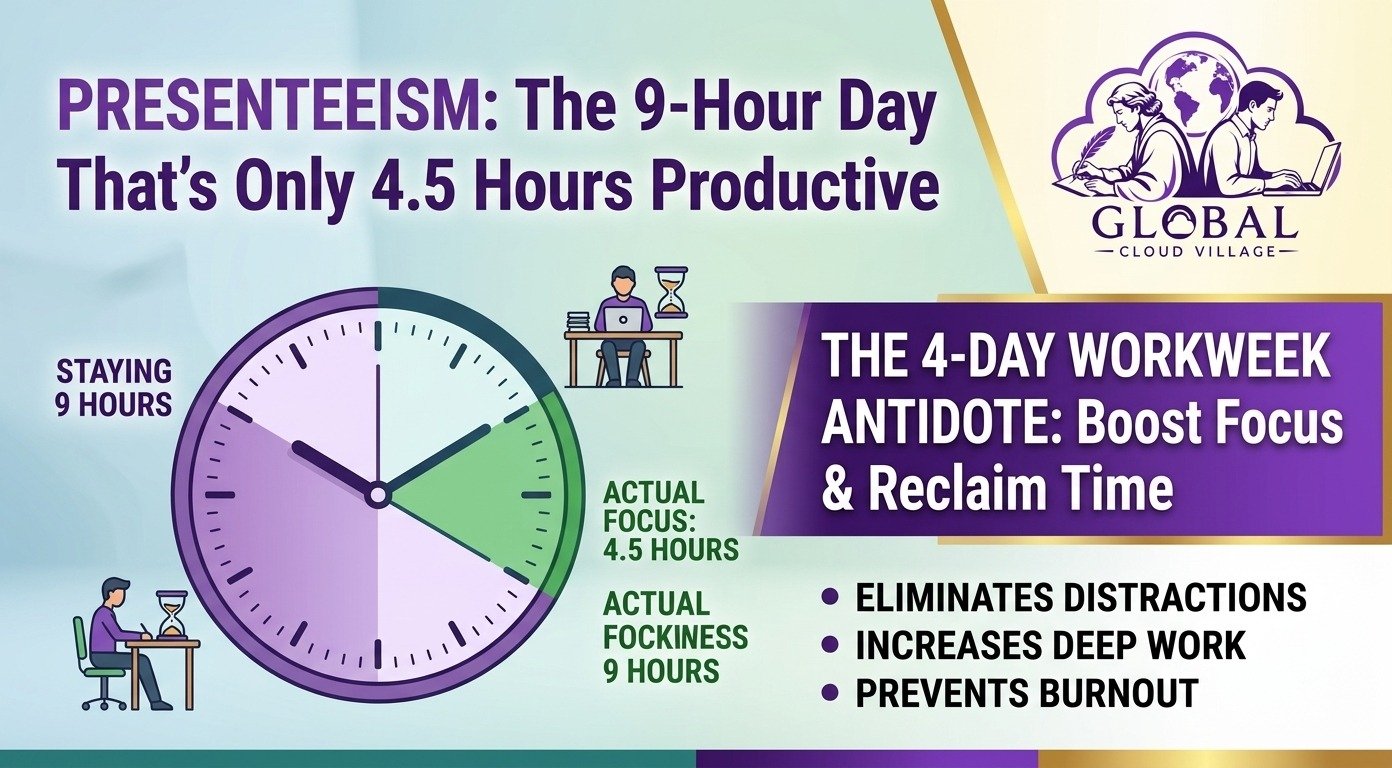
But if you look under the hood of his actual cognitive output, the math falls apart. When measured honestly, Dave experienced perhaps four and a half hours of genuine, focused execution. The rest of his time was spent navigating the invisible tax of corporate presenteeism: lingering in low-level distraction, clicking aimlessly between browser tabs, nursing his third cup of lukewarm coffee, and waiting for the socially acceptable hour to close his laptop so he wouldn’t be labeled a slacker.
Multiply Dave’s phantom hours across a 30-person or 50-person organization, and you are bleeding thousands of hours every month into the void of performative attendance.
Managers often react to this sluggish inertia by doubling down on monitoring software, keystroke trackers, or mandatory web-blocking tools. But you cannot police focus into existence. The fact that your staff is staying 9 hours but only working 5 is not an indictment of their work ethic—it is the natural consequence of an unconstrained timeline.
When time is treated as an infinite resource, work swells to fill it with noise. The cure for presenteeism isn’t tighter surveillance; it is the clean constraint of a 4-day productivity model.
The Illusion of the 8-Hour Stretch
The 8-hour workday is an industrial ghost. It was popularized in the early 20th century on assembly lines, where physical presence directly correlated with the number of widgets rolling off the belt. If a factory worker stood by the machine for eight hours, they produced twice as many widgets as someone who stood there for four.
Knowledge work does not obey assembly-line physics.
Human brains cannot sustain unbroken, high-level cognitive execution for eight or nine hours a day. Neuroscientists and productivity researchers have repeatedly demonstrated that the human capacity for intense, creative, and analytical deep work maxes out at roughly four to five hours per 24-hour cycle.
When you force a knowledge worker to sit at a desk for nine hours, what happens to the remaining four hours? They don’t magically turn into extra coding, brilliant strategy, or flawless copywriting. Instead, they transform into padding:
- Meandering through meandering group chats.
- Attending meetings where attendance is mandatory but contribution is zero.
- Staring blankly at an incoming email stream while feeling too mentally fried to draft a coherent reply.
Presenteeism is an adaptive survival mechanism. When employees realize their brains are completely depleted by noon but they are required to remain “on duty” until 5:00 or 6:00 PM, their minds naturally disengage to protect themselves from total cognitive collapse. They stay at the desk, but they check out.
The Compounding Cost of Performative Presence
Presenteeism is stealthy because it masquerades as dedication. A boss looks out over an office at 5:30 PM, sees ten people still typing away, and feels a warm sense of corporate pride. “Look at how hard everyone is working.”
In reality, those workers are trapped in a cultural standoff. Nobody wants to be the first person to leave at 4:30 PM because of the unwritten penalty of looking uncommitted. So everyone stays late, accomplishing next to nothing, resenting the office, and delaying their evening rest.
This dynamic introduces massive systemic drag to your business:
- Diluted Accountability: When everyone is working long, hazy hours, it becomes difficult to measure who is actually driving results. Work gets judged by how long a person takes to reply to a ping rather than the caliber of the asset they deliver.
- Mid-Week Fatigue Spirals: Because Monday through Thursday are bloated with phantom hours and unstructured distractions, employees stretch tasks out. They lose the urgency that makes execution sharp and efficient.
- The Evening Bleed: Because people fritter away prime morning energy on administrative clutter and interruptions, they have to push real work into their personal evenings, ruining their sleep and wrecking their Thursday and Friday momentum.
The 4-Day Antidote: Weaponizing Constraints
When you transition your organization to a 4-day workweek (reducing weekly hours from 40 to 32 while maintaining 100% pay), you do something radical to the psychological landscape of the office: you pop the balloon of performative time.
When the workday has a hard, unyielding boundary—say, a 4:30 or 5:00 PM hard stop every Thursday, with Friday completely free from labor—the rules of engagement change instantly.
- Focus Becomes Mandatory: Employees know they don’t have five full days to fumbled through a project. They realize their working window is tight and precious. The ambient permission to waste two hours scrolling news sites or holding redundant syncs evaporates.
- Presenteeism Dies: You cannot practice performative presence when you are actively encouraged to log off and go live your life. The cultural pressure shifts entirely from how long you sat in front of a monitor to what milestones you cleared before your three-day weekend began.
- The Velocity Spike: When Global Cloud Village analyzed teams that pruned their schedules down to 32 focused hours, the common denominator was a massive surge in execution velocity. People attacked their hardest analytical and creative challenges during peak morning energy windows, knowing that a clear desk meant a clean break.
Designing an Attendance-Free Culture
Eliminating presenteeism requires treating the 4-day shift as an operational redesign, not a casual holiday policy.
- Audit the Calendar Fat: For one week, map every recurring sync and check-in. If a meeting does not require active, real-time creative debate, cancel it and replace it with a concise, searchable async update.
- Enforce the Hard Stop: Train managers to actively police the exit doors—digital and physical. If a team member is regularly lingering online three hours past quitting time without an emergency, address it not as dedication, but as an operational failure in time-triage.
- Measure Output, Not Activity: Tie recognition and compensation strictly to completed deliverables, project milestones, and client outcomes. Make keystroke counting obsolete.
Conclusion: Trading Hours for Impact
Clinging to the 9-hour desk-warming ritual is a losing battle. It rewards people for being slow, distracted, and exhausted while penalizing the sharp operators who can solve a complex problem in three hours of pristine, uninterrupted focus.
When you drop the pretense of the bloated schedule and implement a disciplined 4-day productivity system, presenteeism starves for lack of oxygen. Your staff stops acting busy and starts actually being productive.
Trim the fat off the clock, protect your team’s focus, and watch how much farther your business goes when your people are judged by their impact instead of their shadow.
About the Author: Global Cloud Village
Global Cloud Village translates complex digital tech systems into clear, human-centric strategies for growing SMEs, founders, and industry leaders. We help businesses replace clunky, fragmented legacy habits with automated, high-adoption cloud architectures that protect data and build operational scale. Explore our optimization insights at globalcloudvillage.com.