Can’t Compete With Big Companies on Salary: Offer a 4-Day Week Instead
Mark stared at the spreadsheet on his second monitor, a cold bead of sweat forming at the base of his neck. On the left side of the screen was the resume of an extraordinary senior full-stack developer who had breezed through their technical interviews with effortless brilliance. On the right side was the counter-offer requirement: $195,000 base salary, plus a signing bonus that looked perilously close to Mark’s entire quarterly marketing budget.
Mark’s bootstrapped SaaS startup could not match that number. He ran the numbers twice, hoping the math would magically alter itself. It didn’t.
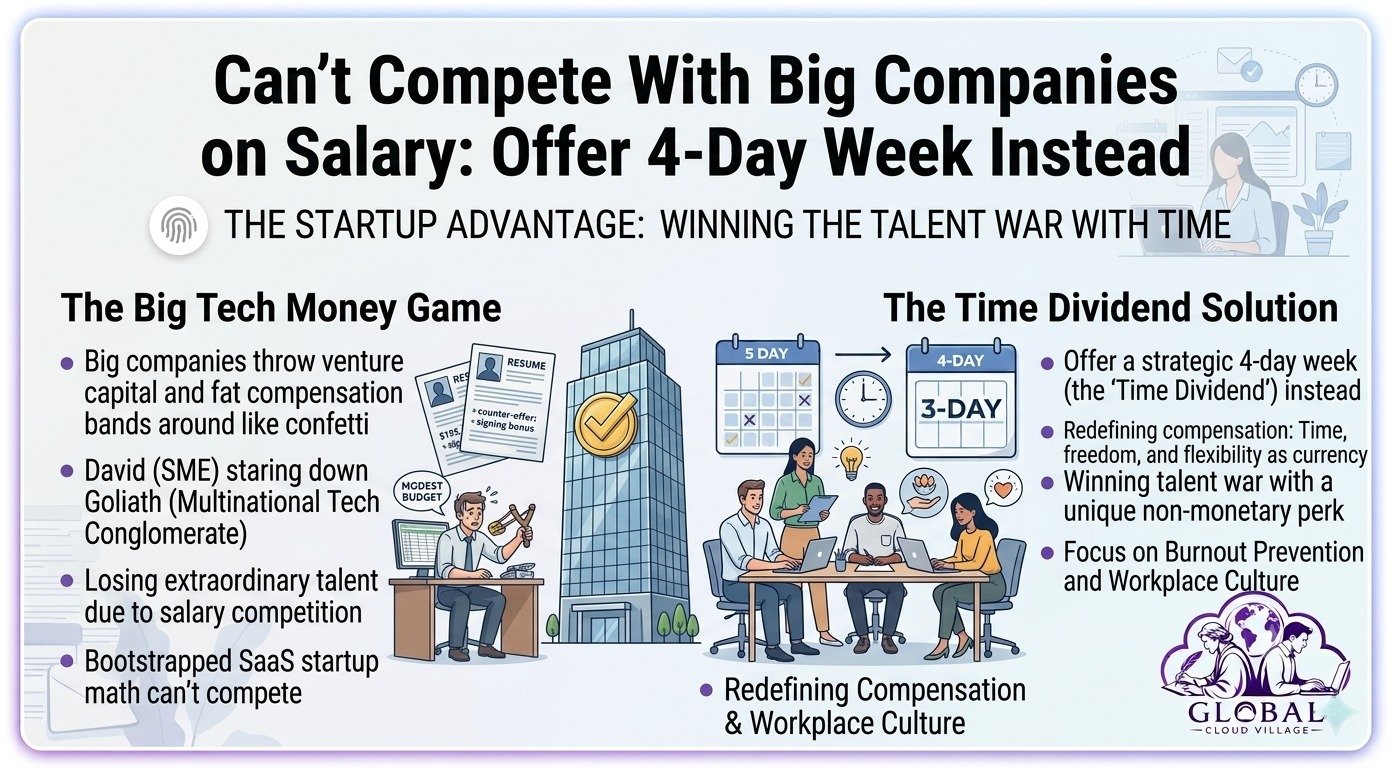
Thirty minutes later, the candidate sent a polite email declining Mark’s best offer. They had accepted a position with a massive multinational tech conglomerate that could throw venture capital and fat compensation bands around like confetti.
It’s a heartbreaking ritual played out in boardrooms and Zoom rooms across the globe every single day. Small and mid-sized companies feel like David staring down an unyielding corporate Goliath, holding a slingshot made of modest budgets while Goliath wields a golden checkbook. We try to compete on salary, and we lose. We try to offer vanity perks—free kombucha on tap, ping pong tables, branded tote bags—and candidates roll their eyes.
So what do you do when you can’t out-pay the giants? You stop playing their game on their terms. You don’t try to buy your talent with their currency; you buy their loyalty with something money can’t easily purchase: sovereignty over time.
Welcome to the ultimate hiring arbitrage: offering a genuine 4-day workweek to win the talent war against the highest-paying goliaths in your industry.
The Limits of the Dollar
For decades, conventional wisdom held that compensation was the alpha and omega of employee attraction. If you paid more, you got the best people. End of story.
But the post-pandemic labor market underwent a tectonic psychological shift. The collective trauma of burnout, combined with a stark re-evaluation of mortality and lifestyle during global lockdowns, recalibrated what people value.
Money matters, of course. Rent has to be paid, groceries bought, and savings built. But economists and behavioral psychologists have known for years about the principle of diminishing marginal utility of income. Once an employee crosses the threshold where their baseline financial security is met, every additional dollar yields a sharply declining return in personal happiness.
An engineer making $160,000 at a 4-day startup where they finish work at 4:00 PM on Thursday and have a three-day weekend every single week is often fundamentally happier, less stressed, and more fulfilled than the same engineer making $195,000 at a soul-crushing corporate giant where they are trapped in back-to-back video calls until 7:00 PM every night and expected to answer urgent pings on Saturday morning.
When candidates look at big tech or multinational corporations, they see the golden handcuffs. They know the high salary comes wrapped in the barbed wire of corporate bureaucracy, endless politics, and sixty-hour weeks.
This is your opening. This is where David doesn’t need a bigger sword; he needs a completely different battlefield.
The Time Dividend: Why Candidates Are Choosing Freedom
When Global Cloud Village advises scaling startups and mid-market companies on talent acquisition, we consistently see a staggering trend: when job listings feature a structured 4-day workweek (100% pay for 80% time), the volume and quality of inbound applications explode—often outperforming competitors who offer 20% higher base salaries on a traditional 5-day schedule.
Why? Because time is the ultimate luxury good of the 21st century.
Think about the high-performing senior talent you want to attract. These aren’t entry-level workers looking to pad their resumes; these are experienced professionals—often in their 30s and 40s—who have young children, aging parents, creative side-projects, or simply a deep-seated desire to not waste their prime years staring at a corporate spreadsheet.
When you offer a 4-day week, you are making a profound value proposition to that candidate:
“We may not be able to match the Silicon Valley mega-corporation’s stock options on day one, but we respect your humanity. We are giving you 52 extra days a year to live your life. You will work with intense focus, but when Thursday ends, your time is yours.”
To a stressed, burned-out senior developer currently drowning in corporate red tape at a Fortune 500 company, that offer isn’t just a perk—it’s an escape hatch. It’s an irresistible invitation to reclaim their life without taking a catastrophic pay cut.
Rewriting the Pitch Deck
If you are going to compete against deep-pocketed competitors using a 4-day schedule, you cannot whisper it as a secret footnote at the bottom of a generic job description. You have to weaponize it as your core cultural differentiator.
Here is how you frame the narrative in your recruitment process:
- Shift the Focus from Perks to Productivity: Don’t talk about how fun the office is. Talk about how clean your operational systems are. Tell candidates: “We work four days a week because we have eliminated bureaucratic meetings and protect deep work. You won’t waste your life here; you’ll build things that matter and log off.”
- Highlight the Real-World Value: Translate the extra day off into tangible human terms. In your interview pitches, talk about how your team members use Fridays to write books, surf, spend time with toddlers, or travel. Make the lifestyle tangible and desirable.
- Attract Self-Starters and High-Achievers: A 4-day week acts as a magnificent filter. It attracts professionals who are exceptionally good at what they do, who know how to manage their time, and who despise micromanagement. It repels clock-watchers and corporate politicians who thrive on performative presence.
The Business Case for the Small Player
Can a smaller company actually afford to lose 20% of its working hours to a 4-day schedule while trying to scale against giants? The data suggests you can’t afford to.
Big companies are bloated by their own scale. They move slowly, trapped in layers of approval chains, legacy systems, and endless status meetings. A lean, focused startup operating on a razor-sharp 4-day cadence moves with terrifying agility.
When your team is rested, clear-headed, and motivated by the reward of a 3-day weekend, their output per hour crushes the distracted, burned-out corporate drone working 50 hours in an open-plan office with free snacks. You win not by out-working the giant in sheer volume of hours, but by out-thinking and out-executing them in velocity and clarity.
Mark learned this lesson the hard way in January. But by February, he changed his hiring strategy. He rewrote his open senior developer listing, proudly anchoring it with a rigid, non-negotiable 4-day workweek policy backed by async documentation standards.
The very next week, an elite senior architect from a major tech monopoly applied. During the interview, Mark braced himself for the salary demand. The candidate looked at Mark and said, “I saw your 4-day policy. I’m taking a slight pay cut from my current role to come here, but honestly? Getting my Fridays back is worth ten times the difference.”
Conclusion: Winning the War Without the Golden Checkbook
You don’t need a venture capital war chest to build an elite team. You don’t need to match the bloated compensation packages of multinational goliaths who monetize their employees’ waking hours.
You have something better to offer: respect, focus, and freedom.
When you offer a 4-day workweek, you stop competing on the financial battlefield where the big companies hold all the cards, and you start competing on the human battlefield where talent actually wants to live. Offer the schedule, clean up your operations, and watch the best people in your industry line up to build your future.
Frequently Asked Questions About Competing on Talent With a 4-Day Week
Won’t top-tier candidates be suspicious that a 4-day week means lower total compensation or unstable finances?
Address this by being completely transparent about your business model and explaining that you trade bureaucratic waste for 32 hours of high-impact focus. Demonstrating operational efficiency builds immediate trust.
How do we address candidates who ask for both a high salary and the 4-day schedule?
Frame your total compensation package holistically. While you may offer a slightly lower base salary than enterprise giants, the monetary equivalent of an extra day of personal freedom each week far outweighs marginal salary bumps tied to burnout.
Is it difficult to transition a new hire directly into a 4-day rhythm?
Not if your internal documentation and async onboarding frameworks are clean. When new talent steps into an environment where deep work is protected from day one, they adapt quickly and appreciate the lack of administrative bloat.
What kind of roles respond best to a 4-day recruitment pitch?
Knowledge-heavy roles—such as software engineers, product designers, digital marketers, and data analysts—respond most powerfully because their output is tied to cognitive focus rather than physical attendance.
Ready to Outsmart the Giants in Talent Acquisition?
Winning top-tier professionals without out-spending massive corporations is the vital step toward building a nimble, highly competitive organization. Discover the complete human-centric blueprint for modern operational efficiency.
Get your copy of Global Cloud Village and 4 Day Work Week on Amazon:
About the Author: Global Cloud Village
Global Cloud Village translates complex digital tech systems into clear, human-centric strategies for growing SMEs, founders, and industry leaders. We help businesses replace clunky, fragmented legacy habits with automated, high-adoption cloud architectures that protect data and build operational scale. Explore our optimization insights at globalcloudvillage.com.