4-Day Time Management System: Keep Projects on Track and Meet Deadlines
It was 4:50 PM on a Thursday, and Marcus, a project director at a digital infrastructure consultancy, was staring at a project status dashboard filled with overdue tasks.
Several major client implementations were behind schedule. One project was caught in a review loop, while the engineering team was trying to resolve a deployment problem.
Under a traditional five-day schedule, the team might respond by working late, logging in over the weekend, and starting the following week already exhausted.
But Marcus’s firm was testing a compressed four-day, 32-hour workweek.
There was no Friday available as a safety net.
Marcus had a reasonable concern:
“How are we supposed to hit our milestones when we are already struggling to finish projects in five days?”
This is one of the biggest concerns businesses have when considering a shorter workweek.
If a company simply removes one working day while keeping the same inefficient processes, project delays can become worse.
But a four-day workweek also creates an opportunity to rethink how time is managed.
Instead of relying on extra hours, last-minute work, and deadline padding, organizations can build a structured 4-Day Time Management System around priorities, fixed time boundaries, transparent workflows, and controlled scope.
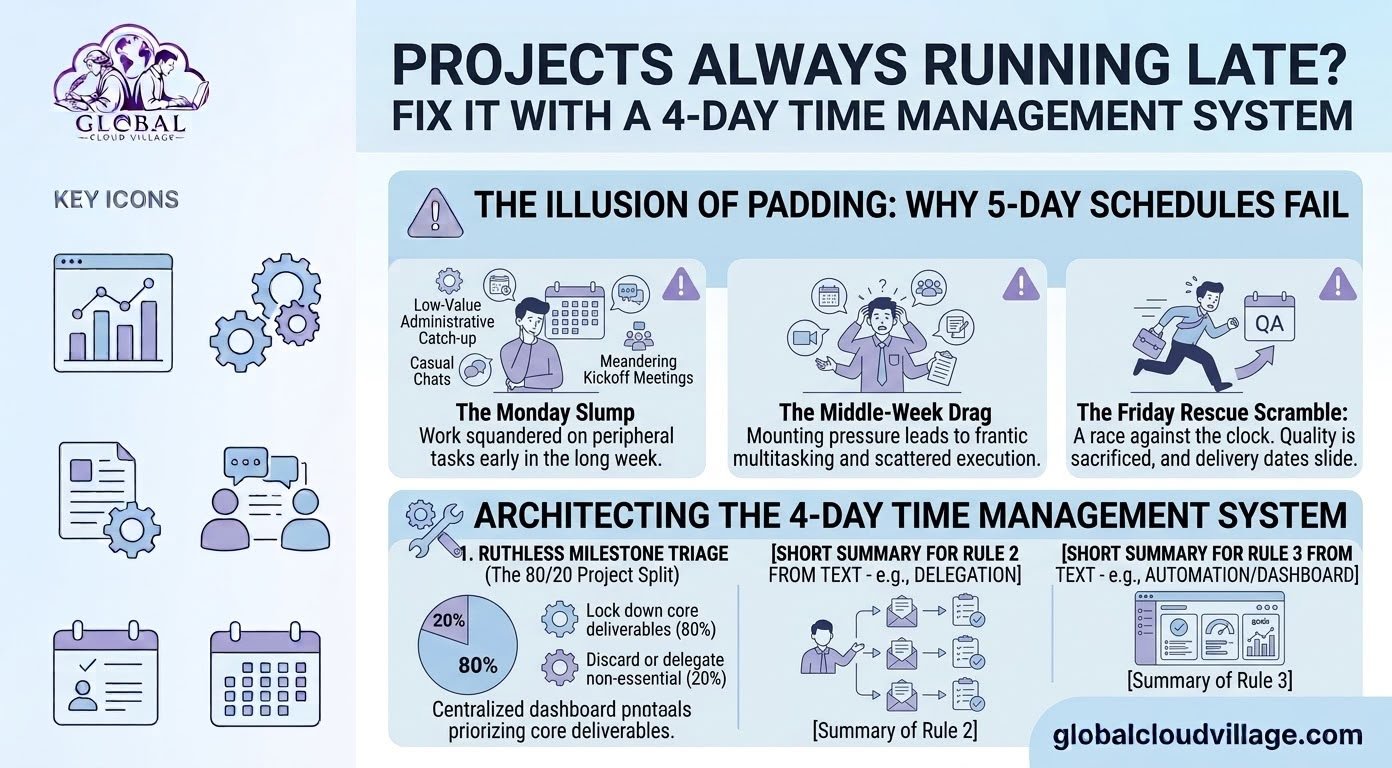
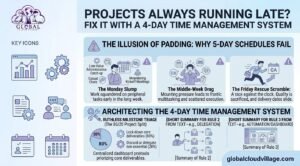
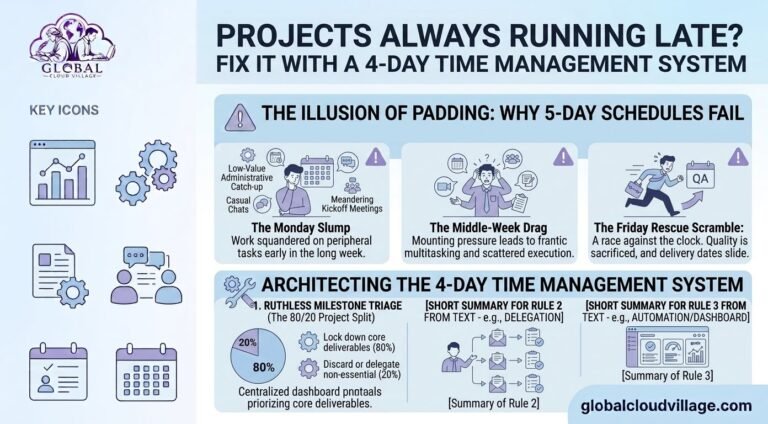
The Illusion of Padding: Why 5-Day Schedules Can Fail
One reason projects run late is that teams often treat available time as flexible.
Parkinson’s Law is commonly summarized as the idea that work expands to fill the time available for its completion.
In practice, a project milestone that has five working days available can experience delays through meetings, approvals, task switching, revisions, and low-priority work.
The result can look something like this:
Monday: Administrative Catch-Up
Teams spend the beginning of the week reviewing messages, attending meetings, checking project status, and organizing tasks.
Some of these activities are necessary, but excessive administrative work can delay actual execution.
Tuesday and Wednesday: Fragmented Execution
As deadlines approach, employees may begin switching between projects, meetings, customer requests, internal discussions, and urgent issues.
Instead of uninterrupted execution, the team operates reactively.
Thursday: Deadline Pressure
With fewer hours remaining, teams begin prioritizing whatever appears most urgent.
This can lead to rushed reviews, additional meetings, unnecessary overtime, or postponed tasks.
Friday: Rescue Mode
In a traditional five-day model, Friday can become the final safety net.
Teams may use the extra day to complete unfinished work, fix errors, or respond to last-minute changes.
A four-day schedule removes that buffer.
That does not automatically make a business more productive. It simply makes inefficient processes more visible.
A 4-Day Time Management System therefore treats time as a defined operating constraint rather than an unlimited resource.
Architecting the 4-Day Time Management System
A successful 4-Day Time Management System can be built around three important operational changes.
1. Prioritize the Work That Creates the Most Value
A 32-hour workweek does not provide unlimited capacity.
Teams therefore need to distinguish between essential deliverables and lower-priority work.
Using a centralized project dashboard, managers can identify:
- Critical client deliverables
- Revenue-impacting tasks
- Project dependencies
- High-priority technical work
- Required quality checks
- Tasks that can be postponed or automated
The goal is not to reduce quality.
The goal is to ensure that limited working time is allocated to work that matters most.
The 80/20 principle can be useful as a prioritization framework, but teams should validate priorities against actual project requirements rather than assuming that every project follows the same ratio.
2. Use Fixed-Time, Variable-Scope Sprints
One of the most useful principles in a four-day schedule is to establish a clear time boundary.
If the team has 32 hours available, the organization should not assume that every possible task must fit inside those 32 hours.
Instead, time can remain fixed while lower-priority scope moves into a future sprint.
For example, imagine a client requests an additional feature halfway through the week.
Instead of automatically adding the feature to an already full workload, the project manager can ask:
What should move out to make room for this new requirement?
This creates a transparent trade-off between time and scope.
The approach helps protect delivery dates while giving stakeholders visibility into the consequences of changing requirements.
3. Automate Workflow Hand-Offs
Projects can lose significant time when work sits waiting for someone to manually communicate that a task is ready.
For example:
A designer finishes an asset.
The designer sends an email.
A developer checks the email later.
The project manager updates a spreadsheet.
The developer begins work.
A reviewer then asks for another status update.
Each individual step may appear small, but repeated across multiple projects, these hand-offs can create operational friction.
A connected cloud ERP, CRM, or project management platform can reduce this friction.
When a task reaches a defined status, the next person can automatically receive the required notification or task assignment.
The objective is not to automate everything.
It is to remove unnecessary administrative steps so employees can spend more time executing valuable work.
How Marcus Fixed His Project Delays
When Marcus realized that his team’s problem was not simply the number of working hours, he redesigned the project workflow.
The team replaced scattered spreadsheets with a centralized project dashboard.
They also introduced several operating rules for their four-day sprint:
No Unnecessary Internal Status Meetings
Routine project updates were recorded asynchronously in the dashboard.
This allowed team members to review progress without repeatedly attending meetings simply to hear information that could have been documented.
Short Blocker Discussions
Instead of long status meetings, teams used short discussions focused specifically on active blockers.
The purpose was to remove obstacles rather than provide lengthy progress reports.
A Thursday Delivery Cutoff
The team established an internal delivery deadline before the end of the final working day.
This created a buffer for final checks, approvals, and unexpected issues.
The important lesson from Marcus’s example is not a specific percentage improvement.
The real lesson is that a shorter workweek requires deliberate project architecture.
When priorities are visible, scope is controlled, and workflow hand-offs are clear, teams have fewer reasons to rely on last-minute rescue work.
Step-by-Step: Implementing Your 4-Day Time Management System
If your projects are regularly running late, start with the following implementation process.
1. Audit Past Project Delays
Review recent projects and identify where time was lost.
Look for:
- Waiting for client feedback
- Approval delays
- Repeated revisions
- Unclear responsibilities
- Excessive meetings
- Manual data entry
- Poor task hand-offs
- Scope changes
The goal is to find the actual bottlenecks rather than simply asking employees to work faster.
2. Set Fixed Weekly Capacity
Define the available working capacity for the four-day schedule.
For a 32-hour model, make the boundary clear.
Managers should understand that adding new work requires a corresponding change in priorities, scope, resources, or deadlines.
This prevents the four-day schedule from quietly becoming a five-day workload compressed into four days.
3. Centralize Project Tracking
Move important project information into one reliable system.
The dashboard should make it easy to see:
- Current milestones
- Task owners
- Deadlines
- Dependencies
- Project status
- Blockers
- Client approvals
Everyone should know where to look for the latest information.
4. Create an Internal Finish Line
Do not make the official client deadline the team’s only deadline.
Set an internal completion target before the end of the final working day where possible.
This gives the team time to perform final quality checks and deal with unexpected issues.
5. Review the System Weekly
A four-day operating model should evolve based on real project data.
Review:
- On-time delivery
- Work completed
- Delayed tasks
- Scope changes
- Meeting hours
- Overtime
- Rework
- Customer issues
Use the results to improve the system rather than assuming the initial process will be perfect.
How to Prevent Quality Problems in a Shorter Week
A common concern about a four-day schedule is that employees will rush their work.
That risk is real if management treats reduced hours as a demand to produce exactly the same scope regardless of capacity.
The solution is not simply to increase pressure.
Instead, establish a clear Definition of Done for important tasks.
For example, a software deliverable might require:
- Development completed
- Testing completed
- Required documentation updated
- Quality checks passed
- Stakeholder approval received
If the work does not meet the agreed standard, it is not considered complete.
This creates an important distinction:
Time is constrained, but quality standards remain clear.
When additional work appears, scope and priorities should be adjusted rather than allowing quality to deteriorate.
Conclusion: Constraints Create Execution Clarity
The traditional response to a late project is often to add more hours.
That can sometimes solve an immediate problem, but it does not necessarily fix the process that created the delay.
A 4-Day Time Management System takes a different approach.
It creates clear capacity boundaries, prioritizes high-value work, controls scope, reduces unnecessary hand-offs, and makes project status visible.
The objective is not to force every project into an artificially rigid four-day box.
The objective is to make the organization more deliberate about how it uses its available time.
When teams know what matters, understand their capacity, and have transparent workflows, deadlines become easier to manage.
Constraints can create clarity when they are supported by a strong operating system.
Frequently Asked Questions About 4-Day Time Management
How do we handle unexpected client scope changes during a 32-hour workweek?
Use a fixed-time, variable-scope approach.
If a client requests additional work, evaluate its priority and determine what existing work should be moved, delayed, or removed.
If the new requirement cannot fit within available capacity, discuss the effect on the timeline or resources with the client.
What if a complex project genuinely requires more than 32 hours in a week?
Break the project into smaller milestones that can be distributed across multiple weeks.
A four-day workweek does not mean every project must be completed within one week.
It means the organization’s weekly capacity needs to be planned realistically.
How do we prevent employees from rushing to meet Thursday deadlines?
Define quality standards before work begins.
Use checklists, testing procedures, approval requirements, and clear definitions of done.
If the planned scope consistently exceeds available capacity, reduce or reprioritize the scope rather than relying on employees to compensate with rushed work.
What software tools support a 4-Day Time Management System?
Cloud-based project management and ERP platforms can support milestone tracking, task assignments, dependencies, dashboards, documentation, and asynchronous collaboration.
Tools such as Asana, Monday.com, Jira, and ERP project modules can be considered depending on the organization’s requirements.
The right tool is the one that provides clear visibility and supports the team’s actual workflow.
Does a four-day workweek work for every type of project?
Not necessarily.
Some projects require continuous customer coverage, field operations, or other schedules that do not fit a simple four-day model.
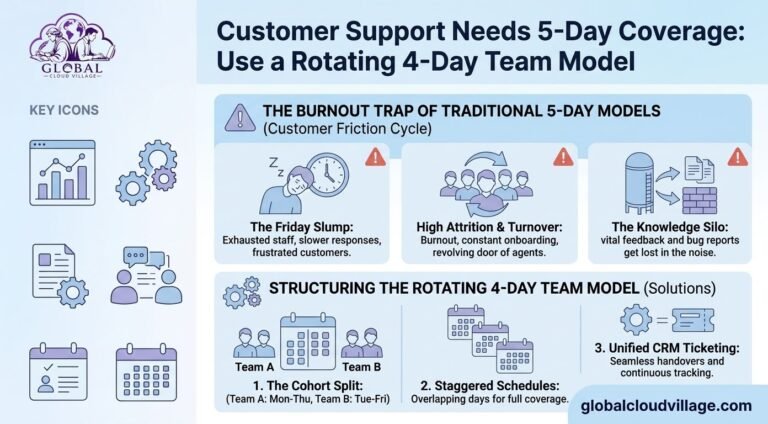
In those situations, organizations may need rotating schedules, staggered teams, or other coverage models.
The principles of capacity planning, prioritization, and workflow visibility can still apply.
Ready to Optimize Your Team’s Output?
Reducing operational friction and improving project delivery are important steps toward sustainable growth.
If your organization is considering a four-day workweek, start by examining where time is currently being lost.
Identify bottlenecks, prioritize high-value work, centralize project information, automate repetitive hand-offs, and establish realistic capacity boundaries.
Get your copy of Global Cloud Village and 4 Day Work Week on Amazon Kindle:
https://www.amazon.co.uk/dp/B0H3RDH78S
About the Author: Global Cloud Village
Global Cloud Village translates complex digital technology systems into clear, human-centric strategies for growing SMEs, founders, and industry leaders.
We help businesses replace fragmented processes with practical cloud architectures, automation, and technology strategies designed to improve operational efficiency and support sustainable growth.
Explore more optimization insights at globalcloudvillage.com.
Author Profile
Explore the author’s books and publications on Amazon: