4-Day Sales Process: How to Protect Leads and Improve Sales Velocity
David, the VP of Sales for a fast-growing enterprise software company, walked into the executive meeting looking concerned.
“We can’t do it,” David said, placing the latest pipeline report on the table. “If we move our sales team to a four-day, 32-hour workweek, our lead response time could suffer. Deals could stall, competitors could reach prospects first, and revenue could be affected.”
His concern reflected a common assumption about sales.
More hours must mean more calls.
More calls must mean more opportunities.
More opportunities must mean more sales.
But David’s team was already working long hours, and additional activity was not automatically producing better results.
Salespeople were spending significant time searching through spreadsheets, entering CRM data, preparing follow-ups, attending internal meetings, and chasing poorly qualified prospects.
The problem was not simply the number of hours available.
It was how those hours were being used.
David was confusing activity with execution.
A successful four-day sales model requires a different approach. Instead of trying to squeeze a traditional five-day workflow into four days, businesses need to remove unnecessary administrative work and build a structured 4-Day Sales Process around qualification, automation, focused selling, and pipeline visibility.
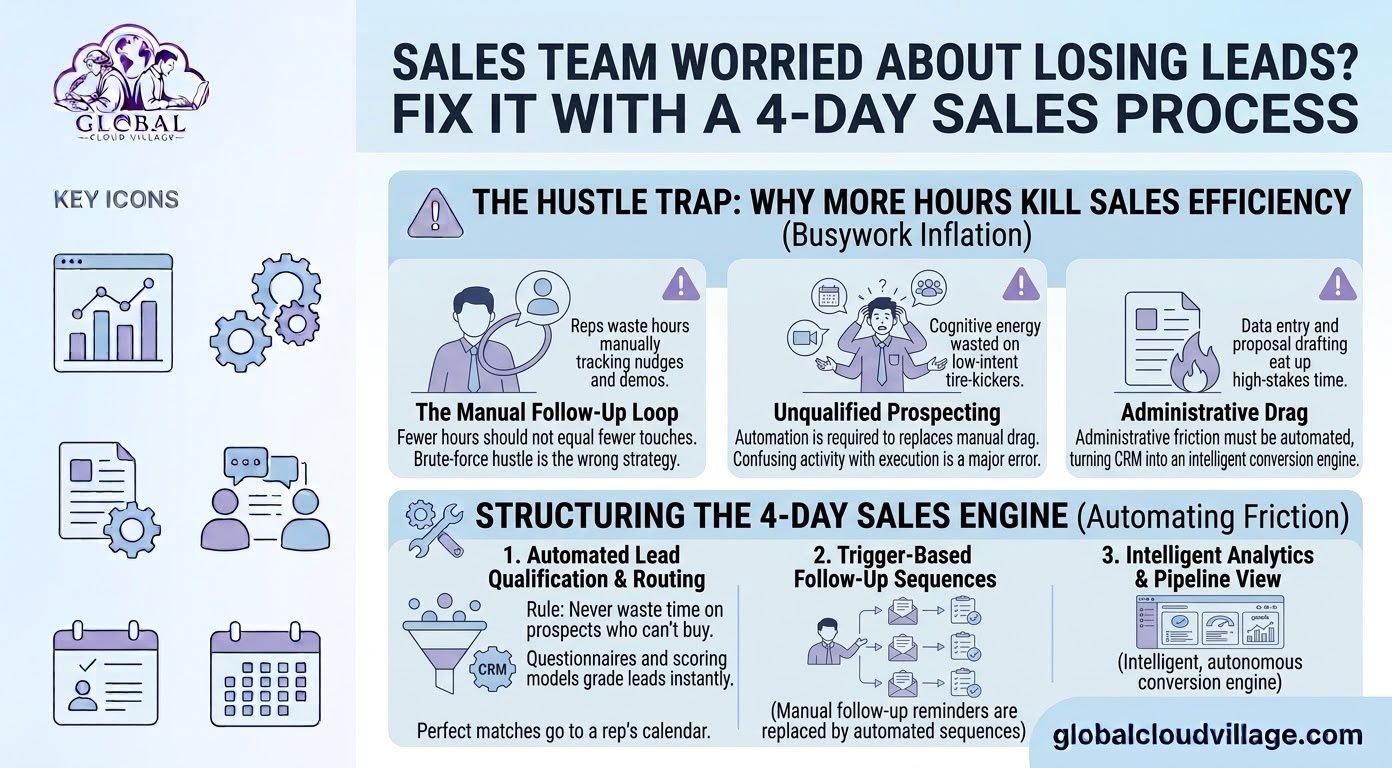
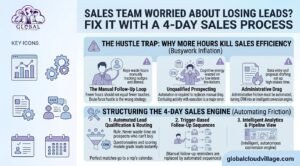
The Sales Hustle Trap
Traditional sales environments often reward visible activity.
More calls.
More emails.
More meetings.
More follow-ups.
But activity does not always equal progress.
A salesperson can spend hours contacting prospects without moving a qualified opportunity closer to a decision.
This creates several common sources of sales inefficiency.
Manual Follow-Up
Sales representatives may spend considerable time checking email activity, remembering follow-up dates, writing repetitive messages, and updating tasks.
Unqualified Prospecting
Without effective qualification, salespeople can spend valuable time pursuing prospects that do not match the company’s ideal customer profile.
Administrative Work
CRM updates, proposal preparation, reporting, internal meetings, and pipeline administration can consume time that could otherwise be used for customer conversations.
Fragmented Information
When lead information is spread across spreadsheets, email inboxes, forms, and separate systems, salespeople spend additional time finding information instead of using it.
A four-day workweek exposes these inefficiencies.
If the old workflow depends on spare hours to compensate for poor processes, reducing the available working time will make those weaknesses more visible.
The answer is not simply asking salespeople to work faster.
It is redesigning the sales process.
Building a 4-Day Sales Process
A strong 4-Day Sales Process should focus the available working time on activities that directly contribute to pipeline progression.
Three areas are particularly important.
1. Automate Lead Qualification and Routing
Salespeople should not have to manually determine whether every inbound lead is worth pursuing.
A CRM can collect information such as:
- Company size
- Industry
- Location
- Business requirements
- Budget range
- Purchase timeframe
- Decision-making role
Lead-scoring rules can then help categorize prospects based on predefined criteria.
Qualified leads can be routed to the appropriate salesperson or booking calendar.
Leads that are not ready to speak with sales can enter a nurture workflow instead.
The exact scoring model should depend on the company’s sales cycle and ideal customer profile.
The objective is simple:
Let automation handle initial qualification so salespeople can focus on qualified opportunities.
2. Use Trigger-Based Follow-Up
Follow-up is essential in sales, but remembering every follow-up manually creates unnecessary operational friction.
CRM automation can create tasks or trigger sequences based on defined events.
For example:
A prospect submits a form.
The CRM records the lead.
A confirmation email is sent automatically.
The prospect books a meeting.
The salesperson receives the relevant information.
After the meeting, the CRM creates the next follow-up task.
If the prospect interacts with a proposal or another tracked asset, the sales workflow can notify the appropriate team member.
The exact automation will depend on the CRM and sales process, but the principle remains the same:
The system should help maintain pipeline momentum without requiring salespeople to remember every administrative step.
3. Protect High-Value Selling Time
Salespeople need uninterrupted time for activities that require judgment, communication, and relationship building.
These can include:
- Discovery calls
- Product demonstrations
- Proposal discussions
- Negotiations
- Account planning
- High-value outbound conversations
A four-day schedule can therefore include protected selling blocks.
For example, a company operating Monday through Thursday could reserve selected morning periods for customer-facing sales activity while limiting internal meetings during those windows.
The exact schedule should be tested against customer demand, time zones, team responsibilities, and existing service commitments.
The principle is more important than the specific hours:
Protect the time that directly moves opportunities forward.
How David Restructured His Sales Process
David eventually agreed to pilot a structured four-day sales workflow.
Instead of simply reducing the team’s working hours, he first reviewed the existing sales operation.
The company discovered that its lead-generation forms, CRM, sales pipeline, and internal reporting systems were not fully connected.
The team then redesigned the workflow.
Lead information was routed directly into the CRM.
Qualification rules were introduced.
Routine follow-up tasks were automated.
Proposal workflows were standardized.
Salespeople received protected periods for customer-facing work.
Internal meetings were reviewed and reduced where they were not contributing directly to pipeline progression.
The goal was not to make the team work harder during four days.
The goal was to make the four available working days more structured.
After the pilot, the company reviewed its actual performance data, including:
- Lead response time
- Qualified lead volume
- Meeting conversion
- Opportunity progression
- Closed-won revenue
- CRM activity
- Customer feedback
This approach allowed David’s team to evaluate the four-day model based on measurable business outcomes rather than assumptions about productivity.
Step-by-Step: Implementing Your 4-Day Sales Process
If your sales team is concerned about losing leads under a four-day schedule, use the following framework.
1. Audit the Sales Day
Track how representatives spend their working time.
Look specifically at:
- CRM administration
- Internal meetings
- Lead research
- Proposal preparation
- Follow-up
- Prospecting
- Customer conversations
The goal is to identify activities that can be simplified, automated, delegated, or removed.
2. Automate the Top of the Funnel
Connect your lead-generation channels to your CRM.
Where appropriate, automate:
- Lead capture
- Lead enrichment
- Qualification
- Lead scoring
- Calendar booking
- Initial confirmation emails
- Lead routing
This creates a faster path between initial interest and sales engagement.
3. Build a Follow-Up System
Create defined follow-up stages for your sales pipeline.
For example:
New Lead → Qualified → Discovery → Proposal → Negotiation → Closed
Each stage should have clear ownership and next actions.
This makes it easier for salespeople and managers to identify opportunities that are becoming inactive.
4. Protect Selling Blocks
Reserve focused time for high-value sales activity.
Reduce unnecessary internal meetings during these periods.
The objective is to make customer conversations a priority rather than something salespeople try to fit between administrative tasks.
5. Create Asynchronous Sales Assets
Not every customer question requires a live meeting.
Build useful resources such as:
- Case studies
- Product demonstrations
- Pricing guides
- Proposal templates
- FAQs
- Video presentations
- Comparison documents
- Product documentation
These resources allow prospects to gather information independently while reducing repetitive conversations for sales representatives.
6. Measure the Results
Do not judge the new process based on working hours alone.
Track the metrics that matter to your sales operation.
Useful measurements include:
| Metric | What It Shows |
|---|---|
| Lead response time | How quickly new opportunities receive attention |
| Lead-to-meeting rate | Effectiveness of initial qualification |
| Meeting-to-opportunity rate | Quality of sales conversations |
| Opportunity velocity | How quickly deals progress |
| Win rate | Percentage of opportunities that become customers |
| Sales cycle length | Time required to close opportunities |
| Revenue per rep | Commercial output relative to sales capacity |
| Pipeline coverage | Availability of future opportunities |
These measurements provide a clearer picture of whether the process is working.
What Happens to Friday Leads?
One of the biggest concerns surrounding a four-day sales schedule is what happens when a prospect submits an inquiry on the non-working day.
The answer depends on the business model.
A company may use:
Automated Lead Capture
Forms and landing pages can continue collecting inquiries outside standard working hours.
Automated Acknowledgment
An automated message can confirm that the inquiry has been received and explain when the prospect should expect a response.
Lead Prioritization
High-priority opportunities can be flagged for the next available sales window.
Rotating Coverage
Businesses with contractual or operational requirements for Friday support can create designated coverage rather than requiring the entire sales team to work.
Chat and Self-Service
AI-assisted chat, knowledge bases, FAQs, and automated resources can answer basic questions outside standard operating hours.
The important point is to define the process before changing the schedule.
A four-day sales model should not leave the Friday workflow undefined.
What About International Sales Teams?
International sales teams may need additional planning.
A Monday-to-Thursday schedule can create different challenges depending on where prospects and customers are located.
For example, a company selling into North America from Europe or the Middle East may need to align sales blocks with customer availability.
Instead of assuming one universal schedule will work, examine:
- Customer time zones
- Lead arrival patterns
- Meeting demand
- Contractual service windows
- Sales territory ownership
- Existing account coverage
The four-day model should be designed around customer demand rather than simply copying another company’s schedule.
How CRM and ERP Integration Can Support Sales
A 4-Day Sales Process becomes easier to manage when sales data and operational information are connected.
A CRM can manage:
- Leads
- Contacts
- Opportunities
- Sales activities
- Follow-ups
- Pipeline stages
ERP systems can manage areas such as:
- Orders
- Invoicing
- Inventory
- Financial information
- Fulfillment
When appropriate, connecting these systems can reduce duplicate data entry and improve visibility across the customer lifecycle.
For example, a sales representative should not need to repeatedly request order or customer information from another department if the relevant data is already available through connected systems.
The exact integration architecture will depend on the organization’s size, systems, security requirements, and operational complexity.
Technology should support the process.
It should not create another layer of complexity.
Common Mistakes When Moving to a 4-Day Sales Process
Mistake 1: Simply Removing Friday
Reducing the workweek without changing the underlying sales process can leave the team with the same workload and fewer hours.
The schedule and workflow need to be redesigned together.
Mistake 2: Measuring Only Call Volume
Call volume can be useful, but it does not tell the entire story.
Also examine qualified opportunities, meetings, pipeline progression, conversion rates, and revenue.
Mistake 3: Automating Everything
Automation should remove repetitive administrative work.
It should not eliminate the human conversations that require trust, judgment, negotiation, and relationship building.
Mistake 4: Ignoring Friday Inquiries
If prospects can submit leads seven days a week, the business needs a defined process for inquiries received outside operating hours.
Mistake 5: Making Unsupported Guarantees
A four-day schedule does not automatically improve conversion rates or revenue.
Test the model, measure performance, and adjust the process based on evidence.
Frequently Asked Questions About 4-Day Sales Processes
How can a 4-Day Sales Process prevent lost leads?
It can reduce the risk of lost leads by combining automated lead capture, qualification, routing, follow-up workflows, and clearly defined response processes.
Will a four-day workweek reduce sales call volume?
Potentially. A four-day schedule provides fewer working hours, so raw activity volume may change. The relevant question is whether the sales team can maintain sufficient qualified activity and commercial outcomes.
How should Friday leads be handled?
Use a defined combination of automated lead capture, acknowledgment, prioritization, and, where necessary, rotating coverage or an agreed emergency process.
What CRM features are useful for a 4-Day Sales Process?
Useful features can include lead scoring, automated workflows, email sequencing, task automation, calendar integration, pipeline dashboards, reporting, and real-time notifications.
Popular CRM platforms include HubSpot and Salesforce, although the appropriate system depends on your business requirements.
How do I know whether the process is working?
Compare performance before and after implementation.
Monitor lead response time, qualified opportunities, meeting conversion, opportunity velocity, sales cycle length, win rate, revenue, and customer feedback.
Can a four-day sales model work for B2B companies?
It can, but the operating model should be designed around customer expectations, sales cycles, time zones, contractual requirements, and lead patterns.
Conclusion: Build Sales Velocity Through Better Processes
The traditional sales mindset often focuses heavily on activity.
More calls.
More emails.
More hours.
But sustainable sales performance also depends on process design.
A structured 4-Day Sales Process gives businesses an opportunity to examine where salespeople spend their time and identify work that can be automated, simplified, or removed.
The objective is not simply to fit five days of work into four.
It is to create a sales operation where:
- Qualified leads are identified quickly.
- Follow-ups are systematically managed.
- CRM data remains organized.
- Salespeople have protected customer-facing time.
- Friday inquiries have a defined process.
- Managers can measure pipeline performance.
- Customers receive clear communication.
A four-day workweek is therefore not just a scheduling decision.
It is an opportunity to rethink how sales work gets done.
Automate the repetitive work. Protect the valuable conversations. Measure the results.
Ready to Optimize Your Team’s Output?
A productive four-day sales model requires more than changing the calendar.
It requires better processes, reliable CRM automation, clear pipeline ownership, and measurable performance standards.
Discover more practical strategies for modern business productivity in Global Cloud Village and 4 Day Work Week.
You can also explore the author’s work through the Amazon Author Profile.
About the Author
Global Cloud Village translates complex digital technology systems into clear, human-centric strategies for growing SMEs, founders, and industry leaders.
The platform explores cloud technology, automation, digital transformation, productivity, data-driven management, and modern workplace strategies that help businesses replace fragmented processes with scalable systems.