Cut Meetings for 4-Day Success: Reclaim Time for Deep Work
Julian looked at his team’s calendar on a Tuesday afternoon and saw a wall of meetings.
There was the “Weekly Sprint Alignment,” the “Departmental Sync,” the “Follow-Up on the Sync,” and the familiar “Quick Chat to Align on Next Steps.”
His senior product team was spending a significant portion of the working week in meetings.
Now Julian was preparing to move his agency toward a compressed four-day, 32-hour workweek.
The problem quickly became obvious.
If meetings continued to consume a large portion of the available working time, employees would have far less time for the work that actually creates value.
Developers would have less time to build.
Designers would have less time to create.
Account managers would have less time to serve clients.
The company did not simply need fewer working hours.
It needed less wasted time.
That is why Cut Meetings for 4-Day Success should be treated as an operational priority rather than simply a calendar-management exercise.
A successful four-day workweek requires businesses to eliminate unnecessary meetings, improve asynchronous communication, and protect uninterrupted time for execution.
Why Meetings Become a Problem in a 4-Day Workweek
Meeting overload rarely happens because managers intentionally want to waste time.
It often develops because meetings become the easiest way to solve organizational uncertainty.
When managers cannot see project progress, they schedule a meeting.
When employees do not know what another department is doing, they schedule a meeting.
When a decision is unclear, another meeting appears on the calendar.
Over time, meetings become a substitute for visibility.
This creates several problems.
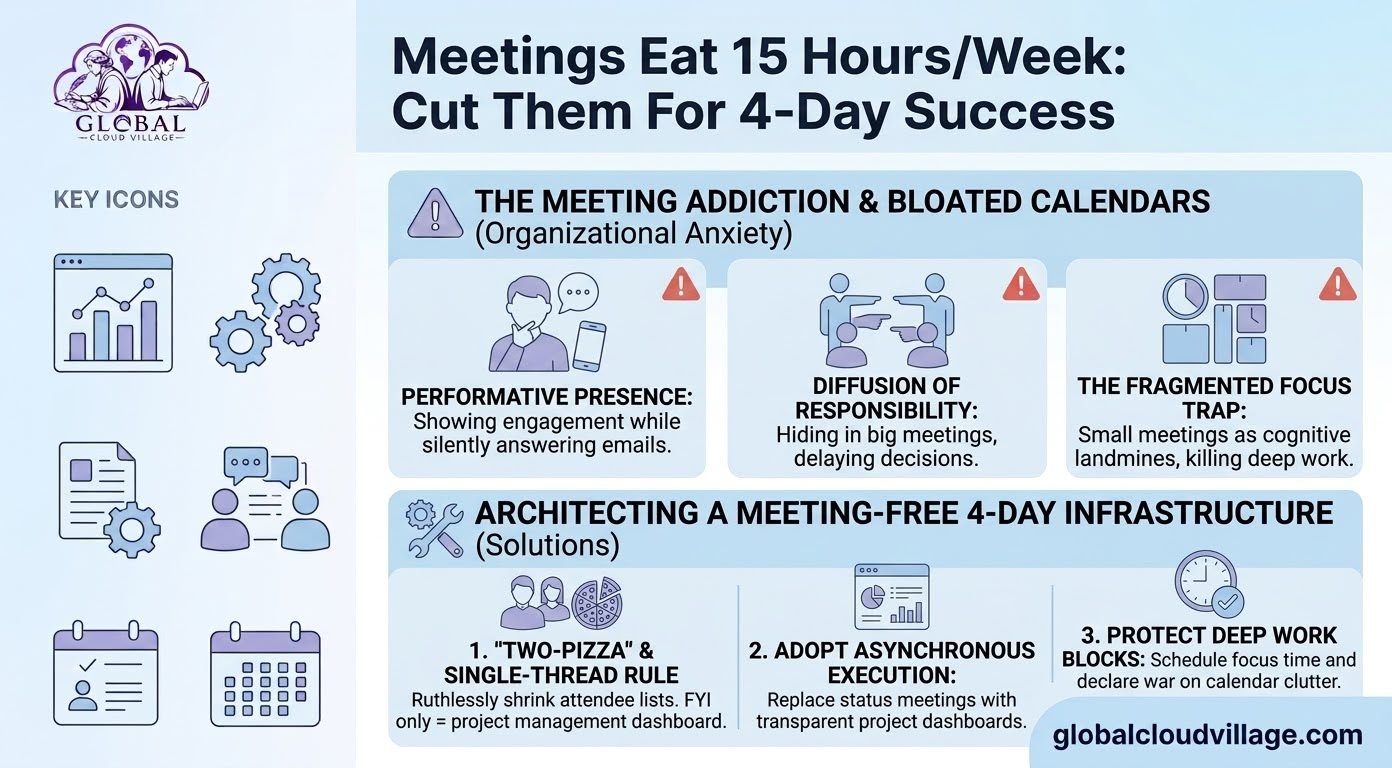
Performative Presence
Employees may feel pressure to attend meetings simply to demonstrate that they are engaged.
Being visible in a meeting, however, is not the same as creating business value.
Diffused Responsibility
Large meetings can make ownership unclear.
When too many people are involved in a decision, participants may assume someone else will take responsibility for the next step.
Fragmented Focus
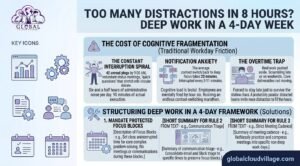
A 30-minute meeting can disrupt significantly more than 30 minutes of productive work.
If meetings are scattered throughout the day, employees may struggle to find uninterrupted time for complex tasks.
A meeting at 10:00 AM followed by another at 11:30 AM can leave the intervening period difficult to use for deep work.
Slower Decision-Making
Some meetings exist because information is not available elsewhere.
When teams lack a centralized source of truth, employees repeatedly ask for updates that could have been documented in a project management system or dashboard.
In a five-day workweek, businesses may absorb some of this inefficiency.
In a four-day workweek, the cost becomes much more visible.
The Real Cost of Meeting Overload
The cost of meetings is not limited to the length of the meeting itself.
Consider a one-hour meeting involving six employees.
The direct meeting cost is six employee-hours.
But the real cost can be higher when you include preparation, context switching, follow-up work, and the time required to return to a previous task.
For knowledge workers, switching between meetings and focused work can make the day feel fragmented.
This is particularly important for roles involving:
- Software development
- Graphic design
- Content creation
- Strategy
- Research
- Marketing
- Data analysis
- Consulting
- Complex client work
These roles often require uninterrupted concentration.
A meeting-heavy calendar can therefore reduce the amount of time available for meaningful execution even when employees remain busy throughout the day.
How to Cut Meetings for 4-Day Success
A four-day workweek does not require eliminating every meeting.
It requires becoming much more selective about which meetings deserve time.
The goal is simple:
Every meeting should have a clear reason to exist.
If the same outcome can be achieved through a written update, dashboard, shared document, or asynchronous discussion, a live meeting may not be necessary.
1. Reduce the Number of Meeting Participants
Not everyone who needs information needs to attend the meeting.
Before adding someone to a calendar invitation, ask:
- Do they need to make a decision?
- Do they own an action?
- Is their expertise required?
- Do they need the information immediately?
- Could they review the outcome afterward?
If someone is attending only because they might find the discussion interesting, they may not need to be there.
Smaller meetings are generally easier to manage and can make decision-making more focused.
A useful principle is to invite people based on contribution and responsibility rather than simply organizational hierarchy.
2. Create Meeting-Free Work Blocks
Deep work becomes difficult when meetings are scattered throughout every working day.
One solution is to establish protected meeting-free periods.
For example, a business might reserve several hours each day for focused execution.
During these periods:
- Internal meetings are avoided
- Non-urgent notifications are reduced
- Employees focus on priority tasks
- Managers avoid unnecessary interruptions
- Teams use asynchronous updates instead of live discussions
The exact schedule should reflect the organization’s work pattern.
Some businesses may prefer specific meeting-free days.
Others may find that daily protected blocks work better.
The important principle is consistency.
3. Replace Status Meetings With Written Updates
One of the easiest meetings to eliminate is the routine status meeting.
If the purpose of a meeting is simply to answer:
“What is the current status of this project?”
the information may belong in a project management system instead.
A written project update can include:
Completed: What has been finished?
In Progress: What is currently being worked on?
Blocked: What is preventing progress?
Next: What happens next?
Owner: Who is responsible?
This format allows people to review information when they need it rather than forcing an entire team to attend a meeting.
4. Use Dashboards for Operational Visibility
Meeting overload often reflects a visibility problem.
Managers schedule meetings because they cannot easily see:
- Project progress
- Sales pipeline
- Customer requests
- Pending approvals
- Team workload
- Operational bottlenecks
- Upcoming deadlines
A centralized dashboard can reduce the need for repeated status discussions.
When information is visible in a shared system, managers can spend less time asking for updates and more time solving actual problems.
This is particularly useful when a company combines project management, CRM, ERP, and business intelligence tools.
The technology does not eliminate the need for communication.
It makes routine information easier to access.
5. Require an Agenda for Every Meeting
Every meeting should have a defined purpose.
A simple agenda can answer:
Why are we meeting?
What decision needs to be made?
What information must participants review?
What outcome should exist when the meeting ends?
If the organizer cannot answer these questions, the meeting may not be necessary.
For recurring meetings, review the agenda regularly.
A meeting that once served an important purpose may become unnecessary as processes mature.
6. Use Asynchronous Communication First
Asynchronous communication allows employees to contribute without needing to be available at exactly the same time.
Examples include:
- Written project updates
- Shared documents
- Task comments
- Recorded presentations
- Decision logs
- Email summaries
- CRM notes
- Project management dashboards
This approach is especially useful for teams operating across different locations or working hours.
It also gives employees more control over when they process information.
The goal is not to eliminate real-time collaboration.
It is to reserve synchronous communication for situations where it creates meaningful value.
7. Make Meetings Decision-Oriented
A useful meeting should move something forward.
That could mean:
- Making a decision
- Solving a complex problem
- Resolving a conflict
- Planning a critical activity
- Collaborating on something that genuinely benefits from live discussion
A meeting that simply repeats information available elsewhere should be questioned.
At the end of each meeting, participants should know:
- What was decided
- Who owns the next action
- What the deadline is
- What happens next
This creates accountability without requiring another meeting just to discuss the previous one.
Julian’s Calendar Transformation
When Julian reviewed his company’s meeting culture, he realized that many recurring meetings had continued simply because nobody had questioned them.
He decided to conduct a calendar audit.
Recurring meetings were reviewed based on:
- Purpose
- Participants
- Frequency
- Duration
- Decisions produced
- Alternative communication methods
Some meetings were removed.
Others became shorter.
Several were converted into asynchronous updates.
For important meetings that remained, Julian introduced a simple rule:
Every meeting needs a clear agenda and a defined outcome.
Managers initially worried that reducing meetings would reduce visibility.
The opposite can happen when meetings are replaced with better systems.
Project dashboards provide ongoing visibility.
Written updates create a record.
Clear task ownership improves accountability.
And employees gain larger blocks of uninterrupted time.
The objective was not simply to make calendars look empty.
It was to create more time for valuable work.
The 4-Step Calendar Detox Blueprint
Step 1: Audit Your Existing Meetings
Review every recurring meeting.
Record:
- Meeting name
- Frequency
- Duration
- Number of participants
- Purpose
- Decision required
- Alternative communication method
Then ask one important question:
Would anything important fail if this meeting disappeared?
If the answer is unclear, the meeting deserves review.
Step 2: Remove or Redesign Low-Value Meetings
Do not automatically replace every meeting with another communication process.
First determine whether the communication is necessary.
Some meetings can be:
- Cancelled
- Shortened
- Combined
- Converted into written updates
- Moved to a project dashboard
- Held less frequently
The goal is to reduce communication overhead, not simply change its format.
Step 3: Protect Deep Work
After reducing meetings, protect the time you have recovered.
Create clear deep-work blocks for activities that require concentration.
During these periods, employees should be encouraged to:
- Silence non-urgent notifications
- Avoid unnecessary meetings
- Focus on priority work
- Use asynchronous communication
- Escalate only genuine urgent issues
Without protected focus time, freed calendar space can quickly become filled with other interruptions.
Step 4: Measure Meeting ROI
Meeting reduction should itself be measured.
Track indicators such as:
- Total meeting hours
- Average meeting duration
- Number of recurring meetings
- Meeting participants
- Project delivery time
- Decision turnaround time
- Employee feedback
- Overdue work
- Deep-work availability
The objective is not to achieve the lowest possible meeting count.
The objective is to determine whether meetings are contributing to better business outcomes.
What to Do With the Time You Recover
Cutting meetings only creates value if the recovered time is used effectively.
Use the additional capacity for:
Deep Work
Give employees uninterrupted time to complete complex tasks.
Customer Work
Allow client-facing teams to focus on service delivery rather than internal coordination.
Strategic Planning
Give managers time to analyze performance, improve processes, and plan ahead.
Innovation
Create space for experimentation, product development, and new ideas.
Process Improvement
Use recovered time to eliminate repetitive work and improve operational systems.
A four-day workweek should not become four days of compressed chaos.
It should encourage a more focused way of working.
Common Meeting Reduction Mistakes
Eliminating Meetings Without Improving Visibility
If employees still cannot see project status, removing meetings can create confusion.
Replace unnecessary meetings with reliable information systems.
Making Every Communication Asynchronous
Not every problem should be solved through text.
Complex decisions, sensitive discussions, and collaborative problem-solving may still benefit from real-time communication.
Filling Every Empty Calendar Slot
Recovered time should not automatically become another meeting.
Protect it for focused work.
Measuring Meeting Reduction as the Only Goal
A company can have fewer meetings and still perform poorly.
Measure business outcomes alongside meeting hours.
Ignoring Manager Behavior
Meeting culture often starts with management.
If managers continue demanding constant updates, employees will recreate the meeting culture through messages and informal interruptions.
Leaders need to model the new communication standards.
Conclusion: Cut Meetings for 4-Day Success
A four-day workweek is not simply a scheduling change.
It is an opportunity to redesign how work gets done.
When calendars are overloaded, employees spend valuable time talking about work instead of completing it.
By choosing to Cut Meetings for 4-Day Success, businesses can create more room for focused execution without sacrificing necessary collaboration.
The most effective approach combines:
- Smaller meetings
- Clear agendas
- Meeting-free work blocks
- Asynchronous communication
- Project dashboards
- Clear ownership
- Outcome-based management
The goal is not to eliminate communication.
The goal is to eliminate unnecessary communication overhead.
When teams have fewer interruptions and better visibility, they can spend more time creating, solving, delivering, and improving.
Stop measuring how busy the calendar looks. Start measuring what the team actually delivers.
Frequently Asked Questions About Cutting Meetings for 4-Day Success
How many meetings should a team have during a four-day workweek?
There is no universal number. The right amount depends on the business, team structure, customer requirements, and type of work. The important question is whether each meeting has a clear purpose and measurable value.
Can we really reduce meetings without hurting team collaboration?
Yes, when unnecessary meetings are replaced with appropriate alternatives such as written updates, shared documents, project dashboards, and structured asynchronous communication. Meetings should remain available for situations that genuinely benefit from real-time collaboration.
What should replace daily status meetings?
Use written status updates or project dashboards that show completed work, current tasks, blockers, owners, and next steps. This gives teams visibility without requiring everyone to attend a live meeting.
Should all meetings be eliminated during a four-day workweek?
No. Important decisions, complex problem-solving, strategic planning, and sensitive conversations may require live discussion. The objective is to remove low-value meetings, not communication itself.
How can managers maintain visibility after reducing meetings?
Use centralized project management tools, CRM systems, ERP platforms, dashboards, and written decision logs. Managers should focus on outcomes, risks, capacity, and blockers rather than monitoring constant employee activity.
How do we protect deep work from meetings?
Create protected meeting-free blocks and establish clear rules for non-urgent communication. Managers should also avoid scheduling unnecessary meetings during these periods.
What is the best way to convince managers to reduce meetings?
Start with data. Review meeting hours, participant numbers, recurring meetings, project delays, and employee feedback. Then identify which meetings produce decisions and which primarily exchange information that could be shared asynchronously.
Ready to Optimize Your Team’s Output?
Reducing unnecessary meetings is one part of building a more efficient four-day operating model.
If your team is spending too much time in meetings, status calls, follow-ups, and internal coordination, the solution may be more than simply deleting calendar invitations.
Better visibility, clearer processes, automation, and asynchronous communication can help your team recover time and use it for meaningful work.
Discover more practical strategies for modern business productivity in Global Cloud Village and 4 Day Work Week.
You can also explore the author’s work through the Amazon Author Profile.
About the Author
Global Cloud Village translates complex digital technology systems into clear, human-centric strategies for growing SMEs, founders, and industry leaders.
The platform explores cloud technology, automation, digital transformation, productivity, data-driven management, and modern workplace strategies that help businesses replace fragmented processes with scalable systems.